Mesenchymal stem cells (MSCs) are multipotent stem cells that can differentiate into a variety of cell types, including osteoblasts, chondrocytes, myocytes, adipocytes, beta-pancreatic islets cells, and potentially, other cell types. MSCs are of intense therapeutic interest, because they represent a population of cells with the potential to treat a range of acute and degenerative diseases. MSCs are advantageous over other stem cells types for a variety of reasons, including that they are immuno-privileged, making them an advantageous cell type for allogenic transplantation. Because of their unique capacity to form structural tissues, MSCs also being explored for use in 3D printing applications. [Read more…]
Mesenchymal Stem Cells (MSCs)
Mesenchymal stem cells (MSCs) are a well-characterized population of adult stem cells that can differentiate into a variety of cell types (chondrocytes, osteoblasts, adipocytes, myocytes, and more).
We Analyzed a Decade of Historical Information on Cord Blood & Cord Tissue Markets (This Is What We Learned)
The cord blood banking market is complex. There are regions experiencing growth and regions experiencing decline. There are extremely successful cord blood banks, and banks that are going out of business or being acquired by the competition.
In addition, there are unique opportunities occurring within the cord blood space that are based on emerging technologies, such as ex vivo expansion of cord blood.
The cord tissue market is also complex, although for different reasons. Today, half of all cord blood banks worldwide offer this service and the number is accelerating. Interestingly, the mesenchymal stem cells (MSCs) contained in cord tissue may have growing opportunities relative to the hematopoietic stem cells (HSCs) contained in cord blood, because MSCs just surpassed HSCs in the scientific literature for the first time in history.
For this reason, BioInformant is offering industry-leading market intelligence for both cord blood and cord tissue markets for the next 14 days only.
Act by Feb 29, 2016, and you can get two reports for the price of one, a savings of $3,795.
CORD BLOOD + CORD TISSUE PACKAGE:
- Complete 2015-16 Global Cord Blood Banking Industry Report
- Mesenchymal Stem Cells – Advances & Applications
This is an exclusive offer available only to BioInformant readers, so enter the coupon code “CordBloodCordTissue” during checkout (for either product) and you will automatically receive the other report for free.
To compete within the global cord blood banking market, you need to be informed about both cord blood and cord tissue markets. This is your opportunity to get a strategic edge.
Imagine Increasing Revenue from Stem Cell Products and Decreasing Risk
We have helped hundreds of the top companies increase revenue from stem cell products and decrease risk. The key is targeted market intelligence, because it will help you to approach institutional investors for fundraising rounds, guide internal decision-making within your company, and reduce the risk that has traditionally accompanied new product development. Simply put, it will help you make smarter decisions, faster.
Whether or not you can invest in the recently released global strategic report, “Stem Cell Research Products – Opportunities, Tools, and Technologies,” the following is an important introduction to the stem cell research products marketplace, including key trends and future projections. [Read more…]
Do You Know Opportunities for Commercializing Stem Cells, by Stem Cell Type?
Commonly investigated stem cell types include embryonic stem cells (ESCs), as well as adult stem cell types that include mesenchymal stem cells (MSCs), hematopoietic stem cells (HSCs), neural stem cells (NSCs), and induced pluripotent stem cells (iPSCs). There are also other less common stem cell types, including dental pulp stem cells (DPSCs), adipose-derived stem cells (ADSCs), and a variety of perinatal stem cell types, including amniotic stem cells, placental stem cells, umbilical cord blood stem cells, and cord tissue stem cells.
Cancer stem cells also exist, giving rise to clonal populations of cells that form tumors or disperse within the body. Each of these stem cell types represents unique opportunities for research product development.
Importantly, literature concerning the biology, characteristics, and applications of stem cells has flourished over the past few decades.
In full-year 2015, there were 25,613 stem cell scientific publications released, and an all-time search returns 259,218 stem cell scientific publications (Pubmed.gov). [Read more…]
Mesenchymal Stem Cells Surpass Hematopoietic Stem Cells in the Scientific Literature
Five of the most commonly used stem cell types that are used for research purposes are embryonic stem cells, mesenchymal stem cells, hematopoietic stem cells, neural stem cells, and induced pluripotent stem cells.
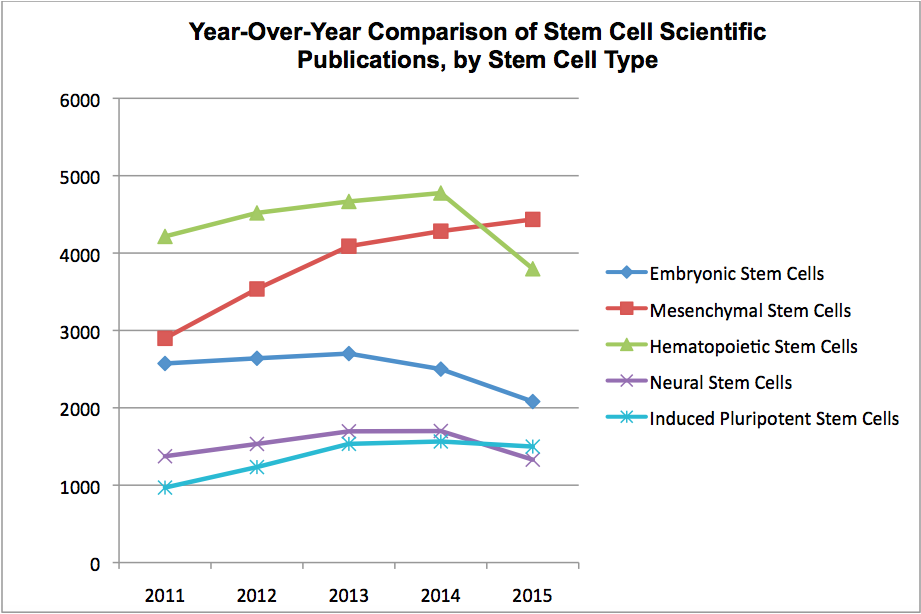
Therefore, the analysis below considers trends in scientific publication rates for these five stem cell types, over a trailing five-year history. PubMed.gov scientific publication rate data is used for this analysis because of its comprehensive nature.1
PubMed is a service of the U.S. National Library of Medicine and the National Institutes of Health (NIH) that includes over 19 million citations from MEDLINE and other life science journals that date back to the 1950s.2 It is the leading search engine through which to search scientific publications, as NIH researchers are mandated by law to submit their research and most external research is submitted as well, either voluntarily or by mandate.3
TABLE. Comparison of Stem Cell Publication Rates, by Stem Cell Type (Five-Year Historical)


Comparison of Stem Cell Research Frequency, by Stem Cell Type
As observed in the graph above, hematopoietic stem cells were the most frequent type of stem cells to be cited in the scientific literature through 2014. Mesenchymal stem cells were the second most common stem cell type through 2014.
In 2015, mesenchymal stem cells surpassed hematopoietic stem cells to become the most common stem cell type to appear within the scientific literature.
This is the first time in history that mesenchymal stem cells substantially outpaced hematopoietic stem cells within the scientific literature.
Additionally, mesenchymal stem cells are the only stem cell type of the five analyzed that had an increase in scientific publications from 2014 to 2015.
All four of the other stem cell types decreased in scientific publication frequency during that period.
Embryonic stem cell research came in third place among the five stem cell types that were analyzed, while neural stem cells and induced pluripotent stem cells both showed lower rates of scientific publications over a trailing five-year period.
Footnotes:
1Source: Pubmed, http://www.ncbi.nlm.nih.gov/pubmed/. Search Terms: 1) “Embyronic Stem Cell” OR “Embryonic Stem Cells”; 2) “Mesenchymal Stem Cell” OR “Mesenchymal Stem Cells”; 3) “Hematopoietic Stem Cell” OR “Hematopoietic Stem Cells”; 4) “Neural Stem Cell” OR “Neural Stem Cells”; 5) “Induced Pluripotent Stem Cell” OR “Induced Pluripotent Stem Cell” OR “iPSC” OR “iPSCs”. Search Executed: January 24, 2106.
2Ncbi.nlm.nih.gov. 2014. Home – PubMed – NCBI. Available at: http://www.ncbi.nlm.nih.gov/pubmed/. Web . 29 Jan. 2016.
3Science Codex. Available at: http://www.sciencecodex.com/public_access _mandate_made_law. Web. 29 Jan. 2016.
- « Previous Page
- 1
- …
- 46
- 47
- 48
- 49
- 50
- …
- 59
- Next Page »