Gamida Cell is an Israeli company specializing in cellular and immune therapies for the treatment of cancer and orphan genetic diseases. Its lead product, NiCord®, offers patients in need of HSCT an alternative to the existing approach of bone marrow transplant by using ex vivo expansion of cord blood. In clinical trials so far, NiCord® has demonstrated rapid engraftment and clinical outcomes that appear comparable to transplantation of peripheral blood. [Read more…]
Hematopoietic Stem Cells (HSCs)
WideCells Group PLC, a Global Stem Cell Services Company, Goes Public with £2m IPO

WideCells Group PLC (‘WideCells Group’ or ‘the Group’) £2m Placing, Admission to Trading and First Day of Dealings
WideCells Group; 27 July 2016 — WideCells Group, the health care services company focused on collecting and storing stem cells and providing ground breaking insurance for stem cell treatment, is pleased to announce that the entire issued share capital of 54,058,061 ordinary shares of 0.25p each (‘Ordinary Shares’) will today be admitted to the Standard Listing segment of the Official List of the UK Listing Authority and to trading on the Main Market for listed securities of the London Stock Exchange (together ‘Admission’). The Company will be trading under the ticker symbol WDC with the ISIN number GB00BD060S65. [Read more…]
NiCord® to Introduce Paradigm Shift to HSCT? Potential to Provide Transplantation Option To Nearly All In Need

Headquartered in Jerusalem, Israel, Gamida Cell is best known for its innovative approaches to hematopoietic stem cell therapeutics. Although a small company at the time, Gamida Cell broke onto the global scene in 2003 when it announced a Phase I trial of its StemEx™ product for the treatment of leukemia and lymphoma patients.
 StemEx™ was Gamida Cell’s first generation product for theex vivo (“outside the body”) expansion of cord blood stem cells, which can be utilized in hematopoietic stem cell transplantation (HSCT) to treat high risk cancers. Although StemEx™ did not make it beyond Phase II/III trials, this expertise in ex vivo expansion of cord blood lead to the development of Gamida Cell’s current flagship product, NiCord®, and established Gamida Cell as a global technology leader for functional expansion of cells. [Read more…]
Why Has Utilization of Umbilical Cord Blood for Transplantation Declined?

In recent years, the rate of umbilical cord blood utilization has declined. To understand the dynamics behind this change, you need to understand cord blood registries and cord blood transplant statistics. Data about umbilical cord blood transplants from the donor registry of the CW Bill Young Cell Transplantation Program, including the National Cord Blood Inventory, are reported annually.[1]
The program’s donor registry, also called the Be The Match Registry®, is operated under Federal contracts by the National Marrow Donor Program® (NMDP).
The Be The Match Registry® is the world’s largest hematopoietic cell registry, listing more than 10.5 million individuals and approximately 185,000 cord blood units.[2]
Cord Blood Transplant Statistics | A Closer Look
In this article:
- The National Marrow Donor Program
- Bone Marrow Donors Worldwide
- The Cooperation of NMDP and BMDW
- The Decline in Utilization of Cord Blood for Transplantation Beginning in 2013
- Why Has Umbilical Cord Blood Transplantation Declined?
The National Marrow Donor Program
The National Marrow Donor Program is a contractor for the CW Bill Young Cell Transplantation Program operated through the U. S. Department of Health and Human Services, Health Resources and Services Administration, and Healthcare Systems Bureau. It is a non-profit organization launched in Minneapolis, MN, USA, in 1986.
Hematopoietic stem cell transplants from NMDP donors or umbilical cord blood units are used to treat patients with a variety of cancers and immune system conditions. To date, the NMDP had facilitated more than 55,000 transplants worldwide.[3]
Bone Marrow Donors Worldwide
Another group that exists is Bone Marrow Donors Worldwide (BMDW), an organization that coordinates the collection of the human leukocyte antigen (HLA) phenotypes of hematopoietic cell donors and cord blood units. BMDW participants currently include 48 cord blood banks from 32 countries worldwide.[4] Presently, more than 60,000 cord blood units are listed within its database.[5] This makes it the largest such database of its type in the world.
The Cooperation of NMDP and BMDW
The NMDP cooperates with BMDW in the Netherlands because BMDW coordinates communications between the world’s cord blood registries. Most national registries, including the NMDP’s Be The Match Registry®, have access to these worldwide volunteer donors, either through the BMDW or through individual terms and agreements.
Because of their wide reach, these organizations represent a method for assessing trends in cord blood banking storage and utilization, making them a valuable predictor of future trends. Specifically for this analysis, the CW Bill Young Cell Transplantation Program is used as a source of aggregated cord blood transplantation data.
Decline in Utilization of Cord Blood for Transplantation
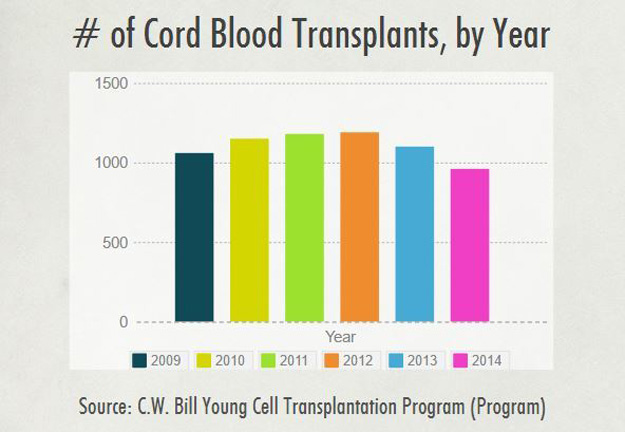
Unfortunately, 2013 saw a decrease in the number of cord blood units used for transplant in the United States. In 2012, the CW Bill Young Cell Transplantation Program facilitated close to 1,200 transplants. In 2013, it facilitated approximately 1,100, a substantial year-over-year decline.[6] See the image below.
While the CW Bill Young Cell Transplantation Program did its last comprehensive analysis of registry data in 2014 using full-year 2013 data, it did release the following statement about FY 2014 data[7]:
“During 2014, cord blood units were used in 960 transplants. The National Cord Blood Inventory provided 544 cord blood units for these transplants.
Also, 1,225 transplants were performed using bone marrow and 4,068 transplants used peripheral blood stem cells.”
As mentioned previously, the registry facilitated close to 1,200 transplants in 2012, and approximately 1,100 in 2013.[8] Therefore, 2014 again experienced a decline in cord blood utilization relative to the prior year, and peripheral blood stem cells again saw an increase in utilization. This information has been incorporated into the graph above.
From conversations with industry experts and independent analysis, BioInformant believes this trend is continuing.
However, this trend is primarily localized to the United States and Europe. Within the UK, the country’s National Health System (NHS) has been working toward building an established volume of publicly donated cord blood units to have as a national inventory for medical purposes. Furthermore, in other countries around the world, including the UK, China, Japan, Taiwan, and France, there have been increases in cord blood transplant rates compared to prior years.
Therefore, the growth or decline in cord blood transplant rates is a geographically dependent variable.
Why Has Cord Blood Transplantation Declined?
All of the information so far is interesting, but the important question here is, “Why has umbilical cord blood transplantation declined?”
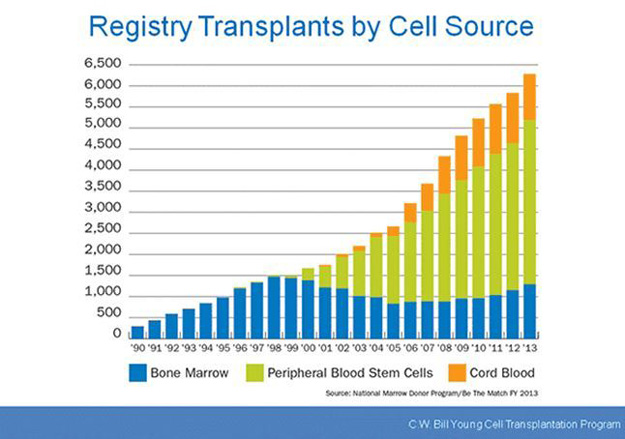
The major reason for declining cord blood transplants in recent years is the increasing utilization of peripheral blood stem cells as an alternative for HSCT.
A much lesser reason is that there was declining utilization of bone marrow as a source of stem cells for HSCT from 1998 to 2005, but that trend corrected from 2005 to 2013, with the utilization of bone marrow slightly increasing over that period.
These answers are visually represented by the graph below.
To learn more, view the “Global Cord Blood Banking Industry Report.“
What are your thoughts on cord blood transplant statistics and the decline in the utilization of umbilical cord blood for transplantation? Share them in the comments below.
Up Next: 38 Athletes Who Have Had Stem Cell Treatments
[1] “Donor Registry Transplant Data”. Home. [online] Available at: Bloodcell.transplant.hrsa.gov. [Accessed 24 Apr. 2016].
[2] Bethematch.org. Home. Available at: http://bethematch.org/ [Accessed 24 Apr. 2016].
[3] Ibid.
[4] Bmdw.org. BMDW: Home. Available at: http://bmdw.org/ [Accessed 25 Apr. 2016].
[5] Ibid.
[6] “Donor Registry Transplant Data”. Registry Data. Available at: http://bloodcell.transplant.hrsa.gov/research/transplant_data/registry_tx_data/index.html. 2016. [Accessed 24 Apr. 2016].
[7] “Blood Cell Transplantation”. Donor Registry Transplant Data. [online] Available at: http://bloodcell.transplant.hrsa.gov/ [Accessed 25 April 2016].
[8] Bloodcell.transplant.hrsa.gov, (2014). Donor Registry Transplant Data. [online] Available at: http://bloodcell.transplant.hrsa.gov/research/transplant_data/registry_tx_data/index.html [Accessed 25 April 2016].
Are You Planning to Attend FDA’s September 8th Public Workshop on Development of Cellular and Tissue-Based Products?

The Food and Drug Administration has announced a public workshop entitled, “Scientific Evidence in the Development of Human Cells, Tissues, and Cellular and Tissue-Based Products Subject to Premarket Approval.” [Read more…]
- « Previous Page
- 1
- …
- 13
- 14
- 15
- 16
- 17
- …
- 28
- Next Page »