
 NEW YORK, New York — Americord, the fastest growing cord blood bank in the country, and a leader in the advancement of umbilical cord blood, cord tissue, and placenta tissue banking, announces the launch of its Cord Blood Banking Pricing Calculator. [Read more…]
FDA Approves the Cleveland Cord Blood Center’s CLEVECORD™ for Stem Cell Transplants
CLEVELAND, Sept. 12, 2016 /PRNewswire-USNewswire/ — The U.S. Food and Drug Administration (FDA) has issued a biologics license to the Cleveland Cord Blood Center (CCBC) for CLEVECORD™, a stem cell product (HPC, Cord Blood) derived from umbilical cord blood. Under this license, CCBC is authorized to manufacture CLEVECORD, for use in unrelated hematopoietic cell transplantation in patients with disorders affecting the hematopoietic system such as leukemia, lymphoma and immune system disorders.
“Obtaining FDA licensure for CLEVECORD is reflective of the Cleveland Cord Blood Center’s dedication to meeting the highest quality standards in the industry for distribution of our cord blood products to transplant centers throughout the U.S. and around the world,” said Wouter Van’t Hof, the CCBC’s Cord Blood Bank Director. “The ability to meet such standards is indicative of the commitment of our organization to providing high quality transplant options to patient populations that are underserved in hematopoietic transplantation. It also stages the pursuit of new life-saving and life-enhancing research and product development opportunities.”
Key Market Leaders for Adipose-Derived Mesenchymal Stem Cell (MSC) Storage

In addition to cord tissue storage, many cord blood banks are now investigating the addition of adipose-derived stem cell storage.
It is a logical product extension for cord blood banks, given that a range of collection, processing, and storage equipment is already present within the facility.
Additionally, conversion costs to allow for adipose-derived stem cell storage can be as low as USD $100,000 to $150,000.
The conversion of a cord blood facility to be able to offer adipose-derived stem cell storage can be efficiently accomplished through collaboration with a specialist in the area of adipose tissue extraction and storage.
Companies such as American Cryostem in the United States have been willing to partner with cord blood banks to assist them with adding adipose-derived MSC storage as a service.
Leading Companies Offering Mesenchymal Stem Cell (MSC) Storage
Below is an analysis of both diversified cord blood banks and specialty companies that currently offer adipose-derived stem cell storage. [Read more…]
Cord Blood Processing – AutoXpress® (AXP), Sepax, PrepaCyte®, Cord Blood 2.0
Automated cord blood processing systems, like Sepax, have many benefits, including speed, processing technology, and cost-savings. Automated the processing technology entered the cord blood sector in 2006, and since that time, a variety of systems have been developed. Cord blood processing systems are used to support cord blood banking, which is the long-term storage of the stem cells contained within umbilical cord blood for future therapeutic use.
Sepax | A Closer Look At Automated Cord Blood Systems
In this article:
- Automated Cord Blood Processing
- Cesca’s AutoXpress (AXP) System
- Advantages of AutoXpress (AXP) System
- Automated Cord Blood Processing | AutoXpress (AXP) Cellular Recovery
- Shift Toward Automated Cord Blood Processing
- Expanding Market for Automated Cord Blood Processing
- Sepax Cord Blood System
- Cord Blood Processing with PrepaCyte®-CB and Cord Blood 2.0TM
- Cord Blood Processing | TotiCyte by Cells4Life
- Summary of Cord Blood Processing
Automated Cord Blood Processing
In the United States, most cord blood banks have incorporated automated cord blood processing technologies, but this is not the case in every region of the world.
Cesca’s AutoXpress (AXP) System

In 2006, the AutoXpress® System (AXP) by Cesca Therapeutics was announced as the first automated, functionally closed, sterile system that procures stem cells from cord blood with efficient and high yield throughout. [1]
The AXP Platform brought unprecedented automation and precision to stem cell processing, which in 2006 was important and cost-saving. Even though the automated processing technology for umbilical cord blood is becoming more and more standardized, automated processing systems are still fairly new. As of 2007, the AXP’s state-of-the-art technology was being used by only one family cord blood bank, although market acceptance grew more substantially in 2008.
Advantages of AutoXpress (AXP) System
Since then, cord blood harvesting has made a dynamic shift to fully automated processing systems, and other industry alternatives have also emerged. The greatest benefits of automated processing systems are found in the replaced need for additives and human manipulation. The AXP Platform uses optical sensor technology to formulate precision separation and retention of almost all the target mononuclear cell population. When this process is automated, there is a reduced chance of contamination, and result reliability increases.
Automated Cord Blood Processing | AutoXpress (AXP) Cellular Recovery
A key attribute of automated processing systems such as the AutoXpress® (AXP) Platform is that they efficiently recover mononuclear cells in cord blood collections. In tested samples, the recovery percentage of these stem cells has been calculated at 99.3% efficiency, a 22.7% higher yield than the commonly used Hespan-based cord blood stem cell processing method, which achieved an MNC recovery rate of only 80.9% in the largest published Hespan study released in Cord Blood Transplantation.[2]
What is Hespan approach is it requires an additive to facilitate separation of cord blood into layers of plasma, red blood cells, the MNC population of white blood cells, and stem cells. The MNCs are then collected by a laboratory technician, which is a manual (not automated) step of the process.[3] The AXP® System also gained traction because it creates lower and more desirable hematocrit levels than most previous methodologies. [4]
Shift Toward Automated Cord Blood Processing
Not surprisingly, the shift toward fully automated processing systems has also occurred within the public cord blood banking sector. For instance, the New York Blood Center (NYBC), the largest public cord blood bank in the world, has adopted AXP processing. They have, since their inception, banked over 60,000 cord blood units. In addition, there have been more than 30,000 cord blood transplants performed worldwide, and NCBP has provided cord blood units for transplantation to more than 4,900 of those recipients, a pretty astounding accomplishment as their contribution represents nearly 20% of all cord blood transplants worldwide. [5]
Again, the main benefit of the AXP® Platform cited by the National Cord Blood Program of the NYBC was the high success rate of cell yield.
Cell yield is important because transplant survival rates improve with the number of stem cells used in therapy. “Cell yield is an important measure of a cord blood collection’s transplant utility and stem cells are contained in the MNC population,” said Dr. David Harris, Ph.D., professor of immunology at the University of Arizona and scientific director for Cord Blood Registry. [6]
Cord Blood Registry has had full production of the AXP® Platform since 2007.[7]
Expanding Market for Automated Cord Blood Processing
As these automated platforms become more ingrained in the culture of cord blood banking, the market is expanding to other countries. While the United States leads the world in cord blood banking, both in terms of the total number of cord blood banks operating within the country and in terms of the total cord blood units stored, other countries are not far behind. Italy, Spain, and now Portugal are researching ways to innovate and create more efficient cord blood stem cell extractions.
SepaxTM Cord Blood System

Biosafe SepaxTM automated system has also been on the rise in the past few years, having different yet similarly viable results as the AXP’s system. An interesting publication comparing the Sepax and AXP processing systems was released in July 2013, titled “Qualitative and Quantitative Cell Recovery in Umbilical Cord Blood Processed by Two Automated Devices in Routine Cord Blood Banking: A Comparative Study.”
The key findings of the AXP and Sepax comparison were as follows: [8]
“Both the Sepax and AXP automated systems achieve acceptable total nucleated cell recovery and good CD34+ cell recovery after volume reduction of umbilical cord blood units and maintain cell viability. It should be noted that total nucleated cell recovery is significantly better with the Sepax system. Both systems deplete red blood cells efficiently, especially AXP which works without hydroxyethyl starch.“
Cord Blood Processing with PrepaCyte®-CB and Cord Blood 2.0TM
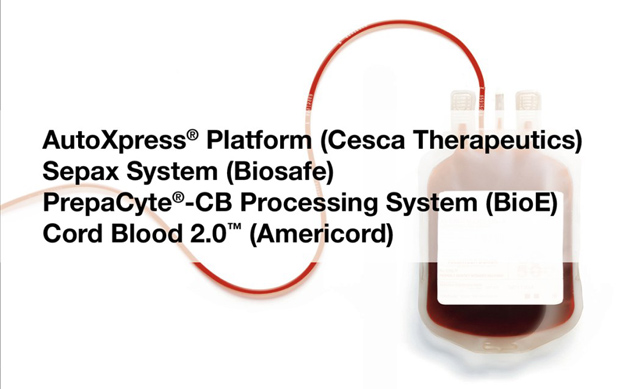
Other automated processing alternatives to the SepaxTM and AXP® Platform are the PrepaCyte®-CB Processing System by BioE and Cord Blood 2.0TM by Americord, as shown below:
Cord Blood Processing | TotiCyte by Cells4Life
Most recently, Cells4Life also launched TotiCyteTM, a processing method which “selectively removes the red blood cells in cord blood and yields over 95% recovery of the white cell fraction, 99.5% removal of the red cells, obviates the need for washing to remove DMSO and red cells, and exceptionally high post-thaw viable cell recovery.”[9]
(Click here to learn more about the companies producing these cord blood processing technologies.)
Summary of Cord Blood Processing
Innovation is part of the rapidly evolving field of cord blood banking. Embracing this and searching for more efficient and effective ways to procure stem cells from cord blood are extremely important. The quantity of total nucleated cells (TNCs), which is reported as a measure of the overall cell count found within a cord blood sample, correlates with improved transplant outcomes, higher patient survival rates, and better patient outcome. It can also determine whether a sample can be used in a full-sized adult patient.
While many studies have confirmed the importance of TNCs on patient outcomes, the importance of TNC count was recognized as early as 1998 when Dr. Rubinstein and his team released their research findings in the New England Journal of Medicine.[10]
What are your thoughts on Sepax and other automated cord blood processing systems? Share them in the comments section.
Up Next: Stem Cell Treatment For Arthritis | Natural Treatments for Arthritis
Footnotes:
[1] StreetInsider.com,. ‘Thermogenesis (KOOL) Says GE Healthcare Launches The Company’s AXP Autoxpress Platform’. N.p., 2015. Web. 5 Mar. 2015.
[2] Registry, Cord. ‘Highest Recovery Of Cord Blood Stem Cells Achieved With New Automated Processing System, Study Shows’. Prnewswire.com. N.p., 2015. Web. 5 Mar. 2015.
[3] Ibid.
[4] Pilar Solves, Francisco Carbonell-Uberos. ‘Qualitative And Quantitative Cell Recovery In Umbilical Cord Blood Processed By Two Automated Devices In Routine Cord Blood Banking: A Comparative Study’. Blood Transfusion 11.3 (2013): 405. Web. 5 Mar. 2015.
[5] Nybloodcenter.org,. ‘National Cord Blood Program | New York Blood Center’. N.p., 2015. Web. 5 Mar. 2015.
[6] Registry, Cord. ‘Highest Recovery Of Cord Blood Stem Cells Achieved With New Automated Processing System, Study Shows’. Prnewswire.com. N.p., 2015. Web. 5 Mar. 2015.
[7] Cordblood.com,. ‘Cord Blood Processing | Cord Tissue Processing | CBR®’. N.p., 2015. Web. 5 Mar. 2015.
[8] Pilar Solves, Francisco Carbonell-Uberos. ‘Qualitative And Quantitative Cell Recovery In Umbilical Cord Blood Processed By Two Automated Devices In Routine Cord Blood Banking: A Comparative Study’. Blood Transfusion 11.3 (2013): 405. Web. 5 Mar. 2015.
[9] “Future Technologies | Cells4life”. Cells4Life. N.p., 2017. Web. 29 Jan. 2017.
[10] Rubinstein P, Carrier C, et al. Outcomes among 562 recipients of placental-blood transplants from unrelated donors. N Engl Jour Med. 1998:339(24): 1565-1577.
To learn more, view the “Global Cord Blood Banking Industry Report.”
WideCells Group PLC, a Global Stem Cell Services Company, Goes Public with £2m IPO

WideCells Group PLC (‘WideCells Group’ or ‘the Group’) £2m Placing, Admission to Trading and First Day of Dealings
WideCells Group; 27 July 2016 — WideCells Group, the health care services company focused on collecting and storing stem cells and providing ground breaking insurance for stem cell treatment, is pleased to announce that the entire issued share capital of 54,058,061 ordinary shares of 0.25p each (‘Ordinary Shares’) will today be admitted to the Standard Listing segment of the Official List of the UK Listing Authority and to trading on the Main Market for listed securities of the London Stock Exchange (together ‘Admission’). The Company will be trading under the ticker symbol WDC with the ISIN number GB00BD060S65. [Read more…]
- « Previous Page
- 1
- …
- 19
- 20
- 21
- 22
- 23
- …
- 31
- Next Page »