Description
The world’s only database of publicly announced RMAT designations that is searchable, sortable, and continuously updated.
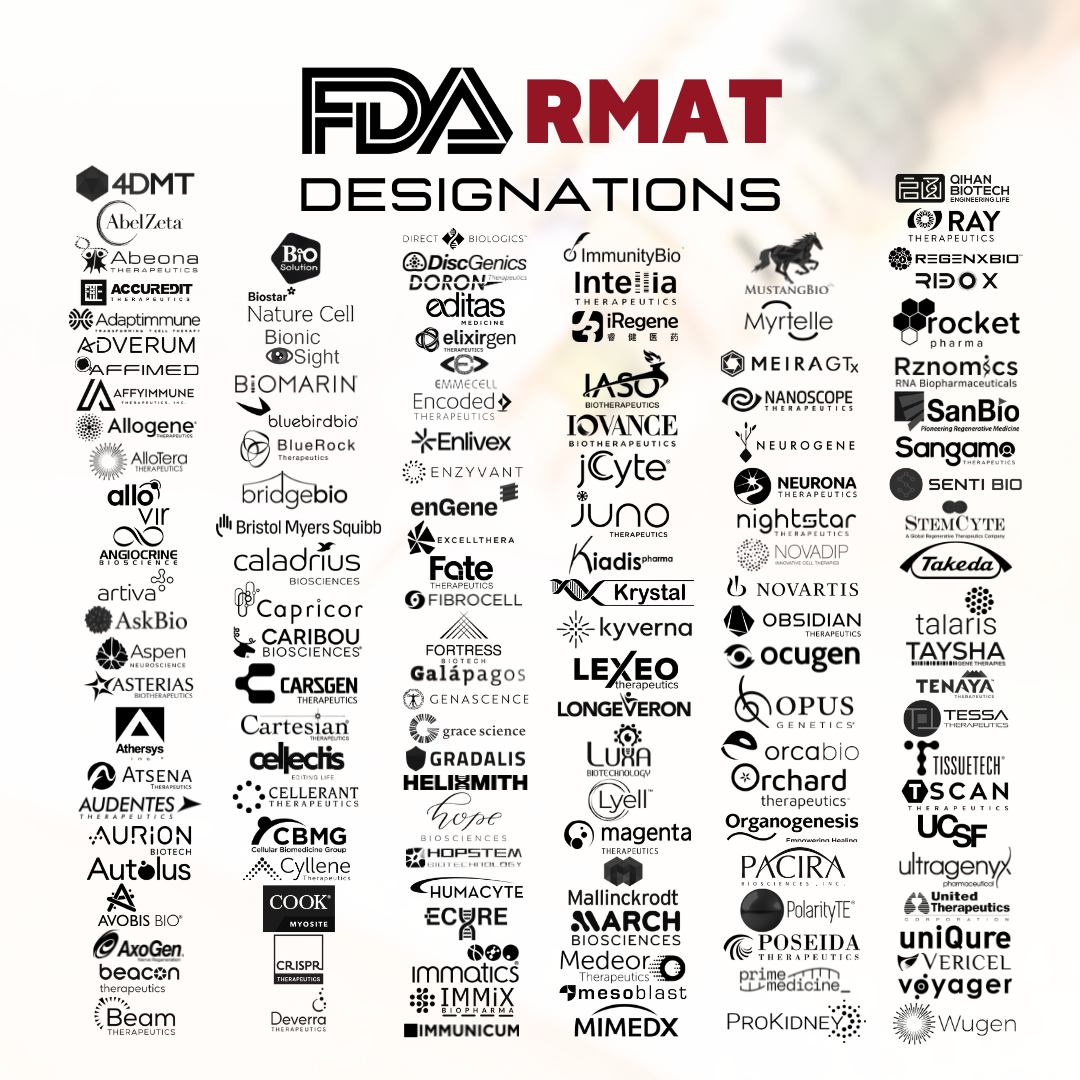
To date, what number of U.S. FDA-approved RMATs have been issued and to whom have they been awarded?

The answer is that 171 RMAT (Regenerative Medicine Advanced Therapy) designations have been publicly announced by biotech and pharma companies. However, the FDA states it has received 388 requests and issued 193, which means that a handful are not yet public knowledge. Therefore, a few companies are operating in stealth mode with regard to their RMAT designations and approximately half of RMAT applications get approved (193 approvals / 388 applications = 49.7%).
So far, Rocket Pharmaceuticals stands out as the only company to have secured five RMAT designations from the U.S. FDA. CRISPR Therapeutics and Allogene follow closely behind with four RMATs.
Four other companies—AlloVir, Humacyte, Mesoblast, and Ocugen—have each received three RMATs to date.
Additionally, 17 companies have earned two RMAT designations each. These include: 4DMT, Abeona Therapeutics, Adaptimmune, Autolus Therapeutics, Athersys, Atsena Therapeutics, Caribou Biosciences, CARsgen Therapeutics, Cook MyoSite, Fate Therapeutics, Intellia Therapeutics, Krystal Biotech, Lexeo Therapeutics, Orca Bio, Orchard Therapeutics, Poseida Therapeutics, and Sangamo Therapeutics.
With several new designations quietly issued in the past month alone (many flying under the radar of mainstream biopharma coverage) and the 200 RMAT milestone now within sight, this designation is increasingly serving as an early signal of where the next wave of transformative therapies will emerge across oncology, rare disease, and beyond.
For companies navigating this space, staying current on who holds these designations, for what indications, and at what pace they are being awarded is not merely useful, it is a competitive necessity.
RMAT Designations
RMAT stands for “Regenerative Medicine Advanced Therapy” designation. Sponsors of cell and gene therapies are eligible to obtain an RMAT designation from the U.S. FDA if their product is intended to treat serious or life-threatening diseases and there is preliminary clinical evidence that it can address unmet medical needs. While cell and gene therapies have been the most common recipients of RMAT awards, tissue engineering and combination products can also received them.
Since the RMAT designation was introduced in 2017, BioInformant’s team of analysts have maintained a searchable, sortable database of every publicly known approval. It was originally developed in-house for our own purposes, but we had more and more clients requesting access to it.
Because this database has remained internal and proprietary, it is not indexed by or accessible to AI tools. Claiming it below is the only way to access this continuously updated dataset, which is overseen and quality controlled by BioInformant’s team of specialized analysts.
Unlike AI-generated summaries, which are prone to errors, gaps, and misattribution, this database is verified, current, and available at an accessible price point below.
The searchable, sortable database presents all known RMAT recipients, including:
- Company Name
- Product Name
- Medical Indication
- Date of Approval
- Product Category (Cell Therapy, Gene Therapy, Tissue Engineering, or Combination Product)
- Company Website
- Company Contact (Email)
- Year Founded
- Company Leadership (CEO or Founder)
- Link to RMAT Announcement
Because RMAT designations serve as a gateway to faster, more streamlined regulatory approval for regenerative medicine products in the U.S., the companies that hold them represent the highly competitive players within the field. This database brings them into focus, revealing not only which products are under development and the conditions they target, but also how the pace of designation has evolved year over year.
Use this database for:
- Competitive Intelligence — Track which companies are advancing regenerative medicine programs and what indications they are targeting.
- Sales and Business Development — Identify and target high-growth biotech and pharma companies actively developing cell and gene therapies.
- Due Diligence and Investment Analysis — Assess pipeline maturity and regulatory progress before making investment or acquisition decisions.
- Regulatory Strategy — Understand which disease areas are gaining FDA traction and anticipate where approval trends are heading.
- Market Opportunity Assessment — Identify therapeutic areas where RMAT designations are clustering to spot the next wave of transformative treatments.
Because it is an essential resource within our company, we’re confident it will be a valuable resource for you too. For a limited time, you can claim this comprehensive RMAT Database for only $97 (50% off).