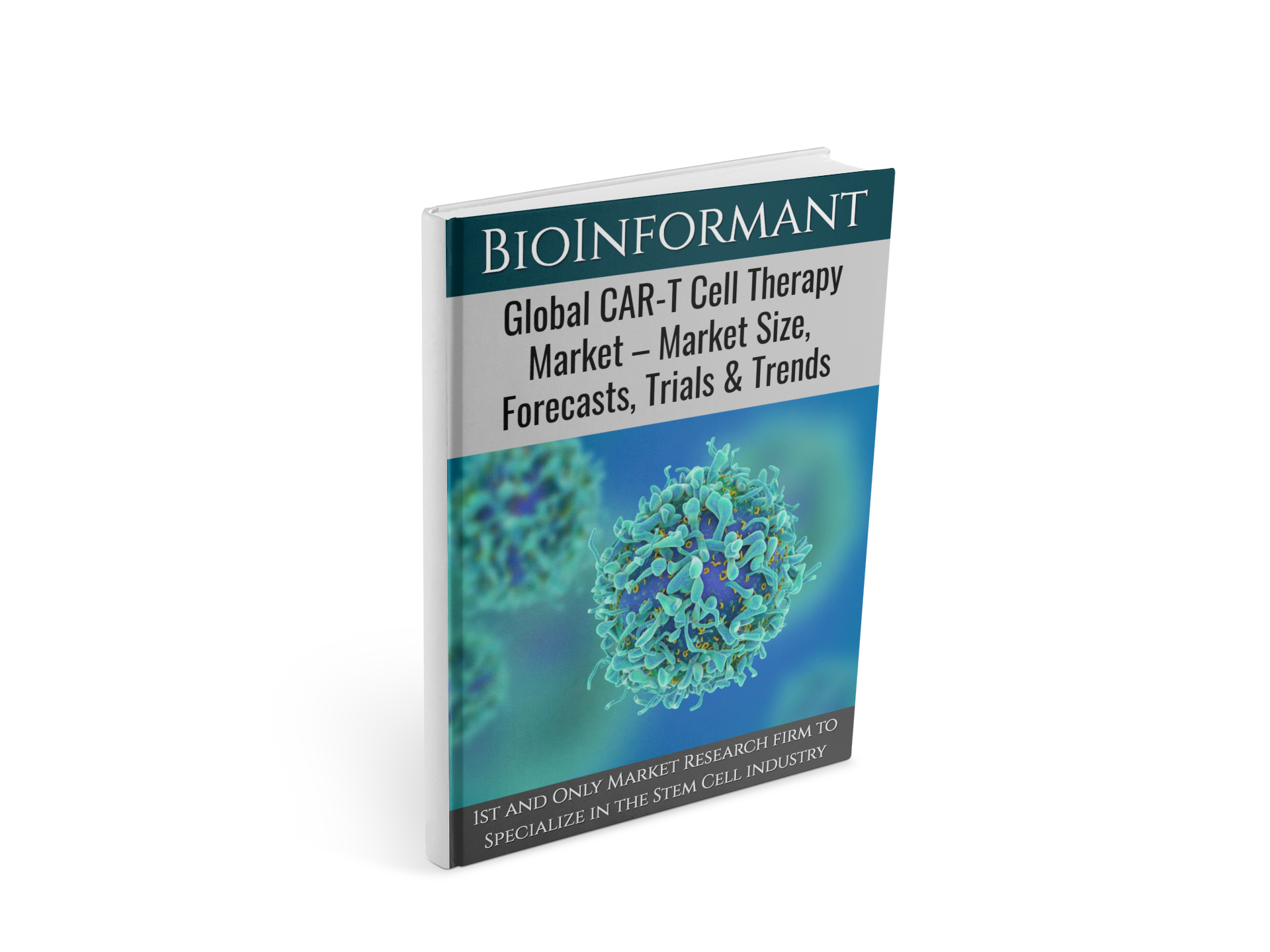
Description
CAR-T Market Report, 437 Pages
NEW RELEASE – September 2026
FLASH SALE: Through September 31st only, you can claim this global strategic report for 20% off. Act fast beacuse this offer expires soon.
CAR-T cell therapy is a groundbreaking advancement in cancer treatment, offering remarkable promise for patients. This form of immunotherapy harnesses the power of the body’s own immune cells, modifying them in a laboratory to enhance their ability to recognize and destroy cancer cells. Once infused back into the patient, these engineered cells multiply and persist in the body as “living drugs,” continually working to fight the disease.

T-cells, a crucial component of the immune system, form the foundation of CAR-T therapy. These immune workhorses play a key role in directing immune responses and eliminating infected or abnormal cells. In CAR-T cell therapy, a patient’s blood is drawn, and T-cells are separated out. Scientists then use a disarmed virus to genetically engineer these cells to express chimeric antigen receptors (CARs) on their surface. These CARs enable the T-cells to specifically target antigens found on cancer cells, leading to their destruction upon infusion back into the patient.
Global Regulatory Approvals
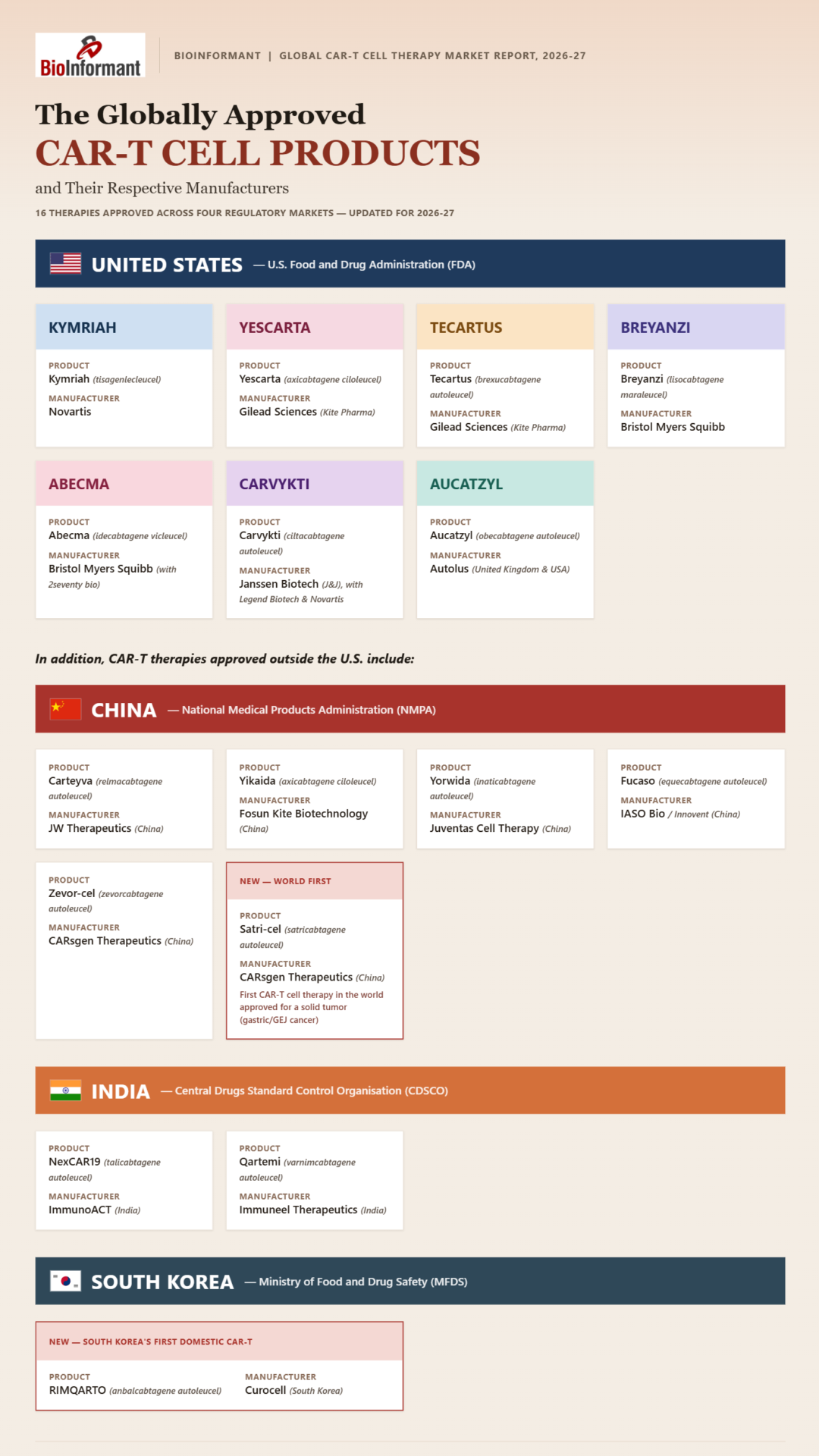
Since 2017, 16 CAR-T cell therapies have reached commercialization across multiple healthcare markets, up from 13 just a year ago. Seven therapies have been approved by the U.S. FDA. These therapies include:
- Kymriah (tisagenlecleucel)
- Yescarta (axicabtagene ciloleucel)
- Tecartus (brexucabtagene autoleucel)
- Breyanzi (lisocabtagene maraleucel)
- Abecma (idecabtagene vicleucel)
- Carvykti (ciltacabtagene autoleucel)
- Aucatzyl (obecabtagene autoleucel)
Beyond the U.S., six CAR-T therapies — Carteyva, Yikaida, Zevor-cel, Yorwida, Fucaso, and Satri-cel — have been approved by China’s National Medical Products Administration (NMPA), including Satri-cel, the world’s first regulatory approval of a CAR-T cell therapy for a solid tumor.
Additionally, two therapies, NexCAR19 and Qartemi, have received approval from India’s Central Drugs Standard Control Organisation (CDSCO). Rounding out the global landscape, South Korea’s Ministry of Food and Drug Safety (MFDS) approved the country’s first domestically developed CAR-T therapy, RIMQARTO, marking the entry of a fifth regulatory market into the commercial CAR-T landscape.
Also, two major additions happened since last year, which are:
- Satri-cel (China, CARsgen) made history as the world’s first CAR-T approved for a solid tumor
- RIMQARTO (South Korea, Curocell) added a new country to the list of CAR-T cell therapy developers
CAR-T Market Expansion and Industry Growth
These regulatory approvals mark a major milestone, solidifying the CAR-T market as a dominant force in biotech. Mergers and acquisitions have only accelerated, demonstrating strong and growing investor confidence. The industry’s formative deals — Celgene’s acquisition of Juno Therapeutics for $9 billion, Bristol-Myers Squibb’s subsequent acquisition of Celgene for $74 billion, Gilead’s acquisition of Kite Pharma for $11.9 billion, and Astellas Pharma’s purchase of Xyphos Biosciences for $665 million — established CAR-T as a must-own capability for large pharma. That appetite hasn’t slowed: since 2024 alone, the industry has recorded over $8 billion in additional licensing deals and acquisitions, including AbbVie’s acquisition of Capstan Therapeutics, Roche’s acquisition of Poseida Therapeutics, and Bristol Myers Squibb’s acquisition of Orbital Therapeutics, as pharmaceutical giants race to secure next-generation platform technologies. These transactions highlight the increasing commitment from major pharmaceutical companies to invest in CAR-T technologies and shape the future of cancer treatment.
As CAR-T therapy continues to evolve, the industry faces key challenges, including improving gene-transfer efficiency and mitigating toxicity risks. Researchers are actively exploring CRISPR and electroporation technologies to enhance T-cell modification, while others develop “on-off” switches to regulate CAR-T activity.
One of the biggest hurdles has long been the treatment of solid tumors, as clinical trials have shown lower response rates compared to blood cancers. This is changing: nearly 290 registered clinical trials are now targeting solid tumors, and China’s approval of Satri-cel proves the barrier is no longer insurmountable. A major focus remains on identifying solid tumor-specific antigens to further improve efficacy in these cancers.
Beyond oncology, the industry is making an aggressive push into autoimmune disease. Over 250 active clinical trials are now exploring CAR-T’s potential to treat conditions like systemic lupus erythematosus (SLE), systemic sclerosis, and multiple sclerosis, with early data showing drug-free remissions in some patients.
Currently, the marketed CAR-T therapy landscape and the large majority of ongoing clinical trials rely on autologous (patient-derived) cells. However, the next breakthrough lies in allogeneic CAR-T therapies — off-the-shelf solutions that could streamline manufacturing, reduce costs, and expand patient accessibility.
Global CAR-T Cell Therapy Market
The CAR-T cell therapy market has grown from early experimental treatments to a multi-billion-dollar industry with global reach. Early successes in blood cancers have paved the way for broader applications, with companies ranging from startups to biotech giants working to expand the field. As innovation continues, the future of CAR-T therapy holds immense potential to revolutionize cancer treatment worldwide.
This report aims to provide readers with the following insights:
- An overview of CAR-T therapy, covering the structure and function of T cells, how they normally act on infected cells, and how they are “armed” with engineered receptors to target and destroy cancer cells.
- A breakdown of chimeric antigen receptors (CARs), cancer cell antigens, CAR-T cell manufacturing, and the available CAR-T products, including autologous and allogeneic CAR-Ts.
- A brief history of CAR-T therapy, highlighting its evolution from 1989 to the present, its transformative potential, and the accelerating activities within the CAR-T sector.
- An examination of the manufacturing process and the costs associated with developing autologous and allogeneic CAR-T cell therapies.
- An overview of cancer biomarkers or antigens targeted by CAR-T cells.
- A detailed analysis of the global CAR-T patent landscape, including leading sponsors, inventors, and regions.
- An in-depth look at the rates, types, and trends for clinical trials involving CAR-T cells, including its rapidly emerging role in autoimmune disease.
- A review of the rates and types of CAR-T cell therapy scientific publications.
- An overview of NIH grants awarded to support CAR-T cell therapy research.
- A review of industry dealmaking and strategic partnerships within the CAR-T sector.
- Descriptions of all 16 globally approved CAR-T therapies, including Kymriah, Yescarta, Tecartus, Breyanzi, Abecma, Carvykti, Aucatzyl, Carteyva, Yikaida, Zevor-cel, Yorwida, Fucaso, Satri-cel, NexCAR19, Qartemi, and RIMQARTO.
- A review of reimbursement policies for CAR-T therapies in the U.S. and outcome-based reimbursement policies in Europe.
- A global market analysis for CAR-T cell therapies by Geography, Product, and Indication.
- Profiles of over 170 leading CAR-T cell therapy market competitors, including their novel products, emerging candidates, and proprietary technology platforms.
Key Questions Answered in This Report:
- What are the features of the FDA-approved CAR-T therapies currently available?
- What future developments are expected within the CAR-T sector?
- Which new CAR-T products are anticipated to enter the market soon?
- How many automated manufacturing systems are available for CAR-T production?
- Which antigens are most commonly targeted in liquid and solid cancers?
- What is the number of CAR-T-related patent publications and granted patents from 2012 to present?
- Which countries hold the most CAR-T patents?
- Which companies have filed the most CAR-T patents?
- Who are the top CAR-T patent inventors?
- How many CAR-T-related clinical trials have been registered from 2003 to the present?
- Which biomarker antigens dominate the CAR-T clinical trial landscape?
- How many CAR-T deals were signed in the past two years and who entered into them?
- What is the current market size for globally approved CAR-T therapies?
- What promising CAR-T candidates are expected to reach commercialization soon?
- How are CAR-T therapies reimbursed in the U.S. and Europe?
- What is the market size for CAR-T therapies by geography, product, and indication?
- Which major companies are developing CAR-T cell therapies?
This global strategic report will position you to:
- Capitalize on rapidly emerging trends
- Optimize decision-making
- Reduce company risk
- Approach partners/investors for collaboration or funding
- Implement an informed and advantageous business strategy in 2026
With the competitive nature of this global market, you don’t have the time to do the research. Claim this report to become immediately informed, without missing critical opportunities.
Companies and Organizations Mentioned
Novartis, Gilead Sciences, Kite Pharma, Bristol Myers Squibb, 2seventy bio, Legend Biotech, Janssen Pharmaceuticals, Autolus Therapeutics, JW Therapeutics, Fosun Pharma, CARsgen Therapeutics, IASO Biotherapeutics, Immuneel Therapeutics, ImmunoACT, Curocell, AbbVie, AstraZeneca, Roche Group, Eli Lilly, Regeneron, Genentech, BioNTech, Sana Biotechnology, Arcellx, Allogene Therapeutics, Caribou Biosciences, CRISPR Therapeutics, Intellia Therapeutics, Precision Biosciences, Century Therapeutics, Fate Therapeutics, Beam Therapeutics, Editas Medicine, Cartesian Therapeutics, Kyverna Therapeutics, Cabaletta Bio, Capstan Therapeutics, Orbital Therapeutics, Umoja Biopharma, Lyell Immunopharma, Mustang Bio, Vor Biopharma, Gracell Biotechnologies, Poseida Therapeutics, Adicet Bio, Atara Biotherapeutics, Cellectis, Celyad Oncology, Wugen, Strand Therapeutics, Waypoint Bio, Kelonia Therapeutics, ArsenalBio, Anixa Biosciences, Xyphos Biosciences, Antion Biosciences, Miltenyi Biomedicine, MaxCyte, Thermo Fisher Scientific, Terumo BCT, and 112 more.
VIEW TABLE OF CONTENTS: Global CAR-T Cell Therapy Market – Market Size, Forecasts, Trials & Trends, 2026-27
About BioInformant
Founded in 2006 and attracting an online readership of nearly one million viewers per year, BioInformant is a U.S. market research firm with 20+ years of experience. As the first and only market research firm to specialize in the cell therapy industry, BioInformant research has been cited by the Wall Street Journal and Vogue Magazine, as well as quoted in Tony Robbin’s best selling book, Life Force. Headquartered near Washington, DC, BioInformant is strategically positioned to be near the National Institutes of Health (NIH), U.S. FDA, Maryland Biotech Corridor, and policy makers on Capitol Hill. Serving all-star clients that include GE Healthcare, Pfizer, and Goldman Sachs, BioInformant is your global leader in cell therapy industry data. For more information, read Client Testimonials here.
The content within this report was compiled using a diverse range of sources, as described in this Research Methodology. Have questions? Email us at [email protected] to get a rapid reply.
Checkout below to get immediate (downloadable) access to this report, with printing rights allowed.
![[SALE] Global Database of Regenerative Medicine (RM) Industry Investors - Featuring 300+ Investors](https://bioinformant.com/wp-content/uploads/2025/09/RM-Investors-2026-2-400x400.jpg)