Description
Market Report, 385 Pages
NEW RELEASE – SEPTEMBER 2026
Exosomes are nano-sized (30–150 nm) extracellular vesicles secreted by virtually all living cells. Once dismissed as cellular waste, they are now recognized as vital mediators of intercellular communication, carrying cell-specific cargos of proteins, lipids, and nucleic acids (including mRNA and miRNA) that are selectively taken up by recipient cells. Researchers have catalogued more than 119,000 exosome-associated protein entries in dedicated databases like ExoCarta, and a single exosome can carry anywhere from a few dozen to 1,000–2,000 distinct proteins reflecting the physiological state of its parent cell.

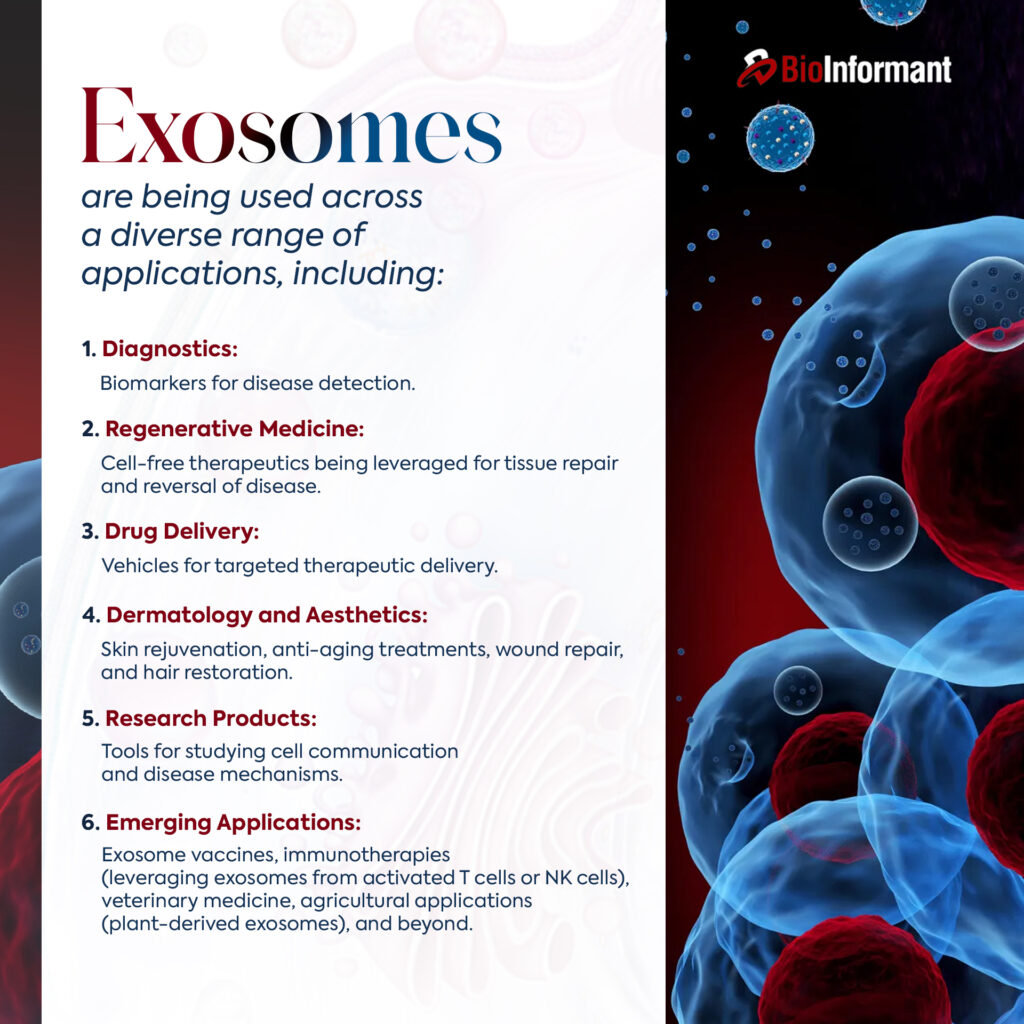
This cargo makes exosomes exceptionally valuable across four major commercial fronts: liquid biopsy diagnostics, where exosomal biomarkers enable non-invasive detection of cancers, cardiovascular disease, and neurodegenerative conditions; targeted drug delivery, where engineered exosomes cross biological barriers (including the blood-brain barrier) to deliver RNA, proteins, and small molecules directly to diseased tissue; regenerative medicine, where stem cell-derived exosomes suppress inflammation and accelerate tissue repair as a cell-free alternative to living-cell therapies; and medical aesthetics, where exosome-based serums and creams are marketed for skin rejuvenation, scar reduction, and hair restoration.
As of June 2026, PubMed.gov indexes 44,211 published papers on exosome research, up from just 282 in 2010, with annual output alone reaching 6,304 papers in 2025. Asia/Pacific now produces 52% of global exosome publications, followed by Europe (28%) and the United States (20%), though the U.S. retains the highest citation impact and remains the top country for clinical translation. Harvard University leads all institutions by publication volume and citation impact, with Karolinska Institutet a leading center for therapeutic applications.
Patent activity has grown just as sharply, from 8 filings in 2000 to 1,921 in 2025, with the United States (22,120 total filings), WIPO, and China as the leading jurisdictions. Clinical development has kept pace: 579 exosome-related trials are now registered globally, led by the United States (149 trials) and China (138), with oncology representing roughly 30% of the therapeutic pipeline.
No exosome-based therapeutic or diagnostic has yet received full FDA approval, but that is poised to change. One of the most closely watched programs in this space is Capricor Therapeutics’ Deramiocel (CAP-1002) for Duchenne Muscular Dystrophy (DMD) cardiomyopathy. Deramiocel is administered as a cell therapy, allogeneic cardiosphere-derived cells (CDCs), but its proposed mechanism of action is exosome-mediated: the CDCs work by secreting exosomes that shift macrophages from a pro-inflammatory to a healing phenotype.
The FDA granted Deramiocel Priority Review, but a July 2026 advisory committee voted 9–3 against recommending approval for the original cardiomyopathy indication. In response, Capricor submitted additional Phase 3 HOPE-3 data and narrowed its proposed indication to preservation of upper-limb function; the FDA has since extended its target action (PDUFA) date to November 22, 2026. If this first-in-class approval occurs, it could open the door for a wave of exosome-based drug launches in the following 3–5 years.
On the diagnostics side, two tests already operate as CLIA-certified Laboratory Developed Tests: the ExoDx Prostate IntelliScore (EPI), now under MDxHealth following its 2025 divestiture from Bio-Techne, and ExoTRU, a kidney transplant-rejection assay from Bio-Techne/Thermo Fisher Scientific.
The industry is also seeing intensifying investment and dealmaking activity. Venture capital funding into exosome-focused companies has mobilized close to $600 million since 2010, with roughly $155 million raised between 2023 and mid-2026 alone across notable rounds such as EXO Biologics’ $18.7 million Series A, Annie Aesthetic Holdings’ $65 million Series B, and PranaX Corporation’s $17 million Series A. Strategic acquisitions are consolidating the space as larger players move to secure diagnostic and technology platforms — most notably MDxHealth’s purchase of Exosome Diagnostics (and its ExoDx Prostate test) from Bio-Techne for $15 million, ExoCoBio’s acquisition of majority ownership in BENEV to expand global aesthetic distribution, and Evox Therapeutics’ acquisition of Codiak Biosciences’ engineered exosome technology platform.
Meanwhile, licensing and partnership activity between biopharma and exosome innovators, including deals involving Capricor Therapeutics, RION, Lonza, and Evox Therapeutics, increasingly features milestone-based structures reaching up to $1 billion, reflecting how major pharmaceutical players are moving to lock in proprietary delivery platforms and manufacturing capacity ahead of costly late-stage clinical trials.
To characterize this rapidly maturing industry, BioInformant has released this global strategic report exploring demand across six distinct market segments: Research Products, Development & Manufacturing, Diagnostics, Therapeutics, Medical Aesthetics, and Ready-to-Use Exosomes.
Collectively, these segments are already generating substantial global revenue and are on track for dramatic multi-year expansion, with the report revealing figures and forecasts for each segment through 2034. Medical Aesthetics is the largest segment currently, while Research Products ranks second. Diagnostics is the fastest-growing segment by percentage, expanding at an especially steep rate off a small current base, while Therapeutics is poised for a sharp inflection point as the first approved products reach the market. Geographically, North America commands the largest share of global revenue by a wide margin, followed by Europe, with Asia-Pacific close behind, led overwhelmingly by China’s outsized share of the regional total.
The report features in-depth profiles of 135 global competitors spanning the exosome marketplace, from research-tool suppliers like Thermo Fisher Scientific, QIAGEN, and Bio-Techne to clinical-stage innovators like Capricor Therapeutics, Evox Therapeutics, and Aruna Bio, and aesthetic-market leaders like ExoCoBio, Rion Aesthetics, and Kimera Labs.
Today, the exosome industry is witnessing:
- Explosive, sustained growth in scientific publications and patent filings
- A rapidly expanding clinical trial pipeline, now numbering 579 registered studies
- The approach of a likely first-in-class regulatory approval (Deramiocel)
- Rapid commercialization of exosome-based aesthetics
- Continued venture capital and strategic investment into platform technologies
- An increasingly competitive IP and M&A environment across all six market segments
This report reveals:
- The clinical pipeline for exosome therapeutics and diagnostics
- Clinical trial activity by phase, geography, application, and sponsor
- Patent landscape trends by jurisdiction, assignee, and domain of innovation
- Industry M&A activity, financing events, and strategic partnerships
- Detailed profiles of 135 competitors across the global exosome marketplace
- Market size determinations across six segments, with forecasts through 2034
- Key industry trends, competitive opportunities, and future outlook
Human Analysts, Not AI
This report was prepared by BioInformant’s talented and experienced human analysts, not AI. We utilize translators to discover companies doing business across a wide range of languages and crowd-source feedback from BioInformant’s partners, clients, and readers to ensure penetrating insights. This report is only possible because of BioInformant’s deep relationships within the exosome industry.
This report would not be possible without the past 20+ years of aggregating historical datasets for this industry, proprietary databasets to which AI does not have access.
These critical insights insights are built on nearly two decades of granular tracking, industry interviews, and daily data collection from across the exosome landscape. AI doesn’t have this data. We do, and if you checkout below, you could too.
With the competitive nature of this global market, you don’t have the time to do the research yourself. Claim this report to become immediately informed, without sacrificing hours of research or missing critical opportunities.
About BioInformant
With an online readership of nearly one million viewers per year, BioInformant is a U.S. market research firm with 20+ years of experience. As the first and only market research firm to specialize in the stem cell industry, BioInformant research has been cited by the Wall Street Journal, AABB, and Vogue Magazine. Headquartered in Washington, DC, BioInformant is strategically positioned to be near the National Institutes of Health (NIH), the U.S. FDA, the Maryland Biotech Corridor, and policy makers on Capitol Hill.
The content within this report was compiled using a diverse range of sources, as described in this Research Methodology.
View Table of Contents: The Global Exosome Market – Market Size, Forecasts, Trials and Trends, 2026
To view product pricing, choose a License Type from the dropdown menu below.
Have questions? Email us at [email protected] to get a rapid reply. Checkout below to get immediate access to this report as an electronic (PDF) file, with printing rights allowed.