
|
|
Today, researchers and clinicians are under great pressure to develop therapies capable of reversing or significantly impacting the progression of disease. In recent years, the arrival of the cell and gene therapy industries have introduced the possibility of providing transformative, durable and potentially curative outcomes for a diverse range of life-threatening conditions, as well as injuries, degenerative diseases, genetic disorders, and cancers.

Cell therapy is the utilization of living cells for the treatment or cure of disease. It can involve both native (unmodified), as well as engineered or gene-edited cells. It also encompasses the exosomes and extracellular vesicles that are secreted by living cells.
Gene therapy is involves the insertion of functional genes into cells to replace faulty genes for the purpose of treating genetic diseases. Usually, a virus is genetically engineered to carry and deliver the therapeutic gene into the cells of the patient’s body. When the treatment is successful, the new gene delivered by the vector produces a functioning protein. There are several techniques to perform gene therapies, which include gene augmentation therapy, gene inhibition therapy, and suicide gene insertion, as well as other methods.
Of course, CAR-T cell therapies are gene-edited cell therapies, so they fall into both categories.
FDA Approved Cell and Gene Therapies
Below is a list of all known cell and gene therapy products that have been licensed by the Office of Tissues and Advanced Therapies (OTAT), a division of the U.S. FDA. At present, 46 cell and gene therapies have been approved within the U.S. To date, no exosome therapies have received FDA approval, although the clinical trial pipeline looks promising.
At present, the largest segment of these products is umbilical cord blood derivatives. These represent 9 of the 46 currently approved cell and gene therapy approvals (19.6%). At present, all of the FDA approved cord blood therapies are cellular therapeutics.
CAR-T cell therapies represent the next largest segment, composing 7 of the 46 approvals (15.2%). The approved CAR-T cell therapies in the U.S. include: Abcema, Aucatzyl, Breyanzi, Carvykti, Kymriah, Tecartus, and Yescarta (listed in alphabetical order).
In addition these these two categories, there are 18 gene therapies that are not CAR-T cell therapies and 12 cell therapies that are not cord blood derived therapeutics.
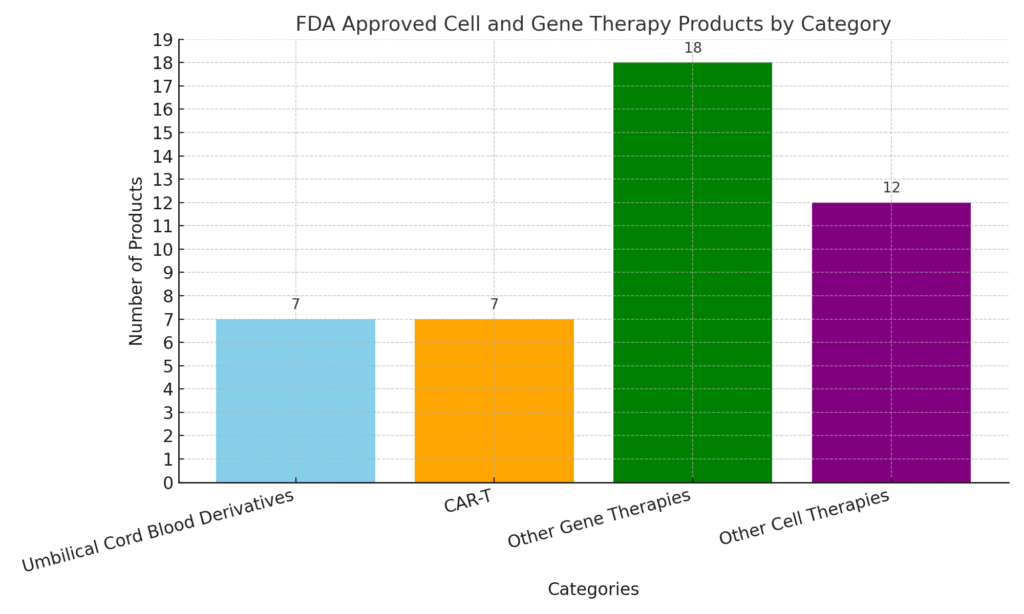
U.S. FDA Approved Cell and Gene Therapies by Category
For each product, the list below presents its brand name, clinical name, the company who developed it, and importantly, the year it was approved.
The most recent approvals on this list were ENCELTO (revakinagene taroretcel-lwey) by Neurotech Pharmaceuticals, PAPZIMEOS (zopapogene imadenovec-drba) by Precigen, and ZEVASKYN (prademagene zamikeracel) by Abeona Therapeutics.
1. Umbilical Cord Blood Derivatives
- ALLOCORD (HPC, Cord Blood) – SSM Cardinal Glennon Children’s Medical Center – 2011
- CLEVECORD (HPC Cord Blood) – Cleveland Cord Blood Center – 2016
- Ducord (HPC Cord Blood) – Duke University School of Medicine – 2008
- HEMACORD (HPC, Cord Blood) – New York Blood Center – 2012
- HPC, Cord Blood – Clinimmune Labs, University of Colorado Cord Blood Bank – 2007
- HPC, Cord Blood – MD Anderson Cord Blood Bank– 2008
- HPC, Cord Blood – LifeSouth Community Blood Centers, Inc. – 2008
- HPC, Cord Blood – Bloodworks – 2010
- REGENECYTE (HPC, Cord Blood) – StemCyte, Inc. – 2008
2. CAR-T
- ABECMA (idecabtagene vicleucel) – Celgene Corporation, a Bristol-Myers Squibb Company – 2021
- AUCATZYL (obecabtagene autoleucel) – Autolus Limited – 2024
- BREYANZI (lisocabtagene maraleucel) – Juno Therapeutics, Inc., a Bristol-Myers Squibb Company – 2021
- CARVYKTI (ciltacabtagene autoleucel) – Janssen Biotech, Inc. – 2022
- KYMRIAH (tisagenlecleucel) – Novartis Pharmaceuticals Corporation – 2017
- TECARTUS (brexucabtagene autoleucel) – Kite Pharma – 2020
- YESCARTA (axicabtagene ciloleucel) – Kite Pharma – 2017
3. Other Gene Therapies
- ADSTILADRIN (nadofaragene firadenovec-vcng) – Ferring Pharmaceuticals A/S – 2022
- BEQVEZ (fidanacogene elaparvovec-dzkt) – Pfizer – 2023
- CASGEVY (exagamglogene autotemcel [exa-cel]) – Vertex Pharmaceuticals – 2023
- ELEVIDYS (delandistrogene moxeparvovec-rokl) – Sarapeta Therapeutics – 2023
- ENCELTO (revakinagene taroretcel-lwey) – Neurotech Pharmaceuticals, Inc. – 2025
- HEMGENIX (etranacogene dezaparvovec-drlb) – CSL Behring – 2022
- IMLYGIC (talimogene laherparepvec) – BioVex, Inc., a subsidiary of Amgen – 2015
- KEBILIDI (eladocagene exuparvovec-tneq) – PTC Therapeutics – 2023
- LENMELDY (atidarsagene autotemcel) – Orchard Therapeutics (Europe) Limited – 2022
- LUXTURNA (voretigene neparvovec-rzyl) – Spark Therapeutics – 2017
- LYFGENIA (lovotibeglogene autotemcel [lovo-cel]) – bluebird bio – 2023
- PAPZIMEOS (zopapogene imadenovec-drba) – Precigen, Inc. – 2025
- ROCTAVIAN (valoctocogene roxaparvovec-rvox) – BioMarin Pharmaceutical – 2022
- SKYSONA (elivaldogene autotemcel) – bluebird bio – 2022
- VYJUVEK (beremagene geperpavec) – Krystal Biotech – 2023
- ZEVASKYN (prademagene zamikeracel) – Abeona Therapeutics, Inc. – 2025
- ZOLGENSMA (onasemnogene abeparvovec-xioi) – Novartis Gene Therapies – 2019
- ZYNTEGLO (betibeglogene autotemcel) – bluebird bio – 2022
4. Other Cell Therapies
- AMTAGVI (lifileucel) – Iovance Biotherapeutics – 2023
- GINTUIT (Allogeneic Cultured Keratinocytes and Fibroblasts in Bovine Collagen) – Organogenesis – 2012
- LANTIDRA (donislecel) – CellTrans – 2023
- LAVIV (Azficel-T) – Fibrocell Technologies – 2011
- MACI (Autologous Cultured Chondrocytes on a Porcine Collagen Membrane) – Vericel Corp. – 2016
- OMISIRGE (omidubicel-onlv) – Gamida Cell – 2023
- PROVENGE (sipuleucel-T) – Dendreon – 2010
- RETHYMIC (allogeneic processed thymus tissue – agdc) – Enzyvant Therapeutics GmbH – 2021
- RYONCIL (remestemcel-L-rknd) – Mesoblast– 2024
- STRATAGRAFT (allogeneic cultured keratinocytes and dermal fibroblasts in murine collagen-dsat) – Stratatech Corporation – 2021
- SYMVESS (acellular tissue engineered vessel-tyod) – Humacyte Global, Inc. – 2024
- TECELRA (afamitresgene autoleucel) – Adaptimmune – 2024
Breakdown of Cell & Gene Therapy Approvals by Year
Next, let’s tally these approvals by year. Here is the breakdown:
2007: 1 (HPC, Cord Blood – Clinimmune Labs)
2008: 4 (Ducord, HPC, Cord Blood – MD Anderson, HPC, Cord Blood – LifeSouth, Regenecyte)
2010: 2 (HPC, Cord Blood – Bloodworks, Provenge)
2011: 2 (Allocord, Laviv)
2012: 2 (Hemacord, Gintuit)
2015: 1 (Imlygic)
2016: 2 (Clevecord, Maci)
2017: 3 (Kymriah, Yescarta, Luxturna)
2019: 1 (Zolgensma)
2020: 1 (Tecartus)
2021: 4 (Abecma, Breyanzi, Stratagraft, Rethymic)
2022: 6 (Carvykti, Adstiladrin, Hemgenix, Lenmeldy, Roctavian, Skysona, Zynteglo)
2023: 6 (Beqvez, Casgevy, Elevidys, Kebilidi, Lyfgenia, Vyjuvek, Lantidra, Omisirge, Amtagvi)
2024: 4 (Ryoncil, Aucatzyl, Symvess, Tecelra)
2025: 3 (Encelto, Papzimeos, Zevaskyn)
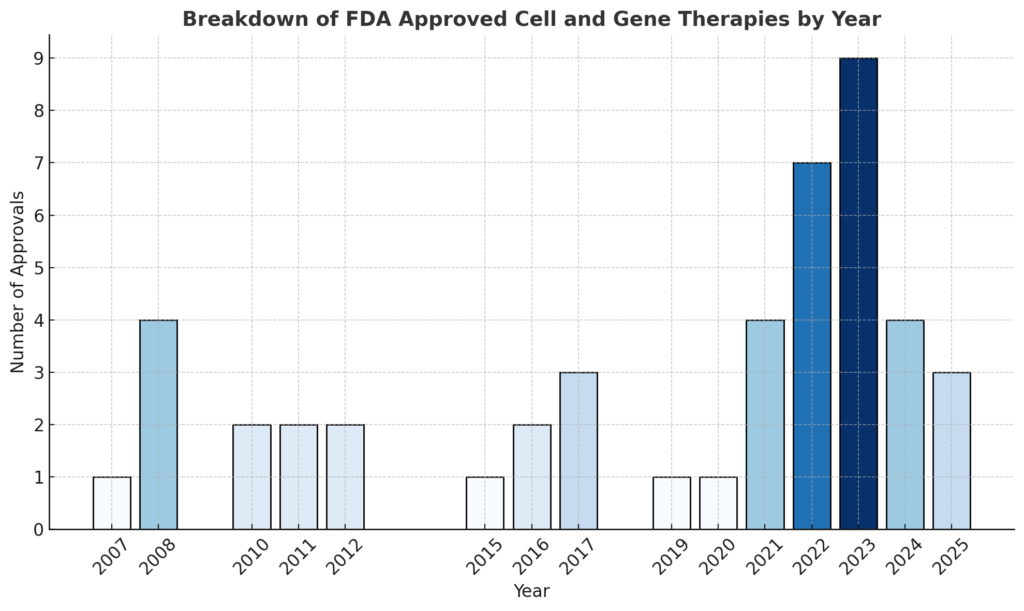
Interestingly, the rates of cell and gene therapy approvals showed consistent growth from 2019 to 2024. However, the number of approvals per year stayed relatively consistent for three years (2022, 2023, and 2024), this number dropped notably in 2025.
Source Data: U.S. FDA
Related: Regenerative Medicine Industry Database, 2026 – Featuring 1,920+ Companies Worldwide

this is fantastic !!! i have been using stem cell in my lower back…they use umbilicord and its life changing. 1 shot and good for 15 months..no pain at all!! sever degeneritive disese and OA and RA …i heard of IV stem cell…for entire body…only in germany??? really need it here !! i pay 750 for 2 shots every 15-17 months..so worth. it!! i could not walk 10 years ago and now at 58 i can run and work all day house clean no PAIN !! my life is back!! this is the way to age we must regenerate what is going bad !! please let me know if anyone in the US is doing IV stem cell
I had 6 ea. 3 on each side 50M in total MSC Umbilical Stem Cells as well as Exosomes and PLP injections for lower back stenosis of the spine back in June, I knew it would help, but what has transpired is awesome. I also had 100M added via IV for other possible issues and longevity. I went to Mexico and it was roughly $6,000 US.