|
|
The cell and gene therapy (CGT) contract manufacturing landscape has a new market entrant, and it’s a big one. On May 7, 2026, San Francisco-based private investment firm GI Partners announced that it has completed its acquisition of the Contract Development and Manufacturing Organization (CDMO) and Cell Solutions businesses from Charles River Laboratories International. The combined operations now form Rose BioSolutions (“Rose Bio” for those in the know), a company providing exclusively advanced therapy development and manufacturing.

The launch is significant for several reasons. First, it separates a substantial portfolio of manufacturing and starting-material assets from one of the world’s largest preclinical services providers and places it under dedicated ownership with a single strategic focus.
Second, backed by GI Partners and its more than $49 billion in raised capital, Rose Bio enters the CGT CDMO market well capitalized to invest in infrastructure, talent, and new capabilities as the field evolves.
Finally, it marks GI Partners’ return to the cell-based sector, following its earlier ownership of Cord Blood Registry (CBR), which GI Partners acquired from AMAG Pharmaceuticals in 2018 for $530M and later sold to CooperSurgical as part of Generate Life Sciences.
Together, these assets give Rose Bio a unique position within the advanced therapies ecosystem, spanning both the materials that enable CGT development and the manufacturing capabilities needed to turn those programs into therapies.
Specifically, Rose Bio combines two complementary business lines:
- CDMO services: full-service development and manufacturing across plasmid DNA, viral vectors, and cell therapies.
- Cell Solutions: a supply operation delivering the cellular materials that research programs and advanced therapies depend on.
A Rose By Any Other Name
Also, if you’re wondering about its name, “Rose” is meant to reflect the company’s client focus. Specifically, it is an acronym for its client service standard, which stands for Reliable, Outcome-driven, Scalable, and Excellent in every partnership.
Rose Bio also launches with an established footprint on both sides of the Atlantic, operating facilities in Rockville, Maryland; Memphis, Tennessee; Northridge, California; and Keele, United Kingdom.
Each site has a history within Charles River’s CGT expansion, which was built largely through acquisitions: HemaCare (cellular products, Southern California), Cobra Biologics (plasmid DNA and viral vectors, Keele, UK), Vigene Biosciences (viral vectors, Rockville), and Cognate BioServices (cell therapy CDMO, Memphis).
Rose Bio now inherits that combined infrastructure and its experienced workforce.
Why the Rose Bio Deal Matters
For years, CGT developers have dealt with a fragmented supply chain. A typical program may source starting materials from one vendor, plasmid DNA from another, and vector or cell therapy manufacturing from a third. Every handoff adds time, tech transfer risk, and quality oversight burden.
GI Partners is betting that a truly integrated model can solve this. Dave Kreter, Managing Director and Head of Healthcare Investments at GI Partners, framed the opportunity aptly, saying: “Rose Bio fills a gap in the market for a truly end-to-end partner where every step, from starting materials to finished therapy, is part of a single, comprehensive offering.”
That end-to-end offering doesn’t mean Rose Bio is going it alone, however. Although it now operates independently, the separation does not appear to be a clean break. GI Partners said it expects to maintain “a long-term and mutually beneficial commercial relationship with Charles River.” This matters for customers whose programs span both preclinical services and manufacturing.
For Charles River, the divestiture continues its move to streamline its portfolio and refocus on core discovery and safety assessment operations. The company has faced pressure on its CGT manufacturing assets over the past several years as biotech funding tightened.
Financial terms were not disclosed in the announcement, although Moelis & Company LLC served as exclusive financial advisor to GI Partners, and Ropes & Gray LLP served as legal counsel.
A Big, Bold, Bankrolled Bet on CGT Manufacturing
In recent years, the CGT CDMO market has gone through a difficult stretch. Overbuilt capacity, cautious biotech spending, and program cancellations have pressured utilization across the sector, and several large players have trimmed or withdrawn from portions of their CGT manufacturing operations (like like Thermo Fisher Scientific, AGC Biologics, and Catalent, for example).
Against that backdrop, launching a standalone CGT-only CDMO is a clear statement of confidence in the long-term trajectory of advanced therapies.
In many ways, Rose Bio’s key differentiator is its vertical integration of cellular starting materials. Relatively few CDMOs can offer cellular starting materials, such as leukopaks and primary cells, alongside plasmid, vector, and cell therapy manufacturing. If Rose Bio can turn that into shorter timelines and fewer handoffs, it could appeal strongly to emerging developers that lack deep internal CMC teams.
The questions to watch are execution-focused. How quickly can Rose Bio integrate these legacy sites into a unified offering? How will GI Partners’ capital be deployed? And can the company win new programs in a market where sponsors are increasingly selective about manufacturing partners?
For now, the CGT space gains a dedicated competitor with established infrastructure across the U.S. and UK and an explicit mandate to focus on advanced therapies.
What are your thoughts on Rose Bio’s recent launch? Let us know in comments below.
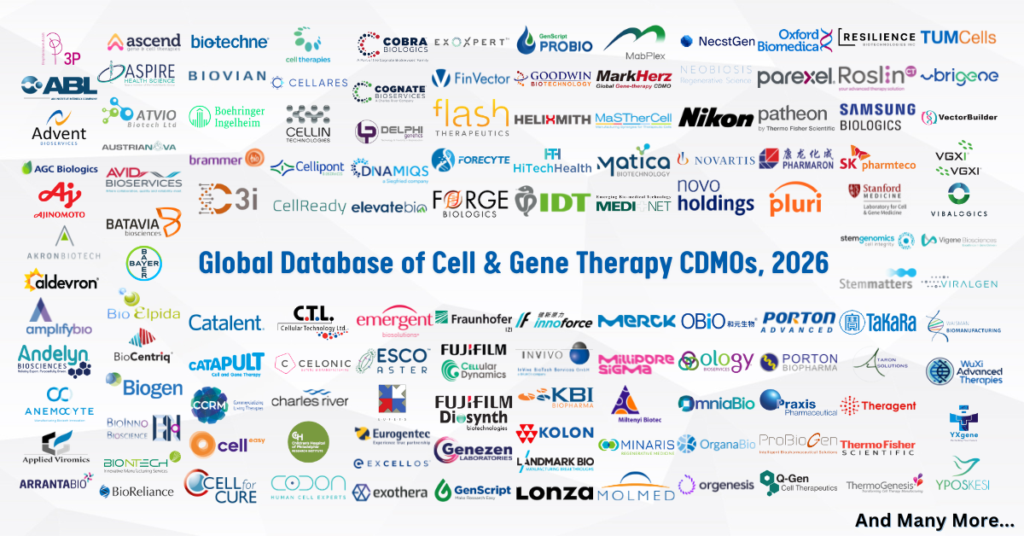
To gain immediate knowledge of all known cell and gene therapy CMDOs worldwide, view the “Global Database of Cell and Gene Therapy CMOs and CDMOs, 2026“
Tell Us What You Think!