|
|
The pharmaceutical industry continues to grapple with preclinical and clinical safety issues, with toxicity remaining a leading cause of drug failure. Cardiovascular toxicity, in particular, stands out, accounting for approximately 40% of all drug withdrawals due to safety concerns. To mitigate these risks, human induced pluripotent stem cell-derived cardiomyocytes (iPSC-CMs) have emerged as a critical tool for evaluating cardiac safety. Traditionally, most studies have relied on iPSC-CMs from one or two healthy donors, limiting the representation of broader population variability in drug response.

Expanding the Scope of iPSC-Based Toxicity Testing
Recent trends indicate a shift towards patient-specific iPSC-CMs, although the field remains in its infancy. This approach has the potential to capture the diversity of cardiac responses in a population, particularly for drugs with variable patient outcomes. In parallel, iPSC-derived neurons and hepatocytes are increasingly replacing animal models in preclinical drug testing. Currently, iPSC-derived cardiomyocytes, neurons, and hepatocytes account for approximately 60%, 23%, and 9% of cell usage in toxicity studies, respectively.
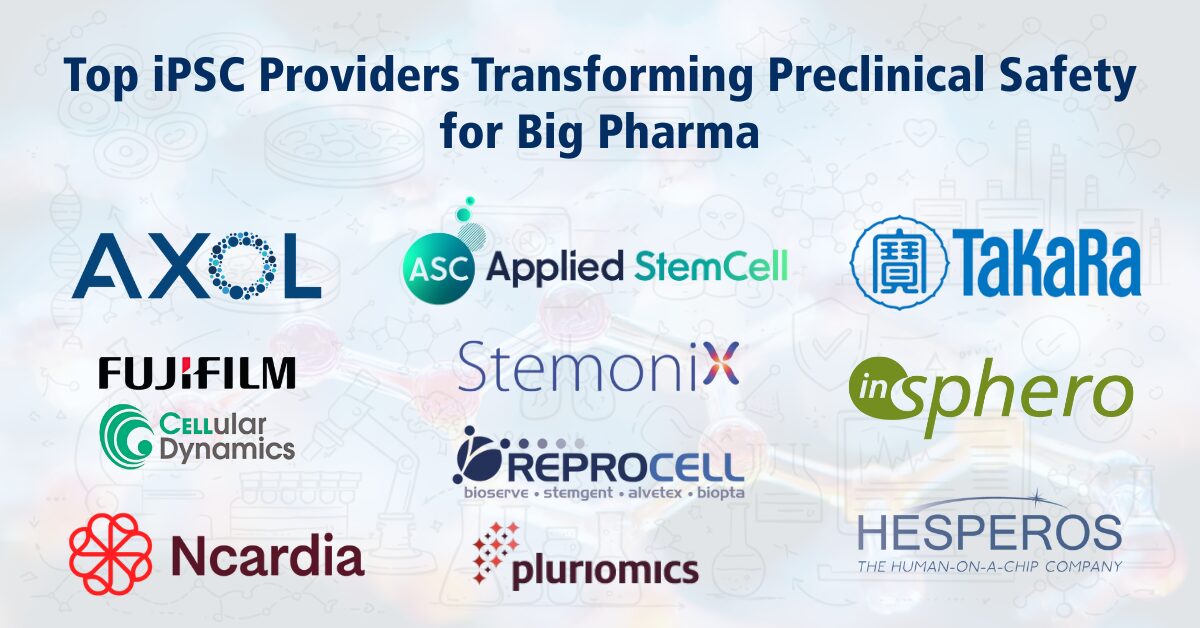
For instance, companies like Axol Bioscience, FUJIFILM Cellular Dynamics, NCardia, Pluriomics, StemoniX, REPROCELL, and Takara Bio now routinely provide iPSC-derived cardiomyocytes and hepatocytes for high-throughput screening platforms, helping pharmaceutical developers assess safety with higher predictive accuracy.
Emerging studies demonstrate the impact of donor diversity on drug response. A 2025 study published in Toxicology Reports compared iPSC-CMs from 50 individuals, revealing significant variability in drug-induced arrhythmias that would not have been observed using cells from a single donor. Similarly, in neurotoxicity testing, iPSC-derived neurons are being used to identify compounds that may trigger cognitive or behavioral side effects, with startups like InSphero, Axol Bioscience, REPROCELL, and Cellular Dynamics International offering customized neuronal platforms for both disease modeling and safety evaluation.
TABLE. Relative Use of iPSC-derived Cell Types in Toxicity Testing Studies
| Cell Type | Relative Use in Toxicity Testing |
|---|---|
| Cardiomyocytes (iPSC-CMs) | 60% |
| Neurons (iPSC-derived) | 23% |
| Hepatocytes (iPSC-derived) | 9% |
Source: BioInformant Worldwide LLC
iPSCs in Disease Modeling
iPSC technologies enable researchers to generate patient-specific cells that carry the full complement of genetic variants responsible for particular diseases. Differentiation protocols now exist for a wide array of cell types, including cardiomyocytes, hematopoietic cells, neurons, glia, and pancreatic beta cells. These cells serve multiple purposes, from in vitro disease modeling to drug screening and potential cell therapy applications.
Companies like Applied StemCell are enabling cell therapy development by combining their iPSC heritage with genome engineering expertise. Their proprietary TARGATT™ large knock-in technology and hypoimmunogenic cell lines are driving the next wave of iPSC-based therapies.
Key advantages of using hiPSCs for disease modeling include:
- Recapitulation of disease biology under physiological conditions: iPSCs retain the genetic background of the donor, providing an accurate representation of disease mechanisms.
- High proliferative capacity: This allows for scalable experiments and repeated testing.
- Multilineage potential: iPSCs can be differentiated into diverse cell types, supporting complex disease modeling.
- Retention of patient-specific genetic signatures: Essential for personalized medicine applications.
Advances in 3D Organoid Engineering
Recent bioengineering innovations, such as microfluidics and synthetic scaffolds, allow hiPSCs to self-organize into 3D organoids that mimic human tissue architecture. For example, Hesperos, StemoniX, NCardia, InSphero, REPROCELL, and Takara Bio are now generating cardiac and liver organoids for high-fidelity toxicity and disease modeling studies. These platforms enhance the predictive power of preclinical tests by replicating developmental and microenvironmental cues found in vivo.
Hesperos focuses on multi-organ systems that allow simultaneous assessment of cardiac and hepatic responses. StemoniX provides scalable cardiac and neuronal organoids designed for high-throughput screening, helping developers evaluate drug safety across multiple endpoints. NCardia emphasizes patient-specific cardiac models that integrate genetic diversity to predict variable drug responses. InSphero offers 3D liver microtissues and neural networks optimized for preclinical toxicity testing, while REPROCELL and Takara Bio supply both customizable iPSC lines and organoid platforms, supporting disease modeling and compound screening.
Together, these companies are advancing predictive biology by creating platforms that closely replicate human tissue microenvironments, reduce reliance on animal testing, and improve translational relevance of preclinical studies.
Industry Adoption and Services
Several biotech companies now offer comprehensive disease modeling services leveraging hiPSC technology. They provide sourcing of both healthy and disease-specific human iPSC lines through partnerships with medical centers and research consortia. Companies like NCardia, Cellular Dynamics International, Pluriomics, FUJIFILM Cellular Dynamics, Axol Bioscience, REPROCELL, and Takara Bio are helping pharmaceutical developers incorporate patient diversity into their safety and efficacy studies, improving translational relevance and reducing reliance on animal models.
To summarize, iPSC-derived cell types are reshaping preclinical toxicity testing and disease modeling. While cardiomyocytes remain the most widely used cell type, neurons and hepatocytes are rapidly gaining traction. Advances in 3D organoid technology and patient-specific iPSC lines are making studies more predictive and personalized, ultimately enhancing drug safety and efficacy in human populations.
What advances are you seeing in this area and what market participants are furthering them?
Tell Us What You Think!