|
|
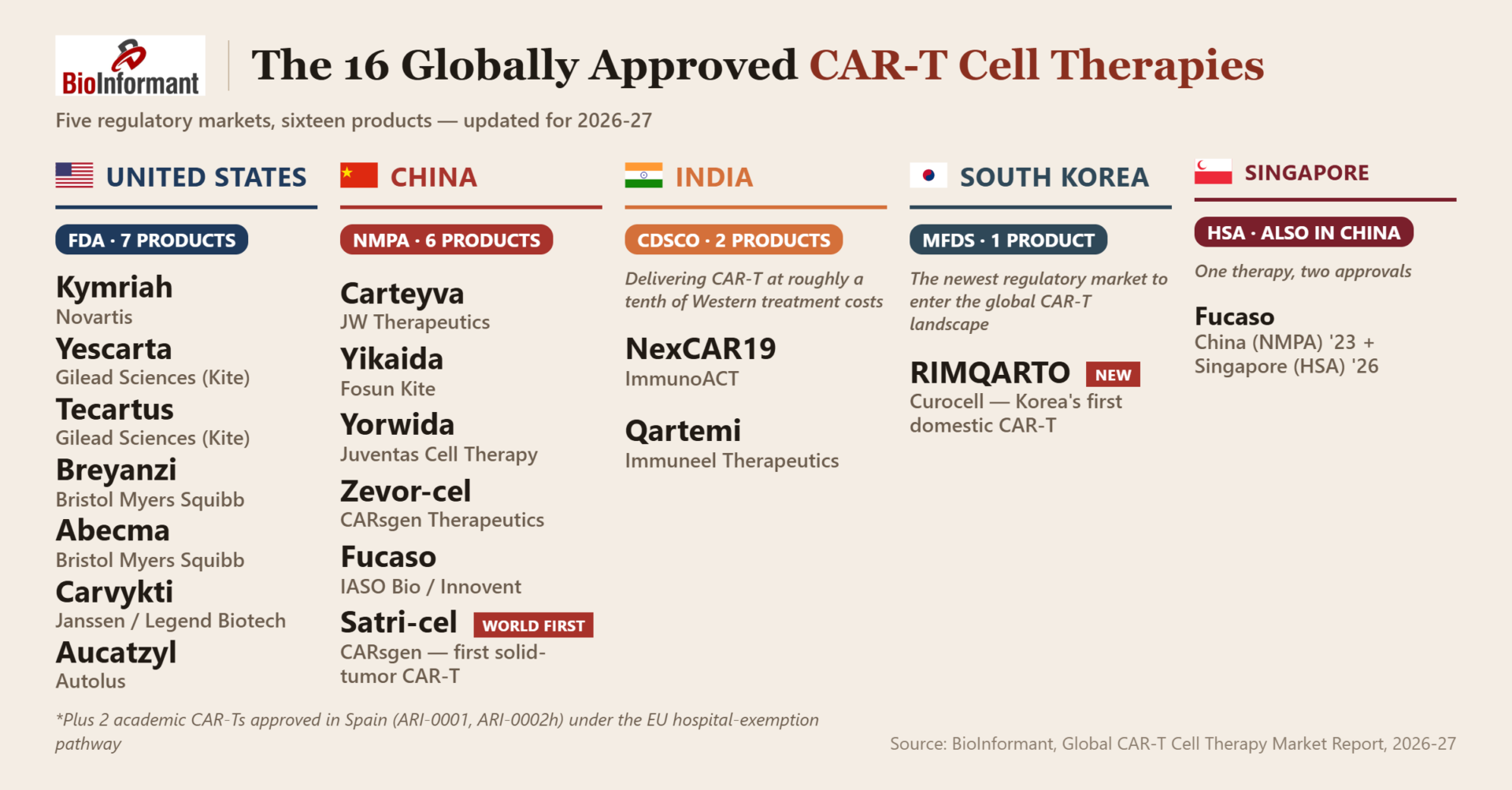
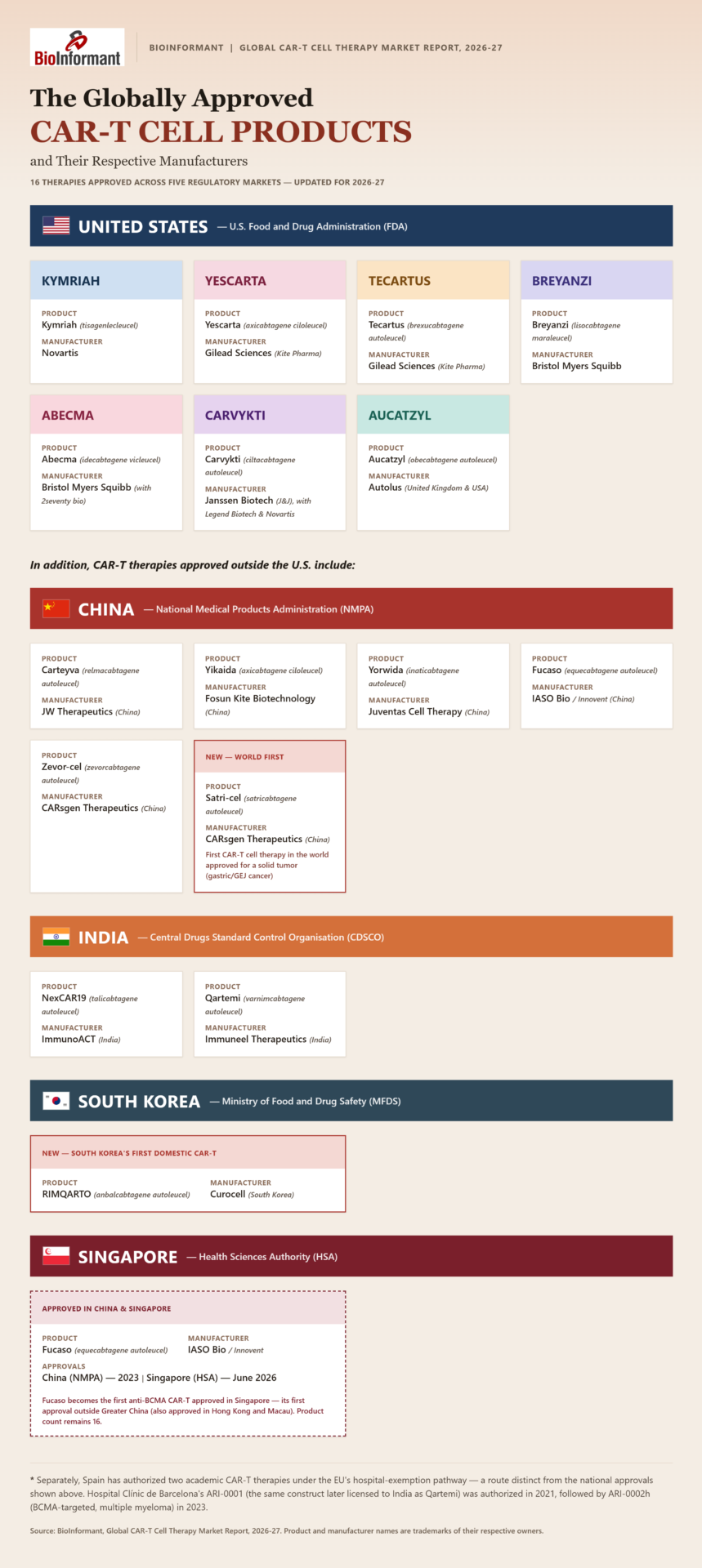
Since 2017, an incredible 16 CAR-T cell therapies have reached commercialization, with several more nearing the finish line. Seven therapies have been approved by the U.S. FDA, after which approvals for them were issued in other major markets as well. These include:

- Kymriah (tisagenlecleucel)
- Yescarta (axicabtagene ciloleucel)
- Tecartus (brexucabtagene autoleucel)
- Breyanzi (lisocabtagene maraleucel)
- Abecma (idecabtagene vicleucel)
- Carvykti (ciltacabtagene autoleucel)
- Aucatzyl (obecabtagene autoleucel)
Beyond the U.S., six CAR-T therapies (Carteyva, Yikaida, Yorwida, Zevor-cel, Fucaso, and Satri-cel) have been approved by China’s National Medical Products Administration (NMPA), including Satri-cel, which made history this year as the world’s first CAR-T cell therapy approved for a solid tumor.
Two therapies, NexCAR19 and Qartemi, have received approval from India’s Central Drugs Standard Control Organisation (CDSCO), and South Korea’s Ministry of Food and Drug Safety (MFDS) approved RIMQARTO, the country’s first domestically developed CAR-T cell therapy. A fifth regulatory market has now entered the picture too, but not a new product: Singapore’s Health Sciences Authority (HSA) has approved Fucaso, already counted above among China’s six NMPA approvals, marking the therapy’s first approval outside Greater China (it’s also cleared in Hong Kong and Macau).
The global tally holds steady at 16 approved CAR-T cell therapies.
Separately, Spain has authorized two academic CAR-T therapies under the EU’s hospital-exemption pathway, a route distinct from the national approvals above. Hospital Clínic de Barcelona’s ARI-0001 (the same construct later licensed to India as Qartemi) was authorized in 2021, followed by ARI-0002h (BCMA-targeted, for multiple myeloma) in 2023.
16 Globally Approved CAR-T Therapies and Counting
These regulatory approvals mark a major milestone, solidifying the CAR-T market as a dominant force. M&As have also been aggressive, demonstrating strong investor confidence. Celgene’s acquisition of Juno Therapeutics, Inc. for $9B underscored the industry’s potential, followed by Bristol Myers Squibb acquiring Celgene for $74B.
Another big move was Gilead Sciences’s acquisition of Kite Pharma for $11.9B, further strengthening its position in the space. Additionally, Astellas Pharma expanded its portfolio by purchasing Xyphos Biosciences for $665 million. Gilead has since gone on to complete its acquisition of Arcellx for a staggering $7.8B, absorbing full ownership of Arcellx’s lead BCMA-directed candidate.
The dealmaking has only accelerated since: AbbVie acquired Capstan Therapeutics for up to $2.1B, Roche acquired Poseida Therapeutics for up to $1.5B, and AstraZeneca acquired EsoBiotec for up to $1.0B, each move giving Big Pharma a foothold in next-generation in vivo and allogeneic cell therapy platforms.
As CAR-T therapy continues to evolve, the industry faces key challenges, including improving gene-transfer efficiency and mitigating toxicity risks. Researchers are actively exploring CRISPR and electroporation technologies to enhance T-cell modification, while others develop “on-off” switches to regulate CAR-T activity.
One of the biggest hurdles has long been the treatment of solid tumors, as clinical trials have shown lower response rates compared to blood cancers. That barrier is finally starting to give way, with hundreds of active trials now targeting solid tumors and Satri-cel’s landmark approval proving the science works. Identifying solid tumor-specific antigens remains a major focus to further improve efficacy.
Currently, the marketed CAR-T therapy landscape and the large majority of ongoing clinical trials rely on autologous (patient-derived) cells. However, the next breakthrough lies in allogeneic CAR-T therapies—off-the-shelf solutions that could streamline manufacturing, reduce costs, and expand patient accessibility.
Beyond oncology, the industry is now making an aggressive push into autoimmune disease, with hundreds of active clinical trials exploring whether CAR-T can deliver drug-free remissions for conditions like lupus and multiple sclerosis.
Future Forecasts for the Global CAR-T Industry
In recent years, the CAR-T cell therapy market has grown from early experimental treatments to a multi-billion-dollar industry. Early successes in blood cancers have paved the way for broader applications, with companies ranging from startups to multinational giants working to expand the field.
To learn more about this rapidly evolving market, view the “Global CAR-T Cell Therapy Market – Market Size, Forecasts, Trials & Trends, 2026.”
It reveals market size figures for the Global CAR-T Cell Therapy Market, segmented by Product, Geography, and Indication, with forecasts through 2035.

Tell Us What You Think!