|
|
Since 2010, exosome companies have quietly built a private capital base exceeding $600M, closed at least five strategic acquisitions in the past three years alone, and struck licensing agreements with milestone structures reaching as high as $1B. None of this activity has produced a single IPO yet, which makes the financing story here unusual: a maturing industry building its capital structure almost entirely through venture rounds, acquisitions, and platform licensing rather than public markets.

Venture capital funding is accelerating and diversifying by stage.
Cumulative VC funding into exosome companies has reached roughly $598.9M since 2010, with $443.3M raised between 2010 and 2021 and another $155.5M raised between 2023 and mid-2026 across eleven disclosed rounds. Most of that recent activity clusters in seed and Series A rounds:
- Esphera SynBio raised $2M in seed funding in January 2025
- INEXOPLAT closed $3.8M in Series A funding in December 2023
- ExoLab Italia raised $5.8M in Series A funding in February 2025
Mid-sized rounds followed a similar pattern, including:
- EXO Biologics’ $18.7M Series A in April 2024
- PranaX Corporation’s $17M Series A in January 2026
- RION Vet’s $15M Series A in November 2025
The clear outlier is Annie Aesthetic Holdings, which closed a $65M Series B in September 2025, the largest disclosed round in the dataset and a signal that later-stage capital is starting to flow into the medical aesthetics side of the industry specifically.
Mergers and acquisitions are consolidating IP and commercial assets.
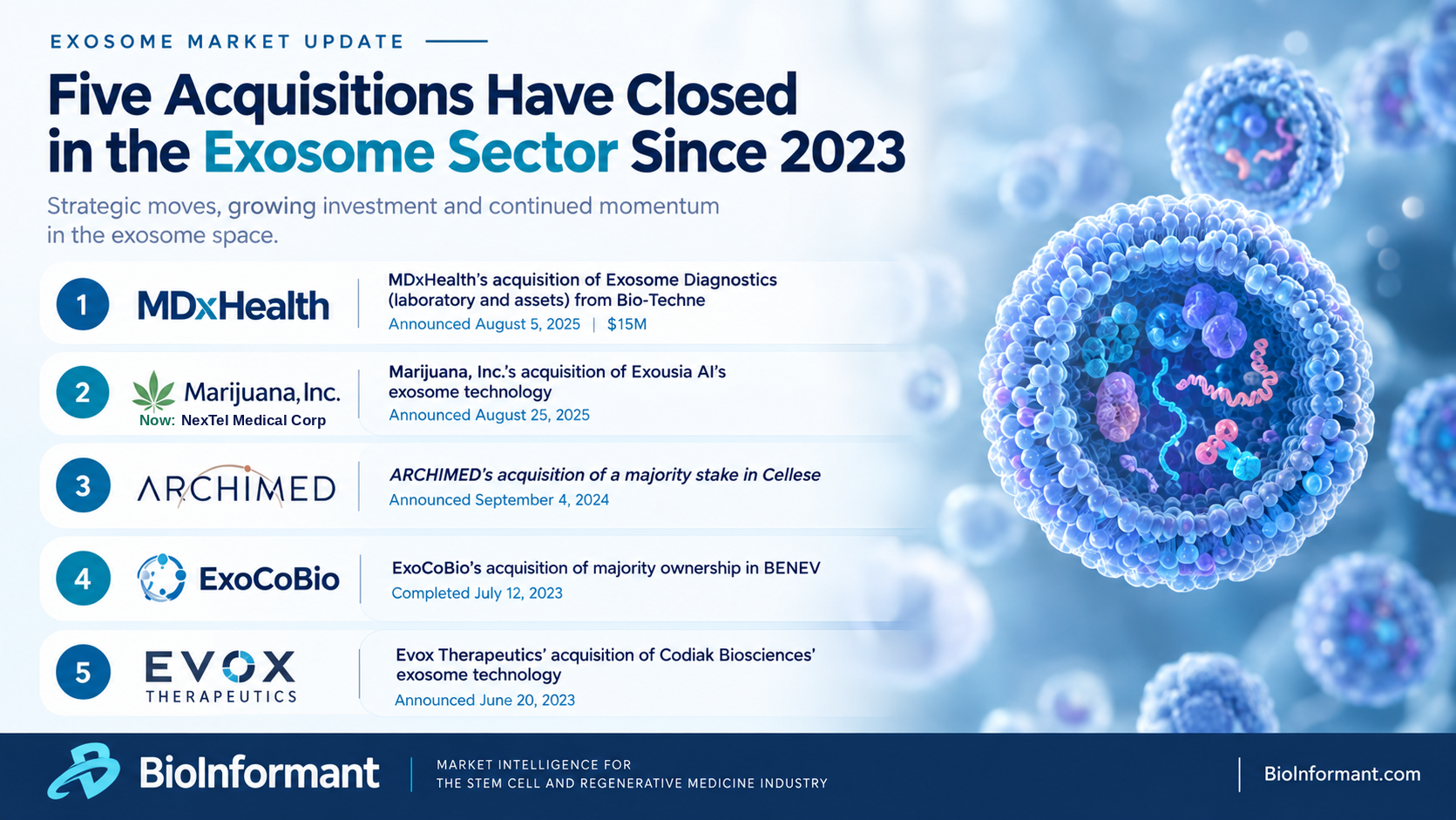
Five acquisitions have closed in the exosome sector since 2023, each aimed at securing intellectual property (IP), diagnostic assets, or manufacturing capability rather than simply buying revenue:
- MDxHealth’s acquisition of Exosome Diagnostics (laboratory and assets) from Bio-Techne, announced August 5, 2025, for $15M
- Marijuana, Inc.’s (now Nextel Medical Corp.) acquisition of Exousia AI’s exosome technology, announced August 25, 2025
- ARCHIMED’s acquisition of a majority stake in Cellese, announced September 4, 2024
- ExoCoBio’s acquisition of majority ownership in BENEV, completed July 12, 2023
- Evox Therapeutics‘ acquisition of Codiak Biosciences’ exosome technology, announced June 20, 2023
The MDxHealth deal is the most strategically significant of the five: it gave MDxHealth control of the ExoDx Prostate IntelliScore platform, one of only two CLIA-certified exosome-based diagnostic tests currently operating commercially.
Because exosome IP remains heavily fragmented across universities, biotechs, and diagnostics companies, acquirers are prioritizing targeted technology and asset purchases over full-company buyouts to work around complex, overlapping patent portfolios.
Licensing deals increasingly carry milestone structures rivaling traditional biopharma agreements.
Codiak’s exosome platform agreement included milestone payments of up to $1B, a figure that illustrates how large pharma partners are structuring deals to secure de-risked access to engineered exosome platforms before committing to costly late-stage development themselves. It was also a major first within the industry to reach a ten-figure price tag for a milestone payment.
Smaller regional deals are emerging too: Brexogen and BMI Korea entered into a $2.3M licensing agreement in February 2025 for BxC-I17e, an exosome-based injectable therapeutic, marking the first major exosome therapeutic licensing deal in Korea.
The spread between these two figures, from low seven figures to potentially ten figures in milestones, reflects how differently licensing is being valued depending on development stage, target indication, and whether a platform or a single asset is changing hands.
Unlike more mature biotech subsectors, the exosome industry has not produced a disclosed IPO to date. Capital formation instead runs almost entirely through private rounds, acquisitions, and licensing, which keeps valuation data less transparent but also means most of the industry’s foundational IP has not yet been tested by public market scrutiny. That said, the door for new entrants is not closing.
Much of the foundational patent activity from the 2010 to 2014 wave, covering basic isolation techniques and biomarker phenotyping, has already lapsed or been abandoned, broadening freedom-to-operate for companies entering the space today, particularly in diagnostics.
Exosome Global Strategic Report
BioInformant’s 385-page report tracks this financial activity in full detail, including VC funding tables, acquisition histories, and licensing deal structures from 2010 through mid-2026, alongside forecasts through 2034 across six market segments. The report profiles 135 global competitors and includes the underlying deal-by-deal data referenced above.
Most importantly, it was prepared by BioInformant’s experienced human analysts, not AI. It would not be possible without the past 20+ years of aggregating historical datasets for this industry, proprietary datasets to which AI does not have access.
This week only, you can claim BioInformant’s market report, “The Global Exosome Market – Market Size, Forecast, Trials and Trends, 2026,” for 20% off with the coupon code “EXOSOMES20”:
Tell Us What You Think!