
|
|
†Sponsored Content: The articel contains sponsored content. It is marked and identified where it appears. The rest of the article is BioInformant’s own editorial content.
How much is stem cell therapy today? According to analysis by BioInformant, the cost of stem cell therapy ranges from less than $5,000 for simple procedures to $25,000 or more for complex ones. In general, stem cell treatment procedures are paid out-of-pocket by patients, because they are not covered by medical insurance. The cost of platelet rich therapy (PRP), which can be used separately or in conjunction with stem cell therapy, is typically $500-700, but may be as high as $2,000 at some locations.
This article explores the key factors that impact the cost of stem cell therapy, including the:
- type/source of stem cells used within the protocol
- number of treatments required
- quality of the clinic
- experience of the physician
It also provides pricing quotes from stem cell clinics within the U.S. and worldwide.
In this article:
- What is the Cost of Stem Cell Therapy?
- Why Is Stem Cell Therapy So Expensive?
- Less Expensive Stem Cell Costs
- The Cost of Stem Cell Therapy in the U.S.
- Stem Cell Treatments Worldwide
- Complications Raising the Costs of Stem Cell Treatment
- Stem Cell Treatment Risks and Benefits
- Stem Cell Treatment Outcomes
- Stem Cell Therapy Procedures
- FAQs
- Sponsored Content Disclosure
Cost of Stem Cell Therapy in 2026-27: A Closer Look
Stem cell therapy is the use of living cells as therapeutics to treat disease or injury. Read on to learn about the cost requirements of these procedures.
To determine the cost of stem cell therapy, BioInformant asked people within our readership who received stem cell treatments to send us their costs of stem cell treatment. Many readers sent us their invoices for treatment (with personal details retracted). We also conducted a Twitter poll, which received hundreds of responses.
According to the poll:
- 30% of the respondents undergoing stem cell treatments spent $5,000 or less
- 20% spent $5,000 to $10,000
- 40% spent $10,000 to $25,000
- 10% spent over $25,000
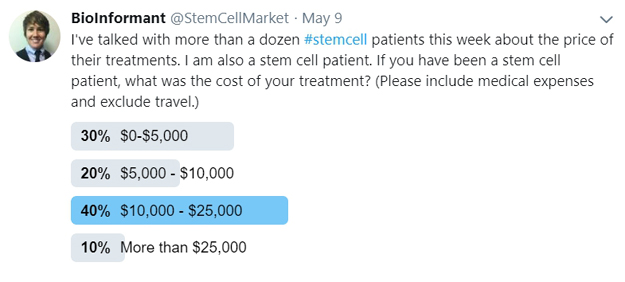
The Twitter poll reported that, on average, patients can expect to spend from under $5,000 to $25,000 or more on stem cell therapies. In general, orthopedic treatments are less expensive, while treatments for chronic and complex conditions are more expensive.
Most of those paying lower stem cell treatment costs under $5,000 were pursuing treatment for orthopedic or musculoskeletal conditions.
In contrast, most of the individuals who paid higher treatment costs were getting treated for systemic or more complex conditions, such as diabetes, multiple sclerosis (MS), neurodegenerative diseases (such as Alzheimer’s disease or dementia), psoriatic arthritis, or autism.
Stem Cell Treatment Costs
Because our Founder is a stem cell patient, we can also report these treatment costs.
Cade paid $6,500 for a stem cell treatment on one knee, which was completed at the National Spine and Pain Center in Fairfax, VA. To comply with FDA standards, the procedure was a same-day, autologous (“self-derived”), minimally manipulated procedure using bone marrow derived stem cells. The procedure was completed by Dr. Mayo Friedlis.
Likewise, CBC Canada shares that the cost of stem cell therapy is $5,000 – $8,000 per stem cell treatment for the Cell Surgical Network (CSN) following its protocol to collected fat tissue and process it before re-injecting it directly or intravenously into the same patient.
Why Is Stem Cell Therapy So Expensive?
Stem cell treatment has gained more and more traction over the last decade. New trials are being added every day for a wide range of conditions, including autism, cerebral palsy, multiple sclerosis (MS), arthritis, neuropathy, and more.
While this high volume of publications and trials are promising, R&D costs contribute to the overall cost of stem cell therapy.
For the patient, a stem cell transplant involves multiple steps, including:
- diagnosis
- isolating the adult stem cells
- re-administering the cells
- post-treatment monitoring and follow-up
There are also real costs for the doctors who provide stem cell treatments. They have overhead costs, including:
- office space
- training acquired through hands-on courses
- support personnel
- admin requirements
Furthermore, there is the time and expertise required to perform the procedure and offer post-operative care. In some cases, the physician must pay licensing fees to access stem cell sourcing, processing, or delivery technologies.
Benefits vs. Cost of Stem Cell Therapy
Providers rarely post their prices for stem cell treatments in print or digital media because they want patients to understand the benefits of therapy before making a price decision.
Additionally, the price of stem cell treatments varies by condition, the number of treatments required, and the complexity of the procedure, factors that can make it difficult for medical providers to provide cost estimates without a diagnostic visit for the patient.
However, in many cases, it is not in the patient’s best interest to make treatment decisions based on the cost of stem cell therapy.
The best way to know whether to pursue stem cell therapy is to explore patient outcomes by condition and compare the healing process to other surgical and non-surgical treatment options.
Less Expensive Stem Cell Costs
Stem cell therapy can be expensive. However, there are some types of procedures that are more affordable than others.
Cost of Platelet Rich Plasma (PRP)
First, PRP can be used alone or in conjunction with stem cell therapies at a more affordable option. What is PRP? Put simply, it is a concentration of a patient’s platelet-rich plasma protein. With this procedure, whole blood is drawn and then it is centrifuged to remove the red blood cells.
This process separates the platelet-rich plasma (PRP) within the blood from the red blood cells. The resulting concentrate is then injected back into the patient. This approach is commonly used to treat soft tissue injuries.
As mentioned above, the cost of platelet rich therapy (PRP), which can be used separately or in conjunction with stem cell therapy, usually ranges from $500-700. However, it can cost as much as $2,000 at some locations.
For the stem cell treatment that our Founder received in 2014, he had PRP injections completed prior to and post stem cell treatment. His stem cell treatment involved the collection of bone marrow stem cells from his hip and re-injection of them into his right knee. His two PRP injections were approximately $750 each.
These two PRP injections accounted for $1,500 of his costs, while his stem cell treatment accounted for approximately $5,000. In total, Cade paid $6,500 for his treatment. It was completed at the National Spine and Pain Center in Fairfax, VA, in 2014, so prices likely have risen since this time.
Stem Cells for Hair and Skin Care
†Sponsored Content: The section below contains sponsored inclusions for Calecim® and Longevity Medical Institute.
Another way to harness the power of stem cell technology at a lower cost is to use it topically. Calecim® Professional Advanced Hair System is a prime example, which utilizes a proprietary blend of growth factors, cytokines, and exosomes derived from its patented source, the umbilical cord lining. This active complex is what the brand calls PTT-6®,. Unlike other more invasive procedures, Calecim® provides an at-home solution that can be easily incorporated into daily routines.
With its cutting-edge stem cell research, Calecim® could be an alternative for those looking for a more cost-effective and time-efficient approach to hair loss management. The product’s advanced formulation delivers targeted results which are backed by substantial clinical data.
PTT-6®, the brand’s proprietary active ingredient, is not limited to just hair growth benefits. The science behind its technology is rooted in wound healing as well as anti-aging. Aesthetic practitioners were the first to discover its benefits when they used the Calecim® Professional Serum for post-procedure care. The brand’s Multi-Action Cream incorporates the same innovative stem cell technology into a daily application to address a range of skin concerns, including skin laxity, pigmentation, and texture.
Another innovative approach to hair restoration is offered through the Aesthetics and Dermatology Division at Longevity Medical Institute. The program uses the Institute’s in-house biotechnology laboratory to prepare fresh stem cells and exosomes tailored to each patient’s hair restoration protocol. In many cases, treatment can also be combined with facial rejuvenation during the same visit. Patients can observe their cells and exosomes being prepared in the laboratory, creating a uniquely transparent and personalized experience.
Stem Cells for Orthopedic Conditions
For orthopedic conditions, the cost of stem cell therapy can also be more accessible, averaging between $5,000 and $8,000 per treatment.
Examples of these types of medical conditions include:
- knee osteoarthritis
- rotator cuff tendonitis
- tennis elbow
- arthritis
- cartilage defects
Note that these prices are typically out-of-pocket costs paid by the patient because most insurance companies will not cover them. They are considered experimental and not the standard of care.
Bone Marrow Stem Cell Treatment Costs
Although fat is a frequently utilized source for stem cells, it is also possible for physicians to utilize stem cells from bone marrow. Regenexx® provides this service in the U.S. and Cayman Islands.
With the Regenexx stem cell injection procedure, a small bone marrow sample is extracted through a needle, and blood is drawn from a vein in the arm. These samples are processed in a laboratory, and the cells it contains are injected into an area of the body that needs repair.
A few years ago, ACAP Health, a national leader in employer healthcare expense reduction, partnered with Regenexx. This partnership provides a glimmer of hope that some stem cell treatments may be covered by medical insurance providers in the future.
The Cost of Stem Cell Therapy in the U.S.
In the United States, treatment protocols vary depending on the clinic and the treating physician.
- A one-time treatment that utilizes blood drawn from a patient can cost as little as $1,500.
- In contrast, protocols that utilize a bone marrow or adipose (fat) tissue extraction can run as much as $15,000 to $30,000.
This is because bone marrow extraction is an invasive procedure that requires a penetrating bone and adipose tissue extraction requires a medical professional trained in liposuction. Examples of invasive procedures include bone marrow and adipose tissue extraction.
In some cases, hospitalization may be required, which raises costs. The location of a stem cell facility can factor heavily into the cost of the procedure.
Higher Costs for Complex Diseases
For treatments that require a systemic (whole-body) approach, the cost tends to be in the higher range, often averaging $20,000 to $30,000 or more.
Examples of the diseases or conditions requiring this type of stem cell treatment include:
- Crohn’s disease
- multiple sclerosis (MS)
- neurodegenerative diseases, like Alzheimer’s disease and dementia
- psoriatic or rheumatoid arthritis
These higher costs reflect the complexity of treating these patients and the fact that multiple treatments are often required.
Complications Affecting Costs of Stem Cell Treatment
Not every cost associated with treatment gets billed to the patient at the time of the procedure. Hidden costs such as reactions to the treatment, graft-versus-host disease, or disability derived from the treatment can all result in more money to the patient, to insurance, or to the government.
The Risk of Graft-Versus-Host Disease
For example, in the case of someone with cancer, it frequently isn’t viable to harvest the patient’s own stem cells because they may contain cancerous cells that can reintroduce tumors to the body. Instead, the patient would receive stem cells by transplant.
Treatments that involve cells from another person are called “allogeneic” treatments.
The danger here is that the body may see those cells as “invaders” and attack them via the immune system, a condition known as graft-versus-host disease (GvHD). The body (“host”) and the introduced stem cells (“graft”) then battle rather than coexist.
In addition to making the stem cell treatments less effective or ineffective, GvHD can be deadly. Roughly 30 to 60% of hematopoietic stem cell and bone marrow transplantation patients suffer from it, and of those, 50 percent eventually die.
The hospital costs associated with it are substantial.
Stem Cell Treatment Risks and Benefits
As with any other area of medicine, patient evaluations of stem cell providers and treatments run the gamut from extremely satisfied to desolately unhappy.
As of now, this much is clear. There exists enough interest in America and across the world that stem cell providers are continuing to offer a wide range of treatments. Stem cell treatments may offer the potential to reverse diseases that traditionally had to be chronically managed by drugs.
Like most medical practices, stem cell treatments will require further testing to reveal merits and risks. Until then, the public will likely continue to pursue services when medical needs arise, despite potential risks.
Although the cost of stem cell therapy is pricey, some patients choose to undergo the treatment because it is more economical than enduring the costs associated with chronic diseases.
Safety of Stem Cell Treatments
†Sponsored Content: The section below includes a sponsored inclusion from Longevity Medical Institute.
Because there has been a rapid rise in the number of medical providers who are offering stem cell treatments in recent years, the safety and quality of stem cell procedures can vary dramatically.
The FDA has repeated warned that patients may be vulnerable to stem cell treatments that are illegal and potentially harmful or ineffective. The agency has also sent out dozens of warning letters to providers of stem cell products.
In December 2019, the FDA warned Liveyon Labs Inc. and Liveyon LLC that their stem cell products “lack required FDA approval and represent a potential risk to the public health.” A month earlier in November 2019, the FDA sent letters to RichSource Stem Cells, Inc., and Chara Biologics, Inc., for offering unapproved stem cell products to patients.
The agency has also sent at least 20 letters to manufacturers and health care providers noting that they may be offering unapproved stem cell products.
However, these warnings should be distinguished from the broader clinical evidence concerning properly manufactured and medically administered mesenchymal stromal cells. When MSC therapies are produced under appropriate laboratory standards, carefully tested, and administered under qualified physician supervision, the research supports a favorable safety profile.
Longevity Medical Institute® recently published a systematic review of stem cell safety based on landmark human clinical trials. The peer-reviewed study evaluated more than 15 years of published clinical evidence, including over 60 clinical studies and approximately 4,000 patients across multiple medical conditions and methods of administration. It found no consistent increase in serious treatment-related complications, including infection, blood clots, organ toxicity, malignancy, or death. Temporary fever was the most consistently reported treatment-associated reaction.
Stem Cell Treatments Worldwide
Because of tight regulations surrounding stem cell procedures performed in the United States, many stem cell treatment providers provide both on-shore (U.S.-based) and offshore (international) treatment options.
Depending on where a treatment is received, patients may have to pay travel, lodging, dining and other expenditures. Because these treatments are completed overseas, they are not covered by medical insurance.
Below, six options for providers of stem cell treatments are described, including:
- Longevity Medical Institute in Mexico
- Rejuvstem
- Stem Cell Institute in Panama
- Regenexx in Cayman Islands
- DVC Stem in Grand Cayman
- Okyanos in Grand Bahamas
1. Longevity Medical Institute in Mexico
†Sponsored Content: The section is a sponsored inclusion.
Longevity Medical Institute® is a 15,000 sq. ft. medical facility offering one of the world’s most comprehensive and clinically integrated platforms for stem cell therapies, regenerative medicine, and longevity therapies.
Its coordinated ecosystem brings together 17 physicians, clinical chemists, biomedical scientists, and medical specialists working under one roof.
The Institute combines physician-led therapies using MSCs from five distinct tissue sources, exosomes, and NK cells produced in its in-house biotechnology laboratory with advanced diagnostics, an on-site clinical laboratory measuring more than 140 biomarkers and health metrics, cardiovascular assessments, AI-enhanced full-body MRI, surgery, rehabilitation, specialist medicine, clinical research, luxury accommodations, and concierge patient services.
2. Rejuvstem
†Sponsored Content: The section is a sponsored inclusion.
Unlike conventional stem cell clinics, RejuvStem combines its patented protocols, rigorously sourced, high-purity mesenchymal stem cells (MSCs) and Dezawa MuseCells® for a range of regenerative applications. Their expert medical team can evaluate whether MUSE cell therapy or premium MSC treatment is the appropriate protocol for your specific condition.
Located in Cancún, Mexico, RejuvStem Clinic serves patients from the United States, Canada, and throughout the world. Contactt them today or request a free consultation.
3. Stem Cell Institute in Panama
Founded by Dr. Neil Riordan, the Stem Cell Institute in Panama is one of the world’s most trusted stem cell therapy centers. Over the past 12 years, the center has performed more than 10,000 procedures, making it a widely recognized destination for stem cell treatments.
Working in collaboration with universities and physicians worldwide, its stem cell treatment protocols utilize allogeneic human umbilical cord blood stem cells and autologous bone marrow stem cells.
On average, stem cell treatments at the Stem Cell Institute in Panama are estimated to range from $10,000 to $30,000.
To provide a specific example, a reader of BioInformant’s was treated for psoriatic arthritis at the Stem Cell Institute in Panama in early 2018.
The price of his stem cell treatment was $22,000. With travel and lodging included, total expenses were approximately $30,000.
4. Regenexx in Cayman Islands
Founded by Dr. Chris Centeno, Regenexx is one of the oldest and most trusted providers of stem cell treatments.
Headquartered in Denver, CO, the company specializes in providing innovative, non-surgical treatments for treating orthopedic injuries. The company pioneered a procedure that involves extracting a small bone marrow sample through a needle and a blood draw from a vein in your arm.
These samples are then processed in a laboratory and the resulting cells are injected into the area needing repair, with the goal of delivering large numbers of stem cells to the injured area.
In addition to offers treatments at a wide range of U.S. facilities, Regenexx offers a laboratory-expanded treatment option at its clinical site in the Cayman Islands. Using this approach, a patient can receive a higher cell dose, due to the expansion of their stem cells within a laboratory prior to treatment.
5. DVC Stem in Grand Cayman
Another company offering stem cell treatments in the Cayman Islands is DVC Stem.
For over a decade, its physicians have been using alternative therapies to clinically treat patients with various medical conditions. Based in the Caribbean, it uses IRB-approved protocols, a licensed staff, and a facility that is accredited by the medical governing bodies of the Cayman Islands.
DVC Stem sources its cells from its partner lab Vitro Biopharma Inc, a US-based, FDA registered, cGMP compliant and ISO 9001 certified laboratory, and only use American Association of Tissue Bank (AATB) certified suppliers of full-term, ethically U.S.-donated human umbilical cords.
Led by Medical Director Louis A. Cona, MD, DVC Stem’s focus is on cord-tissue derived allogeneic stem cell therapy for:
- degenerative conditions
- wear and tear
- intelligent aging
6. Okyanos in Grand Bahamas
Similarly, Okyanos offers treatments to patients at its site in Grand Bahama. It was founded in 2011 and is a stem cell therapy provider specializing in treatments for congestive heart failure (CHF) and other chronic conditions.
It is licensed under the Bahamas Stem Cell Therapy and Research Act and adheres to U.S. surgical center standards.
Stem Cell Therapy Procedures
The cost of stem cell therapy is indeed expensive, especially because the procedures are rarely covered by health insurance. However, with the right knowledge and a clear understanding of the treatment process, the risk of undergoing stem cell therapy can be worth it, especially if it removes the requirement for a lifetime of prescription medication.
Although stem cell therapy has associated risks, it has improved thousands of lives and will continue to play in a key role in the future of modern medicine.
Download this infographic for your reference: 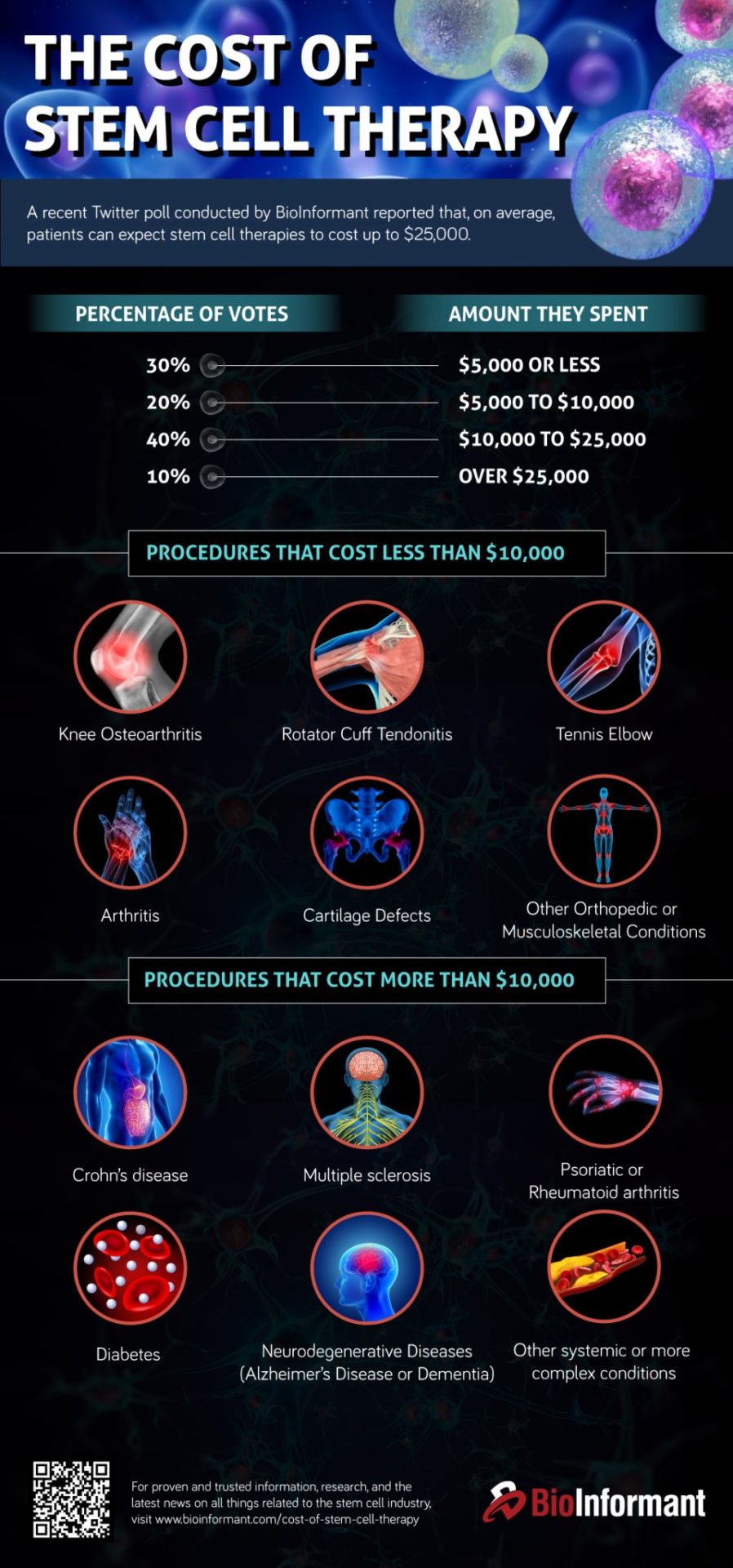
Seeking advanced stem cell treatment?
— Advertisement —
RejuvStem, a premier regenerative medicine center uniquely offers proprietary Dezawa MuseCells® and Dezawa MuseExosomes®.
Unlike conventional stem cell clinics, RejuvStem combines its patented protocols, rigorously sourced, high-purity mesenchymal stem cells (MSCs) and Dezawa MuseCells® for a range of regenerative applications. Their medical team can evaluate whether MUSE cell therapy or premium MSC treatment is the appropriate protocol for your specific condition.

Located in Cancún, Mexico, RejuvStem Clinic serves patients from the United States, Canada, and throughout the world. Contact them today or request a free consultation.
FAQs
What is the average cost of stem cell therapy?
The average cost of stem cell therapy ranges from under $5,000 to over $25,000, depending the type and sources of the stem cells, the patient’s medical condition, and the number of treatments required.
Is stem cell therapy covered by health insurance?
No, other than the use of hematopoietic stem cell transplantation (HSCT) to treat cancer, most stem cell therapies are not covered by health insurance. They are considered to be experimental.
Is stem cell therapy safe?
The safety of a stem cell therapy can vary dramatically, depending on the cell type, route of administration, and patient condition. The FDA has repeatedly warned that patients may be vulnerable to stem cell treatments that are illegal and potentially harmful.
Does stem cell therapy really work?
Stem cells have been used since 1956, when the first successful bone marrow transplantation was completed. Many clinical trials are being conducted to explore the effectiveness of stem cell therapies, with varying results.
How long do stem cell injections last?
How long stem cell injections last can vary, but some patients may receive relief for five years or longer. Cade Hildreth, BioInformant’s Founder, had stem cell injections in 2014 that are still providing relief.
What can stem cell therapy treat?
Hematopoietic stem cell transplantation (HSCT) has been used in the treatment of cancer since the 1950’s. Evidence suggests stem cell therapy may be effective for treating several types of orthopedic conditions. Its use in other applications is being studied in clinical trials, but is largely unconfirmed.
Can stem cells help arthritis?
There is a growing body of evidence to suggest that some types of stem cells, such as mesenchymal stem cells (MSCs), may be effective in the treatment of arthritis.
Can stem cells regrow hair?
In a study published June 2017, Italian researchers documented a 29% increase in hair density after stem cell therapy. Replicel is also developing an autologous cell therapy to treat male pattern baldness.
Is stem cell therapy painful?
Some types of stem cell therapy are painful, while others are not. Collecting stem cells from bone marrow can be a painful procedure, as can some types of stem cell injections. Intravenous (IV) administration of stem cells is usually painless.
If you found this blog valuable, subscribe to BioInformant’s stem cell industry updates.
†SPONSORED CONTENT DISCLOSURE: Sections/descriptions about Calecim, Rejuvstem, and Longevity Medical Institute in the article above are sponsored content provided by the respective companies.
*DISCLAIMER: The information provided on this website is for educational and informational purposes only and is not intended as medical advice. Statements made here are not meant to diagnose, treat, cure, or prevent any disease or condition. Always consult a qualified healthcare professional regarding any questions or concerns you may have about your health.
Concerns, feedback, or suggested edits to this article may be submitted to [email protected]. We are always happy to make edits for purposes of accuracy and compliance.
How do you know if a stem cell clinic is legitimate?
Yes I would love the answer to this!
I’m a veteran with COPD.
I’ve had stem cell treatment.
Once ur lungs is damaged they are not repairable any any way.
Any lung doctor like mine will tell u that
Last year I was offered a treatment for $3,500
I paid $8,000 for a treatment at the same place.
COPD vet, did it help you don’t say?
I guess this treatment is no good with someone with COPD
Do you do stem cell therspy for vitigo?
I received stem cell procedures to my right shoulder & both knees over a year ago. Amazing results. I was actually collapsing with terrific pain in my right knee, my right shoulder was frozen and painful. Amazing results. Procedure performed in Pensacola, Fl.
Lovely Doctors. Great results! Affordable. My husband has been diagnosed with Parkinson’s, much more involved. We are searching for the best facility for his procedure. Any suggestions? We live in Foley, AL.
You did not say the price. Where did you go for this? Regenexx?
Wow Don you seem to have a bad experience. I have been using Stem Cells from Cord blood for 4 years now and have nothing but excellent results. All done in the United States of America. FDA approval does not mean that you can not prescribe a medicine or treatment. There are hundreds of treatments that are considered off book uses for drugs and other treatments. It was only in the last two years that the FDA reclassified certain stem cell therapies as a “Drug” vs a biologic.
I am on the fence about getting stem cells, I have been in decompression therapy for 3 months along with chiropractic adjustments and PRP 3 times. Both knees and lower back, I do have improvements, but not nearly normal. They are strongly suggesting cord stem cells, I would love to know what your treating and how much improvement you have had.
‘all of them have been shown to have no functional stem cells…so….fraudulent.’
As a potential stem cell therapy patient, I feel the statement by Don Burford needs citation confirmation or it should be withdrawn
Basically, he is saying that all Allogenic stem cell treatment is fraudulent because there are no functional stem cells.
What sort of scientist makes that kind of statement without sharing supporting data?
Great write up man. Did the stem cells help you out?