 October 17th, 2017 – Plasticell, the biotechnology company specialising in stem cell screening and cell therapy development, has entered into a collaboration with GSK to use its combinatorial stem cell screening technology, CombiCult®, to optimise the directed differentiation of induced pluripotent stem cells (iPSCs) to specific blood cell lineages for use by GSK in its therapeutic research. [Read more…]
Technology Licensed by Axolotl Biologix Awarded NIH Grant for R&D of Bioengineered Wound-healing Solution for Diabetes Patients

Research to focus on the development of membrane dressing to accelerate wound closure and improve scar tissue strength and flexibility
(PHOENIX) – Phoenix-based biotechnology company Axolotl Biologix, an innovator in regenerative medicine technologies, announced that technology it has exclusively licensed has been awarded a $224,500 grant funded by the National Institutes of Health (NIH) for the research and development of a wound-healing device for chronic wounds in patients suffering from diabetic foot ulcers. [Read more…]
Opportunities and Threats within the Global Cord Blood Banking Market

Over the past five years, the global cord blood banking market has substantially matured and consolidated. This has created both serious threats and novel opportunities for the industry. Serious threats to the industry include low rates of utilization for stored cord blood, expensive cord blood transplantation procedures, difficulty educating obstetricians about cellular therapies, and an increasing trend toward industry consolidation.
Marketing pressures are also impacting the industry, with the term “cord blood” being one of the 20 most expensive search terms on Google. Winning online traffic through Google AdWords for the search phrase “Cord Blood” now costs $45.87 in the U.S. When all locations are allowed, the cost for acquiring online traffic through Google AdWords for the phrase “Cord Blood” is $32.91. [Read more…]
Global Forces within the Cord Blood Banking Industry

Today, cord blood banks exist in every developed country, as well as within most developing nations. With approximately 450 companies marketing cord blood banking services worldwide, maturation of the market means that each company is fighting harder for market share. While the U.S. cord blood banking industry is the most mature cord blood banking market in the world, Asia is extremely close behind and growing more quickly than the U.S. market.
In 2016, Sanpower Group and its subsidiary Nanjing Cenbest announced the acquisition of China Cord Blood Corporation (NYSE:CO) and Shandong Cord Blood Bank, positioning it to hold four licenses out of the only seven issued provincial-level cord blood bank licenses in China. According to the company, Sanpower Group has “reserved 800,000 cord blood samples at home, and the associated reserves nearly amount to 1,100,000 when counting in the Cordlife reserves across various Southeast Asian countries and regions.”[1]
This positions Sanpower Group and its subsidiary Nanjing Cenbest as the world’s largest cord blood banking operator not only in China and Southeast Asia, but in the world.
Currently, the largest cord blood bank in the United States, Cord Blood Registry, reports to have nearly 700,000 cord blood and tissue units in storage, positioning it substantially behind Sanpower Group. Within China, Sanpower Group reports to control approximately 800,000 cord blood samples. Therefore, Sanpower Group leads CBR by 100,000 units, or 14.2% (800,000 / 700,000 = 1.142), respectively. With CBR controlling more than 50% of the market share in the U.S. and Sanpower Group controlling more than 50% of the market share in China, these two entities are the largest cord blood operators in the world. [Read more…]
Pluristem Lands $27 Million in Non-Dilutive Funding for its Advanced-Stage Cell Therapies
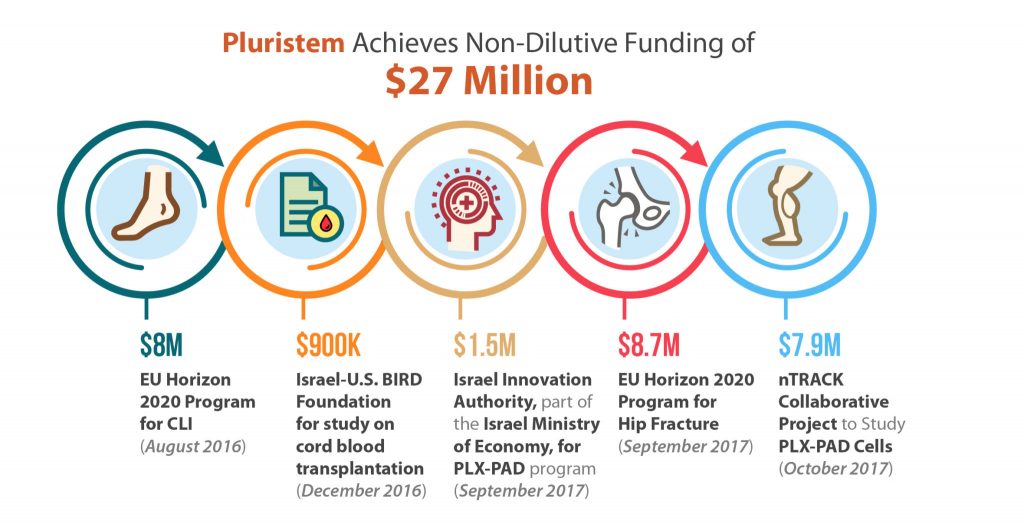
Non-dilutive funding, in substantial amounts, is something nearly all biotechnology companies want, and few get. Although small grants from various government agencies like the NIH are helpful, and are available to a larger number of biotechs, Pluristem Therapeutics (Nasdaq:PSTI) has accomplished something quite unique in the last year as the recipient, of three awards totaling nearly $25 million from the European Union’s Horizon 2020 program as well as $2.4 million in smaller grants from Israel. A majority of these funds are aimed at bringing Pluristem’s Phase III assets to market and to better predict outcomes of cell therapy treatments.
Pluristem’s lead asset, its PLX-PAD cell therapy, is currently in a multinational pivotal Phase III study for the treatment of critical limb ischemia (CLI) in 250 patients with CLI Rutherford Category 5 who are unsuitable for revascularization. These patients have very few remaining treatments options and will most likely be headed for amputation. Cell therapy may be the answer. The U.S. FDA has given Pluristem Fast Track Designation in this indication, while the European Medicines Agency (EMA) has selected the PLX-PAD program in CLI for its Adaptive Pathways project, the goal of which is to shorten time to market for innovative medicines. Europe gave the PLX-PAD program in CLI one more boost with the award of $8 million last August from the EU’s Horizon 2020 program, Europe’s largest research and innovation program. Clearly, the Europeans are eager for a novel cell therapy to treat CLI and they are banking on Pluristem to bring it to market quickly. [Read more…]
- « Previous Page
- 1
- …
- 255
- 256
- 257
- 258
- 259
- …
- 338
- Next Page »