In the evolving landscape of biomedical innovation, exosomes have emerged as one of the most promising tools for next-generation therapies. These nanoscale, membrane-bound vesicles, naturally secreted by cells, play a critical role in intercellular communication. Because of their inherent ability to shuttle biomolecules like RNA, proteins, and lipids between cells, exosomes have captivated the attention of researchers and biotech companies for their vast potential in therapeutic applications. [Read more…]
How Human iPSCs are Revolutionizing Drug Discovery in 2027
Drug discovery involves high cost and uncertain outcomes. Only a few companies can take the risk of investing enormous amounts of money into research and testing, only to see undesirable side effects emerge during the final human clinical trials. In many cases, companies are spending millions of dollars to fail during clinical testing.
Thankfully, some new medicines are now being tested for safety on specialized cells developed from human pluripotent cell lines. Cell types which are increasingly being used within drug discovery applications include heart (cardiomyocytes) and liver cells (hepatocytes), which are the organs where 80% of drug failures occur. [Read more…]
Cellares and Seoul National University Hospital Launch Proof-of-Concept for Automated Manufacturing of Gene-Modified HSPC Therapy on the Cell Shuttle® Platform
Collaboration applies Cellares’ gene-modified HSC manufacturing expertise to SNUH’s PNH program, marking Cellares’ second collaboration in Asia and supporting future U.S. clinical development
NEWS PROVIDED BY Cellares, Sept 23, 2026, 09:010 ET
SOUTH SAN FRANCISCO, Calif. — Cellares, the first Integrated Development and Manufacturing Organization (IDMO), and Seoul National University Hospital (SNUH), a leading translational medical center in South Korea, today announced a partnership to evaluate automated manufacturing for a gene-modified hematopoietic stem and progenitor cell (HSPC) therapy targeting paroxysmal nocturnal hemoglobinuria (PNH) on Cellares’ Cell Shuttle platform.
The collaboration will evaluate the translation of SNUH’s gene-modified HSPC manufacturing process to the Cell Shuttle, with a focus on supporting a two-step transfection workflow, through the use of Cellares fully integrated and single-use electroporation module. The partnership marks Cellares’ second collaboration in Asia and expands the company’s collaboration network in the Asia-Pacific region as it supports SNUH’s program toward clinical development in the United States.
SNUH is an elite translational medical center that collaborates with leading global institutions on gene-modified hematopoietic stem cell therapies. Through the partnership, Cellares will support preclinical development and IND-enabling manufacturing workflows for SNUH’s PNH program, with the goal of establishing a scalable manufacturing strategy for future U.S. clinical development.
“Advancing gene-modified HSPC therapies requires a manufacturing approach that can support both the complexity of the process and the rigor of clinical translation,” said Professor Youngil Koh, Director of the SNUH GMP Facility. “By working with Cellares, we are evaluating how automation can strengthen manufacturing reliability and scalability as we advance this program toward clinical development.”
“Gene-modified HSPC therapies are a natural fit for the Cell Shuttle and an area where Cellares has established manufacturing expertise,” said Fabian Gerlinghaus, Co-Founder and CEO of Cellares. “By automating complex workflows, including electroporation, we can deliver the scalability, reliability and manufacturing economics required to advance these therapies through clinical development. This partnership extends that capability to SNUH as it prepares its PNH program for future clinical development in the United States.”
Gene-modified HSC manufacturing remains labor-intensive, variable and difficult to scale, limiting clinical development, increasing manufacturing costs and constraining patient access. The Cell Shuttle is an end-to-end automated cell therapy manufacturing platform designed to improve the scalability and reliability of autologous cell therapy manufacturing.
The proof-of-concept will assess the potential to automate SNUH’s manufacturing process on the Cell Shuttle, with the goal of improving reliability, driving down manufacturing costs and supporting broader patient access as the program advances.
About Cellares
Cellares is the first Integrated Development and Manufacturing Organization (IDMO), providing global cell therapy development and manufacturing services through an Industry 4.0 approach to the mass manufacture of the living drugs of the 21st century. The company enables drug sponsors to develop, scale, and commercialize cell therapies with the capacity, reliability, and economics required to meet total patient demand.
Cellares’ fully automated platforms — Cell Shuttle® for end-to-end cell therapy manufacturing and Cell Q™ for automated in-process and release quality control — are deployed across its network of IDMO Smart Factories worldwide. These technologies deliver industry-leading manufacturing economics, higher process success rates, and the ability to produce up to 10× more cell therapy batches than conventional CDMOs with comparable footprint and headcount, resulting in the lowest cost of manufacturing in the industry.
The Cell Shuttle is the first cell therapy manufacturing platform to receive the FDA’s Advanced Manufacturing Technology (AMT) designation, and has demonstrated a 100% automation success rate across more than a dozen automated processes. Cellares was also accepted into the FDA’s inaugural Manufacturing PreCheck cohort, the only cell therapy platform among seven companies nationwide, giving Cellares early and ongoing engagement with the FDA during facility development and application submission periods, compressing regulatory timelines and de-risking the path to commercial-scale production for the drug sponsors building on Cellares’ platform.
Cellares has achieved key clinical validation milestones, including a successful IND Amendment enabling active clinical manufacturing on the Cell Shuttle platform, and the successful dosing of first patients in a partner clinical trial — marking the platform’s transition from development-stage technology to clinically validated manufacturing infrastructure. These milestones span multiple therapeutic areas and cell therapy modalities, including both oncology and autoimmune indications.
Headquartered in South San Francisco, California, Cellares operates its first commercial-scale IDMO Smart Factory in Bridgewater, New Jersey, with additional facilities under construction in Europe and Japan. Through its global manufacturing network, Cellares is purpose-built to support both clinical and commercial programs and to expand access to life-saving cell therapies worldwide.
About Seoul National University Hospital
Seoul National University Hospital (SNUH) is a medical center in South Korea dedicated to advancing patient care through the integration of education, research and clinical practice. SNUH works to advance state-of-the-art medical care and expand knowledge through medical research, while fostering the next generation of global healthcare leaders. As a translational medical center, SNUH also collaborates with leading institutions worldwide on the development of innovative therapies, including gene-modified hematopoietic stem cell-based treatments. Its institutional mission emphasizes excellence across medical care, research and education.
Source: Cellares
Related BioInformant Product: Global Database of Cell and Gene Therapy CDMOs, 2026-27 + 7-Page Companion Industry Brief
A Complete List of All Publicly Announced RMAT Designations (173)
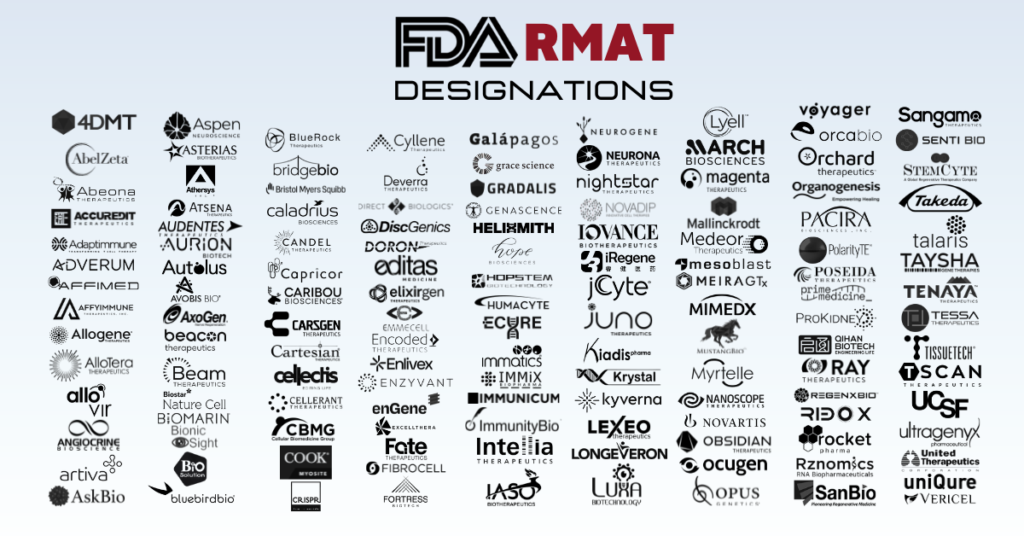
To date, what number of U.S. FDA-approved RMATs have been issued and to whom have they been awarded?
The answer is that 173 RMAT (Regenerative Medicine Advanced Therapy) designations have been publicly announced by biotech and pharma companies. However, the FDA states it has received 388 requests and issued 193, which means that a handful are not yet public knowledge. Therefore, a few companies are operating in stealth mode with regard to their RMAT designations and approximately half of RMAT applications get approved (193 approvals / 388 applications = 49.7%).
Induced Pluripotent Stem Cell (iPS Cell) Applications in 2026

Since the discovery of induced pluripotent stem cells (iPSCs) in 2006, a large and thriving research products market has emerged, largely because the cells are non-controversial and can be generated directly from adult cells. It is clear that iPSCs represent a lucrative market segment, because methods for commercializing this cell type are expanding every year and clinical studies investigating iPSCs are swelling in number. [Read more…]