|
|
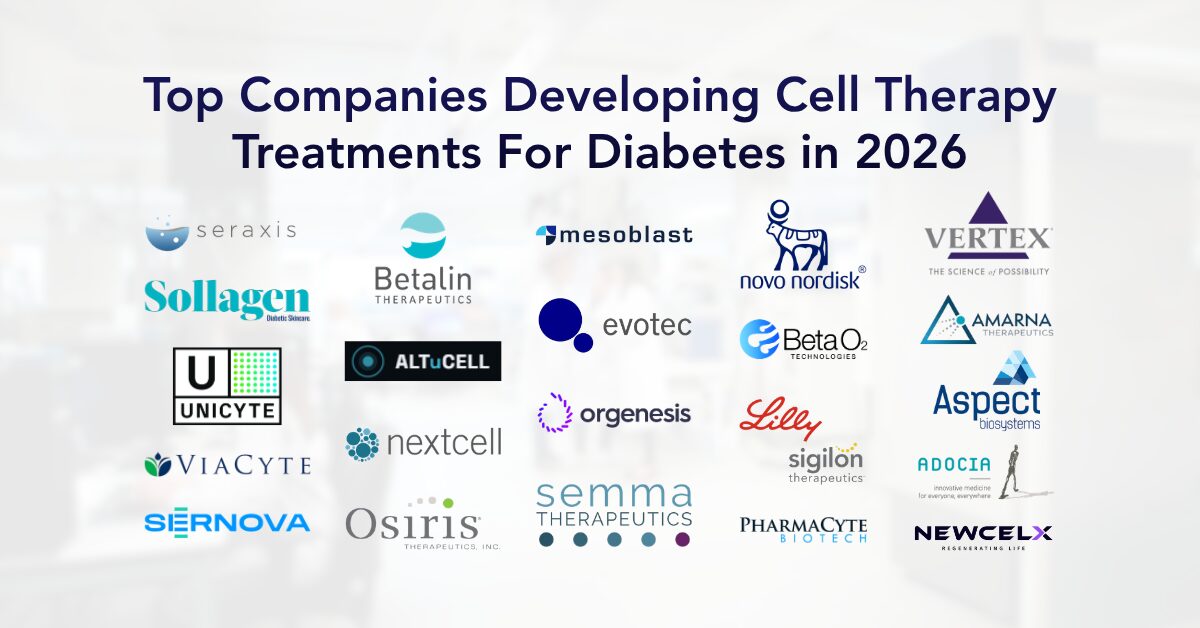
Below is a list of the top companies exploring cell therapy treatments for diabetes.

In this article:
- Companies Exploring Stem Cell Treatment for Diabetes
- Seraxis | Cell Replacement Therapy for Type 1 Diabetes
- Sollagen | Diabetic Ulcers and Chronic Wounds
- Unicyte AG | Diabetes Cell Therapy
- ViaCyte | Insulin for Diabetes
- Sernova | Stem Cell for Diabetes Treatment
- Betalin Therapeutics | Insulin Production
- AltuCell | Stem Cell Therapy for Diabetes Type 2
- NextCell Pharma AB | Stem Cell Therapy for Diabetes Type 1
- Osiris Therapeutics | Type 1 Diabetes Control
- Mesoblast | Type 2 Diabetes Treatment
- Evotec and Sanofi | Stem Cell for Diabetes
- Orgenesis | Insulin-Producing Cells
- Semma Therapeutics | Type 1 Diabetes Therapy
- Novo Nordisk | Treatment of Type 1 Diabetes
- Beta-O2 | Artificial Pancreas for Diabetes
- Eli Lilly and Sigilon | Stem Cell for Diabetes
- Pharmacyte Biotech | Encapsulated Human Cells
- Vertex Pharmaceuticals | Stem Cell-Derived Insulin-Producing Cell Therapy
- Amarna Therapeutics | Investigational Gene Therapy
- Aspect Biosystems & Novo Nordisk| Implantable Bioprinted Tissues
- Adocia | doShell® Islets for Type 1 Diabetes
- NewcelX Ltd. | Stem Cell-Derived Islet Replacement for Type 1 Diabetes
Stem Cells for Diabetes Treatment
With an aging population, surging rates of obesity, and the incidence of diabetes on the rise, these companies are exploring the use of stem cells and cell therapies for diabetes treatment.
According to the Center for Disease Control (CDC), 29.1 million people or 9.3% of the U.S. population has diabetes, including an estimated 8.1 million who are undiagnosed. According to the American Diabetes Association, the annual cost of this disease in the U.S. is “$245 billion per annum or approximately $500,000 every minute.”
Fortunately, companies and institutions worldwide are making progress with stem cell for diabetes treatment. In a historic achievement, the Diabetes Research Institute a Center of Excellence at the University of Miami Miller School of Medicine announced the first diabetic patient in its clinical trial had stopped insulin therapy after the implantation of islet cells within a biological scaffold. Other innovative approaches to the treatment of diabetes are explored below.
Given the growing promise of regenerative medicine, the following companies are exploring the use of stem cells for diabetes.
1. Seraxis | Cell Replacement Therapy for Type 1 Diabetes
Seraxis Inc. is a privately owned biotechnology company with GMP labs located in Germantown, Maryland. Seraxis is developing a cell replacement therapy for insulin-dependent diabetes, called SR-01. Seraxis developed a proprietary induced pluripotent stem cells (iPSC) line that is specifically tailored to produce pure, fully mature lab-grown islets that respond to glucose and secrete insulin like a native islet.
In addition, Seraxis has developed SeraGraft, a device for the encapsulation of the cells and their implant. The biocompatible retrievable macro- device has been shown to be safe and to prevent the destruction of the insulin-producing cells by the host immune system.
2. Sollagen | Diabetic Ulcers and Chronic Wounds
Sollagen has established itself as a market leader in addressing the complications associated with diabetes, particularly diabetic foot ulcers (DFU) and other chronic wounds. Its main active ingredient, PTT-6®, is a proprietary blend of over 3,000 proteins, growth factors, and cytokines that enhance cellular repair and regeneration. PTT-6® is derived from the umbilical cord lining membrane, which was discovered to be a rich source of epithelial and MSCs. Researchers at CellResearch Corporation isolated these stem cells in 2004, leading to the development of PTT-6®.
PTT-6® helps stimulate the production of collagen, elastin, and hyaluronic acid, which are essential for skin regeneration and wound healing. By accelerating cell turnover and reducing inflammation, Sollagen supports wound healing in diabetic patients, preventing further complications and improving skin health.
The efficacy of Sollagen has been demonstrated in various clinical trials, where it showed significant results in reducing wound size and promoting full closure in hard-to-heal diabetic wounds. In clinical studies, over 70% of patients experienced a 75% reduction in wound size within six weeks, with some achieving complete wound closure within 8 to 16 weeks. Beyond diabetic foot ulcers, Sollagen has also been proven effective in treating venous and arterial leg ulcers, pressure injuries, and even eczema, making it a versatile solution for a range of skin conditions related to diabetes.
The Sollagen products are available here.
3. Unicyte AG | Diabetes Cell Therapy
Unicyte has established a collaboration with Prof. Giovanni Camussi from Molecular Biotechnology Center (MBC) at the University of Turin. Through this alliance, Unicyte has developed three proprietary technology platforms:
- human liver stem cells (HLSCs)
- HLSC-derived functional pancreatic islets
- nano-extracellular vesicles
As stated by Unicyte, “Prof Giovanni Camussi recently discovered that Human Liver Stem Cells (HLSCs) are able to undergo differentiation into insulin-secreting cells. Moreover, HLSCs have been shown to aggregate and form three dimensional spherical structures resembling natural islets. HLSC-Islets secrete insulin and are positive for various hormones including glucagon, ghrelin, and somatostatin. When injected into animal models of Type 1 diabetes, these islet-like structures are fully functional and restore glycemic control.”
4. ViaCyte | Insulin for Diabetes
In February 2016, San Diego-based ViaCyte acquired an exclusive license to “BetaLogics intellectual property in the field of metabolic disease, including diabetes, and the transfer of related assets to ViaCyte.” The news positioned ViaCyte as a leader in stem cell therapeutics for the treatment of Types 1 and 2 diabetes.
According to Dr. Paul Laikind, ViaCyte’s President and CEO, “For more than a decade, BetaLogics and ViaCyte have been independently working toward a stem cell-derived therapy for diabetes. By combining the intellectual property and other assets of BetaLogics with ViaCyte, we will further strengthen our advanced program focused on insulin-dependent diabetes and solidify our leadership in the field.”
According to ViaCyte, it differentiates stem cells into pancreatic beta cell precursors (PEC-01™) and subcutaneously implants them into patients using a retrievable medical device (an Encaptra® cell delivery system), allowing the implanted precursor cells to mature into endocrine cells that can secrete insulin and other hormones in a controlled manner to support healthy blood glucose levels.
5. Sernova | Stem Cell for Diabetes Treatment
In September 2015, Sernova Corporation secured exclusive worldwide rights to patent-pending technologies developed by researchers at the University Health Network (UHN) in Canada, with the license giving them the capacity to turn stem cells into glucose-responsive therapeutic cells for use in the treatment of insulin-dependent diabetes.
According to Sernova’s CEO, “This agreement provides us with a proprietary source of stem cell-derived glucose responsive therapeutic cells. When placed within Sernova’s pre-vascularized Cell Pouch(TM), and protected locally from immune system attack, we believe that Sernova has the potential to provide a significant breakthrough in the quality of treatment for the millions of people suffering from insulin-dependent diabetes.”
In January 2016, Sernova then announced a service agreement with the Centre for Commercialization of Regenerative Medicine (CCRM) to “establish, optimize and validate Sernova’s licensed technology for creating stem cell-derived therapeutic cells that produce insulin and are glucose responsive.”
6. Betalin Therapeutics | Insulin Production
Betalin Therapeutics, Ltd., based in Ramat Gan, Israel, is led by Mr. Jacob Ben-Arie (CEO). The company is developing the engineered micro pancreas (EMP), a breakthrough technology that will enable it to implant pancreatic stem cells, which include insulin-producing cells, to restore the body’s intrinsic insulin generation capabilities. This miniature pancreas is implanted in the patient’s body under the skin using a local anesthesia with a minimal risk to the patient and costs of the procedure.
Betalin has acquired technology that is based on the premise that, in order for beta cells to function properly, it is necessary to provide an appropriate stromal (connective tissue) microenvironment. In its first phase, Betalin will use the platform technology to create engineered micro pancreata (EMPs) composed of naked islets (Io) and micro-scaffolds. Instead of using naked islets, EMPs will be used in islet transplantation therapy to provide significant levels of glucose-regulated insulin secretion over extended periods of time.
7. AltuCell | Stem Cell Therapy for Diabetes Type 2
A small but powerful company working in this area is AltuCell, a company whose mission is to find a cure for insulin-dependent diabetes. Led by CEO Gary Harlem, AltuCell is a private pharmaceutical company with a world-renowned medical team spread across the U.S. and Europe. In a recent peer-review article published in the journal Xenotransplantation on September 27, 2016, AltuCell’s medical lead, Dr. Giovanni Luca, announced:
“In this study, the Calafiore group has transplanted microencapsulated porcine Sertoli cells into the subcutaneous fat of 30 type 2 diabetic-prone obese mice (db/db) after they had become frankly diabetic. Remarkably, 60% of the treated mice (18 out of the 30) had their glucose control restored and demonstrated normal glucose tolerance tests. The remaining 40% “failures” all showed improvements as assessed by reduced HbA1c levels. Control mice remained diabetic.” AltuCell’s preclinical breakthrough utilizing microencapsulated Sertoli cells to establish reversal of diabetes in a murine (mouse) mode is further highlighted in the article “Altucell Releases Evidence in Support of Microencapsulated Sertoli Cells for Reversal of Diabetes.”
8. NextCell Pharma AB | Stem Cell Therapy for Diabetes Type 1
In July 2017, Stockholm-based NextCell Pharma submitted an application to the Medical Products Agency for a clinical trial in autoimmune diabetes with its stem cell product ProTrans™. Protrans™ is composed of stem cells derived from the umbilical cord tissue and intended for use in the treatment of inflammatory and autoimmune diseases.
More recently, NextCell Pharma AB announced on September 5, 2017, that its clinical trial application for ProTrans™ had been granted by the Ethics Committee. The clinical trial is designed to evaluate the safety of ProTrans™, as well as its ability to positively affect endogenous insulin production in adult Type 1 diabetes patients.
9. Osiris Therapeutics | Type 1 Diabetes Control
Osiris Therapeutics is exploring the use of its Prochymal cell therapy for multiple indications, including the treatment of diabetes. In 2014, Osiris completed a Phase II Type 1 diabetes clinical trial that evaluated the efficacy and safety of Prochymal. Titled “PROCHYMAL® (Human Adult Stem Cells) for the Treatment of Recently Diagnosed Type 1 Diabetes Mellitus (T1DM),” the clinical trial was completed in December 2014. Prochymal is an adult human mesenchymal stem cells (MSCs) product that may delay the progression of Type 1 diabetes by preserving beta cell function, and therefore, insulin production.
10. Mesoblast | Type 2 Diabetes Treatment
Mesoblast Limited is exploring the use of its human mesenchymal progenitor cells (MPC) product for the treatment of Type 2 diabetes. It first demonstrated the efficacy of its product in preclinical trials when an injection of MPCs into diabetic mice produced an increase in blood insulin levels and a reduction in blood glucose levels.
Mesoblast then moved into clinical trials, publishing the results of its Phase 2 trial of its intravenously (IV) administered MPCs for the treatment of Type 2 diabetes in Diabetes Care, a journal of the American Diabetes Association (ADA). Titled “Allogeneic Mesenchymal Precursor Cells in Type 2 Diabetes: A Randomized, Placebo-Controlled, Dose Escalation Safety and Tolerability Pilot Study,” it was the first controlled trial to investigate cell therapy using adult allogeneic mesenchymal lineage cells in subjects with Type 2 diabetes. Furthermore, it demonstrated the safety and feasibility of leveraging MPCs in subjects with Type 2 diabetes.
11. Evotec and Sanofi | Stem Cell for Diabetes
In August 2015, Evotec and Sanofi entered into a strategic alliance to develop a beta cell replacement therapy for diabetes. The partnership is focused on using human induced pluripotent stem cells (hiPS cells) to create functional human beta cells. According to the companies, “The agreement between Evotec and Sanofi triggers an upfront payment of € 3 m, potential pre-clinical, clinical, regulatory and commercial milestones which could total over € 300 m as well as significant royalties and research payments.”
12. Orgenesis | Insulin-Producing Cells
Orgenesis Ltd. is developing a proprietary and patented platform technology called “transdifferentiation” in which an adult cell is converted into another type of cell. Using this technology, the company is producing autologous insulin-producing (“AIP”) cells that may have the capacity to turn the liver cells of diabetic patients into “fully functional and physiologically glucose-responsive insulin-producing cell, designed to provide long-term insulin independence.”
13. Semma Therapeutics | Type 1 Diabetes Therapy
Semma Therapeutics is commercializing technology from the laboratory of Professor Douglas Melton, who discovered a method to produce billions of functional, insulin-producing beta cells within a laboratory context. According to Semma, initial preclinical work in animal models of diabetes has shown that stem cell transplantation can support healthy blood glucose levels.
In December 2017, Semma Therapeutics announced it had raised $114 million in a Series B financing. The company will use the funds to pursue proof-of-concept studies for its stem cell-derived beta cells, a potential therapy for people living with Type 1 diabetes. Semma is also preparing to file an investigational new drug (IND) application for its beta cell program, as well as exploring other applications for its technologies.
14. Novo Nordisk | Treatment of Type 1 Diabetes
In May 2018, Novo Nordisk announced an increased focus on stem cell-based therapies and expansion of its focus on Type 1 diabetes. The company has an exclusive collaboration with the University of California San Francisco and has reached the first milestone in the development of its human embryonic stem cell (hESC) lines.
Additionally, Novo is collaborating with Cornell University to address impediments to the use of stem cells in the treatment of Type 1 diabetes, by creating an encapsulation device to prevent the recognition of beta cells by the host’s immune system.
15. Beta-O2 | Artificial Pancreas for Diabetes
Beta-O2 is creating the ßAir Bio-artificial Pancreas to cure Type 1 diabetes (TID). Developed by Beta-O2, ßAir provides an environment that allows insulin-producing beta cells to survive within the patient’s body and supply insulin. Because ßAir protects the islet cells from the body’s immune system without the need for immunosuppressive drugs, it can utilize cells from a variety of sources, including human donors, animals (pigs), and/or stem cell derivatives.
16. Eli Lilly and Sigilon | Stem Cell for Diabetes
In April 2018, Eli Lilly and Company and Sigilon Therapeutics announced a partnership to co-develop encapsulated cell therapies for the treatment of Type 1 diabetes. Under the partnership, Sigilon will create proprietary products using induced pluripotent stem cells (iPS cells) that are differentiated into insulin-producing pancreatic beta cells and encapsulated using Afibromer technology from Sigilon. The goal of this cell therapy approach is to restore insulin production over sustained periods without the need to trigger an immune reaction.
Sigilon is a privately held biotech company that is developing “living therapeutics” with its Afibromer™ technology product platform, while Lilly is a global biopharmaceutical company and a worldwide leader in diabetes care.
17. Pharmacyte | Encapsulated Human Cells
PharmaCyte’s therapy for Type 1 diabetes and insulin-dependent Type 2 diabetes involves “encapsulating a human cell line that has been genetically engineered to produce, store and release insulin in response to the levels of blood sugar in the human body.” PharmaCyte is exploring the use of genetically modified liver cells, stem cells and/or beta islet cells, with its encapsulation being done using Cell-in-a-Box® technology. The vision is for the company’s encapsulated cells to be implanted into a diabetic patient and function as an “artificial pancreas” for purposes of insulin production.
18. Vertex Pharmaceuticals| Stem Cell-Derived Insulin-Producing Cell Therapy
Vertex Pharmaceuticals is developing VX-880, an investigational, allogeneic, stem cell-derived, fully differentiated insulin-producing islet cell therapy. Vertex recently released data that after a single infusion of VX-880, “all 12 patients demonstrated islet cell engraftment and glucose-responsive insulin production by Day 90.” If this can be replicated at a larger scale, this cell therapy could potentially eliminate or reduce the need for insulin use in patients with type 1 diabetes (T1D).
19. Amarna Therapeutics| Investigational Gene Therapy
Amarna Therapeutics is developing Nimvec™ AM510, an investigational gene therapy product intended to treat type 1 diabetes (T1D). AM510 is currently a preclinical-stage program, but the company has received regulatory guidance from the U.S. FDA for AM510 and intends to pursue an IND. Preclinical data released by Amarna shows that Nimvec™ AM510 can exert “protective effects in delaying the onset of hyperglycemia and preventing the development of T1DM in relevant animal models.”
20. Aspect Biosystems & Novo Nordisk | Implantable Bioprinted Tissues
In April 2023, Aspect Biosystems and Novo Nordisk entered a partnership to develop implantable bioprinted pancreatic-like tissues that use insulin-producing cells derived from stem cells. In those negotiations, it was agreed that Aspect would get $75M USD, plus up to $650M USD in future milestone payments per product arising from the collaboration, plus tiered royalties.
By combining their strengths, the goal of this collaboration is to develop implantable bioprinted tissues to “replace, repair or supplement” the biological functions that are compromised due to diabetes. The companies are developing an allogeneic product in order to support large-scale manufacturing and use.
21. Adocia | doShell® Islets for Type 1 Diabetes
Adocia is advancing cell therapy for Type 1 diabetes through its innovative AdoShell® Islets technology. This approach involves a hydrogel-based scaffold that encapsulates islets of Langerhans, the cells responsible for insulin production, to restore glycemic control. AdoShell® Islets offers significant advantages over traditional islet transplantation by eliminating the need for immunosuppressive drugs, thanks to its immuno-isolating design, and allowing retrieval of the implanted cells if necessary. The technology shows promise in early preclinical studies, maintaining glycemic control in diabetic rats without immunosuppression for over six months.
The company is focusing on life-saving applications for severe diabetes cases, using donor islets, while also exploring stem-cell-derived β-like cells to address donor scarcity. This approach has the potential to revolutionize diabetes treatment by reducing dependency on daily insulin injections and improving the quality of life for patients
22. NewcelX Ltd. | Stem Cell-Derived Islet Replacement for Type 1 Diabetes
NewcelX Ltd. is a clinical-stage regenerative medicine company developing stem-cell-derived therapies for Type 1 Diabetes. The company’s lead program, NCEL-101, is built on a validated human pluripotent stem cell (hPSC) platform and is designed to restore functional insulin production through scalable, off-the-shelf islet cell replacement. This approach aims to replicate the role of native pancreatic islets, enabling glucose-responsive insulin secretion in patients with insulin-dependent diabetes.
In addition, NewcelX has entered a strategic collaboration with Eledon Pharmaceuticals to combine its cell replacement platform with Eledon’s investigational anti-CD40L monoclonal antibody, tegoprubart. This immune-modulation therapy is designed to prevent immune-mediated rejection of transplanted cells, a key barrier in cell-based diabetes treatments. Together, the integrated approach seeks to improve graft survival and durability, positioning NCEL-101 as part of a broader strategy aimed at achieving a potential functional cure for Type 1 Diabetes.
Treating Diabetes with Stem Cells
Despite the potential for companies to develop stem cell therapies for diabetes, the challenge of autoimmunity for Type 1 diabetes treatment is still present. Although there beta cells can be transplanted, a patient’s immune system may attack these cells. Because of this, scientists are exploring treatments to help protect these cells from immune attacks.
If progress can continue to be made, the development of stem cell treatments for diabetes could usher in a new era of medicine. For the first time in human history, stem cell therapies offer the potential to address the root cause of diabetes rather than managing symptoms.
For millions of people globally, advancements in this area could significantly improve their disease progression and quality of life.
If you found this blog valuable, subscribe to BioInformant’s stem cell industry updates.

Orgenesis have a rather novel approach – http://www.orgenesis.com/proprietary-therapies
Regenerative Medical Solutions is developing a cell therapy for diabetes.
http://www.regenmedsolutions.com
Semma Therapeutics
wonderful , please develop new thyroid medications take away synthroid, as it caused me diabetes and kidney failure.we appreciate your work to un do aging and the destruction some doctors do because of their own ego. will these products help with diseases like kidney failure , and low act has mine was from dropping my adrenal function. Ihorrible doctor.thankyou Audrey
These companies are doing excellent work and should look ar Regenerative Outcomes of Nashville for support.
Giostar is one of the pioneer and leading institution working very sincerely for bringing the stem cell science at its highest potential and working to develop the treatment of the degenerative diseases including diabetes type 1 and type 2.
Hi , you forgot this compagnie Adocia
which one have a promissing program for T1D
https://www.adocia.com/fr/products/adoshell-islets/