
To analyze the emerging global market for mesenchymal stem cells (MSCs), it is important to define the cell type. Broadly defined, MSCs are multi-potent stem cells that can differentiate into a diverse range of cell types. More specifically, MSCs are non-hematopoietic stromal cells that are capable of differentiating into, and assisting in the repair of, tissues of both intra-mesenchymal and extra-mesenchymal lineages.
History of MSCs
Mesenchyme is a form of loose connective tissue within an embryo that contains undifferentiated cells capable of differentiating into bone, cartilage, connective tissue, and cells of the lymphatic and circulatory systems of an adult being.
As such, examples of intra-mesenchymal lineages include osteoblasts, chondrocytes, myocytes, and specialized cells of the circulatory and lymphatic systems. Non-mesenchymal lineages include beta-pancreatic islet cells, neural cells, and cells not associated with the circulatory, lymphatic, or musculo-skeletal systems.
While not immortal, MSCs have the ability to expand significantly in a culture while retaining their growth and multi-lineage potential. MSCs are identified by the expression of many molecules, including CD105 (SH2) and CD73 (SH3/4), and are negative for the hematopoietic markers CD34, CD45, and CD14.[1]
Nomenclature for Mesenchymal Stem Cells
Despite the definitions above, there is still some controversy over what constitutes a “true” mesenchymal stem cell. Debate also exists as to what is the best and most accurate terminology to be used for naming purposes.
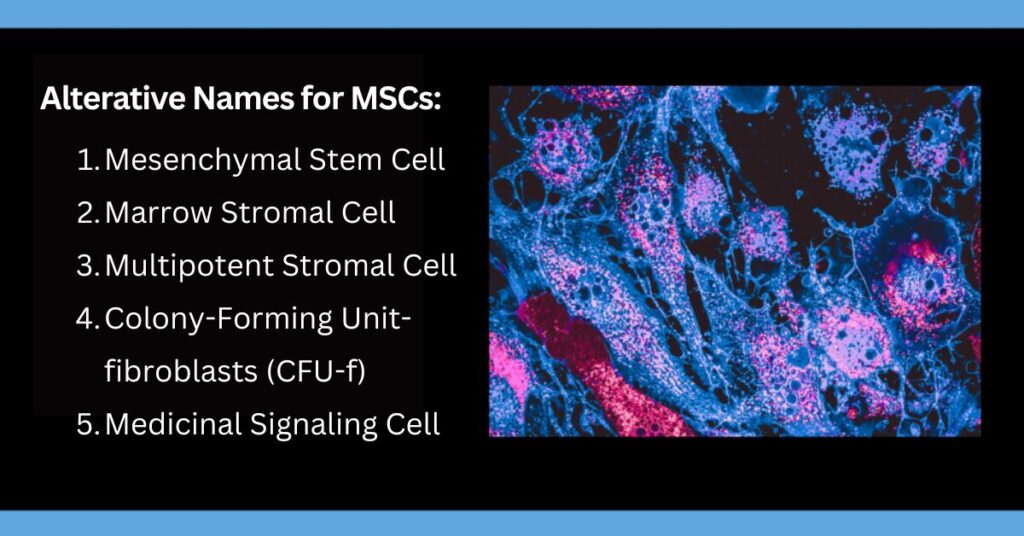
This has resulted in the existence of alternative nomenclature for the cell type, which include:
- Mesenchymal Stem Cell
- Marrow Stromal Cell
- Multipotent Stromal Cell
- Colony-Forming Unit-fibroblasts (CFU-f)
- Medicinal Signaling Cell
Today, the term mesenchymal stem cell is used the most frequently, but the other terms do commonly appear within the scientific literature and within clinical trial descriptions. A description of each of MSC term is included below.
1. Mesenchymal Stem Cell
As described above, mesenchyme is a form of loose connective tissue within an embryo that contains undifferentiated cells capable of differentiating into bone, cartilage, connective tissue, and cells of the lymphatic system and circulatory systems. It is an embryonic connective tissue derived from the mesoderm, one of the three primary germ layers. The purpose of mesenchyme tissue is to differentiate into hematopoietic cells (forming the blood system), as well as to form cells of the lymphatic and musculo-skeletal systems. However, because MSCs do not differentiate into hematopoietic cells, the term “mesenchymal” to describe this type of stem cell is not wholly descriptive.
2. Marrow Stromal Cell
On the other hand, stromal cells are connective tissue cells that form the supportive structure for the functional cells of a tissue or organ. While this is an accurate description for one function of MSCs, the term fails to encompass several other qualities of MSCs, including their ability to differentiate into non-mesenchymal lineages, their active role in tissue repair, and their ability to exert control over the immune response.
3. Multipotent Stromal Cell
Because MSCs can differentiate into a range of different cell types, but do not have the ability to form an entire organ, some researchers have also proposed use of the term multipotent stromal cell. While this term is compatible from a terminology perspective, it has not been met with the same general use or appeal as the term mesenchymal stem cell.
4. Colony-Forming Unit-fibroblasts
Historically, there is yet another name. In 1924, morphologist Alex Maximow used histology markers to identify a precursor cell within mesenchyme that had the potential to develop into a variety of blood cell types;[2] in the 1960s, scientists McColloch and Till discovered the clonal nature of those cells.[3],[4] An assay system demonstrating clonogenic potential of multi-potent stromal cells was presented in 1974 by Friedenstein and colleagues, and in this system, these cells were referred to as Colony-Forming Unit-fibroblasts (CFU-f).[5]
5. Medicinal Signaling Cell
To learn more about this evolving market, view the market report “Mesenchymal Stem Cells / Medicinal Signaling Cells – Advances & Applications, 2025.”
Footnotes
[1] Chamberlain G, Fox J, Ashton B, Middleton J. Concise review: Mesenchymal stem cells: Their phenotype, differentiation capacity, immunological features, and potential for homing. Stem Cell 2007; 25: 2739-2749.
[2] Sell S. Stem cell handbook 2003; 143.
[3] Becker AJ, McCulloch EA, Till JE. Cytological demonstration of the clonal nature of spleen colonies derived from transplanted mouse marrow cells. Nature 1963; 197: 452–454.
[4] Siminovitch L, McCulloch EA, Till JE. The distribution of colony-forming cells among spleen colonies. Journal of Cellular and Comparative Physiology; 1963; 62: 327–336.
[5] Friedenstein AJ, Deriglasova UF, Kulagina NN, Panasuk AF, Rudakowa SF, Luria EA, Ruadkow IA. Precursors for fibroblasts in different populations of hematopoietic cells as detected by the in vitro colony assay method. Exp Hematol 1974; 2: 83–92.