
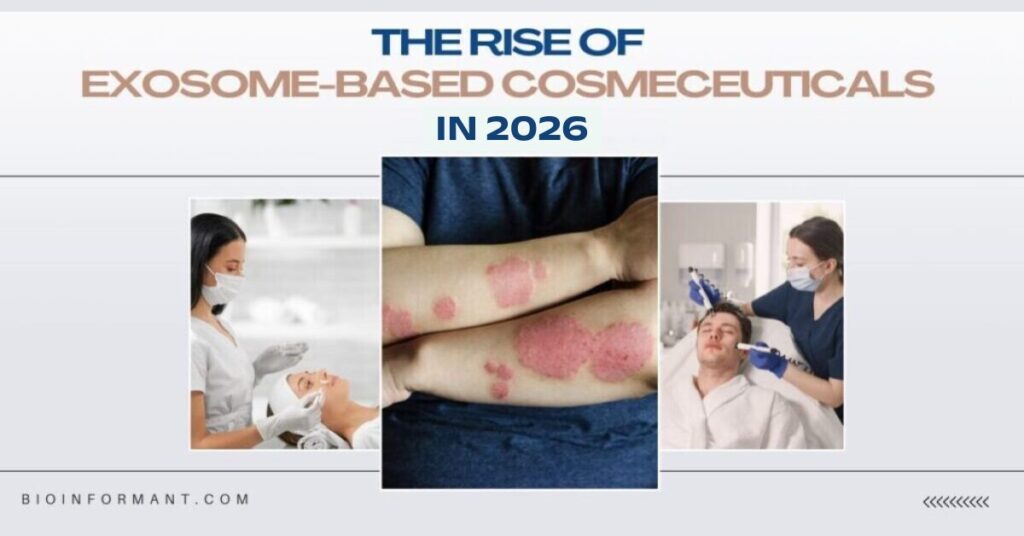
A cosmeceutical is defined as a product that is marketed as a cosmetic but has the capacity to exert pharmaceutical effects. In recent years, exosomes have been utilized within the global cosmetics industry to manufacture and market skincare products that use the power of these small extracellular vesicles to enhance a broad range of traits, including but not limited to skin health and rejuvenation, scar improvement, hair regrowth, anti-aging effects, and beyond. Exosomes can provide bioactive substances such as proteins, lipids, and nucleic acids to the target cells to alter gene expression and cellular function. Importantly, exosomes can also induce collagen formation, enhance tissue regeneration, and exert anti-inflammatory properties.
Exosome-based Cosmeceutical Products
Currently, there are no FDA-approved exosome products that are designed for skincare or cosmeceutical applications. Despite this fact, exosomes are widely used by professional dermatologists within their medical clinics, leveraged by licensed skin care professionals (such as estheticians), used by doctors who provide hair restoration services, and provided as expensive over-the-counter products that are sold directly to consumers.
Facial plastic surgeons use exosome-based skin care products to reduce scarring, while dermatologists use exosome-based serums within their practices, often in combination with lasers and microneedling. Some orthopedic surgeons also offer exosome treatments, typically in combination with stem cell and PRP treatments. Today, there are hundreds of exosome-based skin care products that are being sold within the global beauty market.
BioInformant classifies exosome-based cosmeceutical products under five major categories:
- Skin care cosmetics
- Skin rejuvenation products
- Scar revision products
- Hair regeneration products
- Integrated products (for example, when exosomes are integrated into transdermal patches, microneedle patches, and other devices with cosmetic intent)
Leading Exosome-based Skin Care Cosmetics
Skin care cosmetics make use of exosomes as a key ingredient within their cream and serum preparations. These exosomes are believed to provide growth factors and signaling molecules that can stimulate the synthesis of collagen and extracellular matrix proteins, as well as help with maintaining skin elasticity and firmness.
Some of the most popular exosome-based skin care cosmetics include: XOGLO, Lifeline Intense Moisture Serum, SkinMedica TNS Recovery Complex, CALECIM Professional Serum, U Autologous Regenerative Eye Cream, Venus Skin Stem Cell Therapy Serum, Beautigenix Hydrating Mask, Ruby-Cell Intensive 4U Mist, and Skin Drink Phytoceuticals Sculpting Serum.
Most of these products are made by using exosomes derived from mesenchymal stem cells (MSC) sourced from the bone marrow, umbilical cord, placenta, and adipose tissue, as well as the spent conditioned medium of cell cultures. Other uncommon sources include plants and microbes.
Not Every Product Labelled “Exosome” Is the Same
As the category expands, the word “exosome” on a label should not automatically be taken as a measure of quality or performance. Exosome populations can differ considerably depending on their cellular source, how the cells were cultured and processed, the diversity of molecular cargo they carry, and the other signalling substances present in the formulation. Cell communication is not a solo act: it relies on a chorus of complementary signals from exosomes, cytokines, growth factors and other proteins—not one or two isolated actives. Consumers and practitioners should therefore ask where these bio-signals come from, whether the formula contains a diverse and reproducible mixture, and whether the actual ingredient or finished formulation (not merely the broader ingredient category) has undergone sufficient laboratory and human clinical testing.
This is where Calecim’s PTT-6 stands apart. Derived from ethically sourced umbilical cord-lining stem cells, PTT-6 is a proprietary complex containing exosomes, growth factors, cytokines and thousands of proteins that work together as a broad cell-signalling network.
PTT-6 and Calecim formulations have been examined in published research, including a Journal of Drugs in Dermatology study of skin elasticity and fibroblast activity, a randomised, double-blind JDD facial-rejuvenation study, a Dermatologic Surgery study examining eyelid fibroblast activity and visible eyelid aesthetics, and a PMFA Journal clinical study of PTT-6® for menopausal and androgenetic hair loss. This breadth of research, alongside its use in professional practice, has helped Calecim earn the trust of dermatologists, aesthetic physicians, plastic surgeons and hair-restoration specialists.
Although the U.S. FDA has not yet approved an exosome product for a therapeutic or cosmetic application, several exosome-based skin rejuvenation products are being used within dermatology clinics, particularly those that have a cosmetic and/or anti-aging focus.
Although this area is still evolving, exosome treatments paired with microneedling are being explored for their potential to reduce fine lines, wrinkles, ad age-spots. In some cases, injected exosomes may be able to produce an increase in facial volume, making it a potential alternative to dermal filler treatments.
Exosomes for Skin Treatment Applications
While exosomes are most often used to rejuvenate skin for cosmetic and anti-aging purposes, they may also be effective in treating skin problems such as acne pimples, eczema, herpes cold sores, inflammation, rosacea, wounds, and wrinkles. In particular, adipose stem cell (ADSC)-derived exosomes are being used within keloid and hypertrophic scar treatments. These exosomes are believed to inhibit cell proliferation and extracellular matrix (ECM) production of keloid fibroblast and hypertrophic scar fibroblasts. For example, treatments with LIPOSKILL PLUS from the Bioscience Institute result in the reduction of scars and stretch marks, facilitated by the regenerative potential of exosomes derived from ADSCs.
These exosomes restore the physiological condition of the skin by repairing the damaged skin through the reconstruction of the extracellular matrix (ECM). Moreover, exosomes have demonstrated an ability to reduce the fibrotic tissue that composes prominent scars.
Exosome-based Hair Regeneration Products
Exosome-based hair regeneration products have also arrived in the global market. On August 1, 2023, ExoCel Bio launched its Evovex hair growth serum, Refine. Refine contains exosomes derived from placental MSCs. These exosomes stimulate hair follicles and promote hair growth and prevent additional hair loss. Currently, more than 500 dermatologists across the U.S. are offering this treatment in their clinics.
Another major player in exosome-based hair treatment is RION Aesthetics. The company’s clinically proven HAIR serum significantly improves the appearance of scalp coverage. The product contains platelet-derived exosomes, along with a blend of biotin, sea moss, turmeric, hyaluronic acid, and an antioxidant mix.
As research continues to discover the benefits of exosomes, we can expect more skincare brands to incorporate these powerful components into their formulations and bring new and innovative solutions to the market. BioInformant estimates that the exosome-based skin care market is currently worth approximately $251 million annually.
To view market size figures for the Global Exosome Market, which includes U.S. FDA approved diagnostic products as well as exosomes being utilized for other critical applications (including those described above), view the global strategic report below. It includes market forecasts through 2030, as well as penetrating insights into rates of exosome-based scientific publications, clinical trials, patents, industry partnerships, research collaborations, financing events, and so much more.