
Mesenchymal stem cells (MSCs) are multipotent cells that can differentiate into a variety of cell types, including bone, cartilage, muscle and fat cells, among other cell types. MSCs are a leading type of adult stem cell being investigated for therapeutic applications, because they have the potential to treat a range of acute and degenerative diseases.
MSCs play a critical role in tissue repair and regeneration, primarily through their ability to secrete bioactive molecules that modulate immune responses, reduce inflammation, and promote healing. They are found in various tissues, including bone marrow, adipose tissue, and umbilical cord tissue. Importantly, they MSCs are unique because they tend to exert their effects predominantly through paracrine signaling rather than direct differentiation into target cells.
Characteristics of MSCs
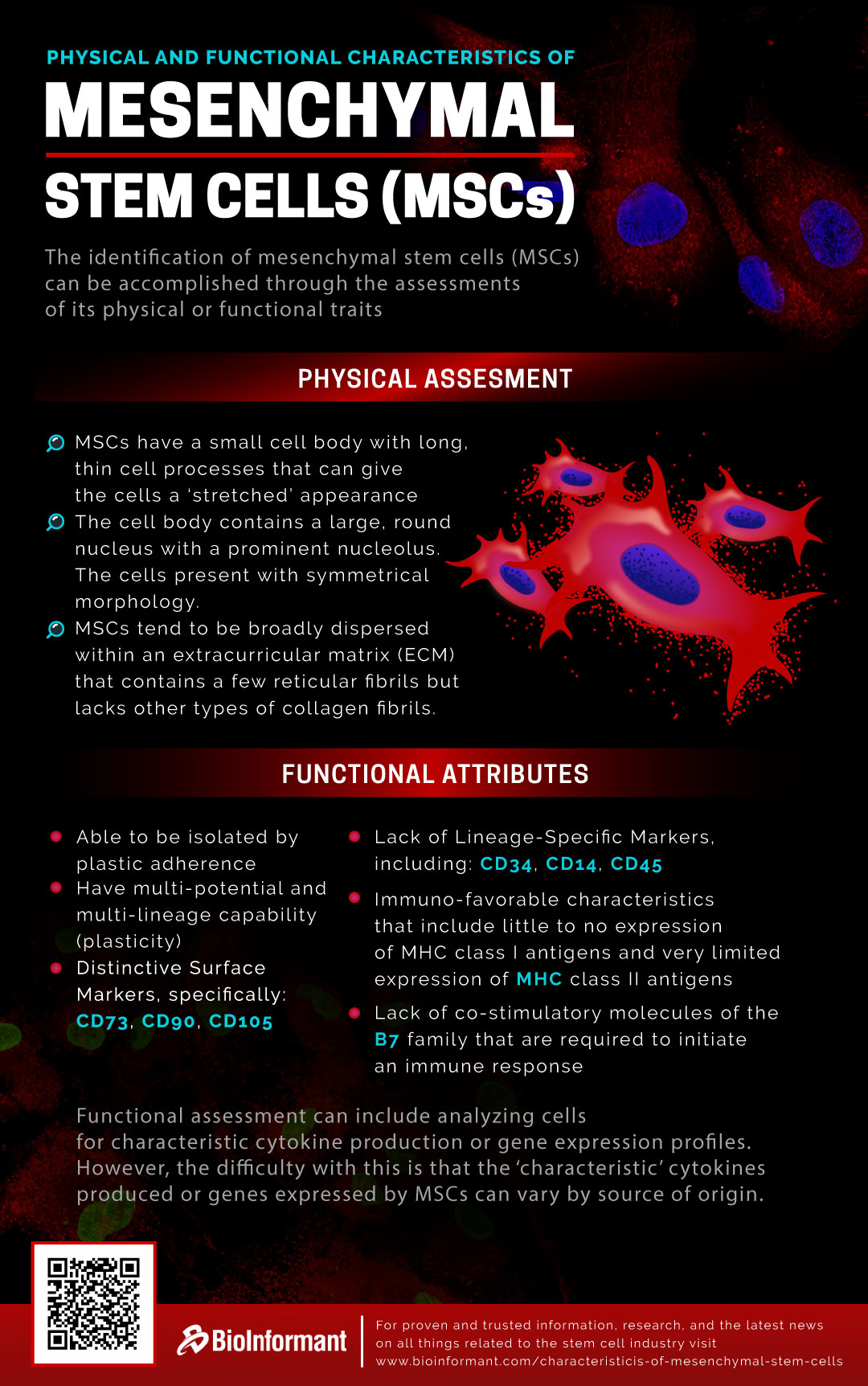
The identification of mesenchymal stem cells (MSCs) can be accomplished through the assessment of either physical or functional traits.
The first and most convenient approach to identifying MSCs is through physical assessment. Morphologically, MSCs have a small cell body with long, thin cell processes that can give the cells a “stretched” appearance.
The cell body contains a large, round nucleus with a prominent nucleolus. The cells present a symmetrical morphology.
MSCs also tend to be broadly dispersed within an extracellular matrix (ECM) that contains a few reticular fibrils but lacks other types of collagen fibrils.
Another secondary approach for identifying mesenchymal stem cells is through functional assessment.
Criteria for functionally identifying MSCs are as follows:
- able to be isolated by plastic adherence
- have the multi-potential and multi-lineage capability (plasticity)
- distinctive surface markers, specifically: CD73, CD90, and CD105[1]
- lack of lineage-specific markers, including CD34, CD14, and CD45[2]
- immuno-favorable characteristics that include little to no expression of MHC class I antigens and very limited expression of MHC class II antigens[3]
- lack of co-stimulatory molecules of the B7 family that are required to initiate an immune response
In addition, functional assessment can include analyzing cells for characteristic cytokine production or gene expression profiles. However, the difficulty with this approach is that the “characteristic” cytokines produced or genes expressed by MSCs can vary by source of origin. For instance, bone marrow-derived MSCs and adipose-derived MSCs exhibit different, source-specific, cytokine production.[4]
Save this infographic for later!
Footnotes
[1] Klingemann H, et al. Mesenchymal Stem Cells, Sources and Applications. Transfusion Medicine and Hemotherapy 2008; 35: 272-277.
[2] Friedman R, Betancur M, Tuncer H, Boissel L, Klingemann H. Umbilical cord mesenchymal stem cells: Adjuvants for human cell transplantation. Biol Blood Marrow Transplant 2007; 13: 1477–1486.
[3] Friedman R, Betancur M, Tuncer H, Boissel L, Klingemann H. Umbilical cord mesenchymal stem cells: Adjuvants for human cell transplantation. Biol Blood Marrow Transplant 2007; 13: 1477–1486.
[4] Gonzalex-Ray, et al. Human adipose-derived mesenchymal stem cells reduce inflammatory and T cell responses and induce regulatory T cells in vitro in rheumatoid arthritis. Ann Rheum Dis 2010; 69: 241-248.
What questions do you have about MSCs, including their unique characteristics and emerging applications? Ask them in comments below.