
Chimeric antigen receptor T-cell (CAR-T) therapy has transformed the landscape of oncology, offering personalized cellular solutions for hematologic malignancies and expanding into solid tumors and autoimmune disorders. By engineering a patient’s own T-cells to recognize and destroy cancer cells, CAR-T therapies provide unprecedented efficacy, often in patient populations with limited treatment options.
The global CAR-T market has grown substantially in recent years, climbing to 13 approvals worldwide. Seven of these therapies have been approved by the U.S. FDA, with subsequent approvals in other major healthcare markets. These therapies include Kymriah, Yescarta, Tecartus, Breyanzi, Abecma, Carvykti, and Aucatzyl. Beyond the U.S., four CAR-T therapies (Relma-cel, Fucaso, Yuanruida, and Zever-cel) have been approved by China’s National Medical Products Administration (NMPA), while two therapies, NexCAR19 and Qartemi, have received approval from India’s Central Drugs Standard Control Organisation (CDSCO).
This growth of the global CAR-T market has been driven by regulatory approvals, technological advances, and increasing adoption worldwide. A growing number of companies, from established biopharmaceutical giants to emerging biotech innovators, are competing to define the future of CAR-T, shaping both clinical practice and market dynamics.
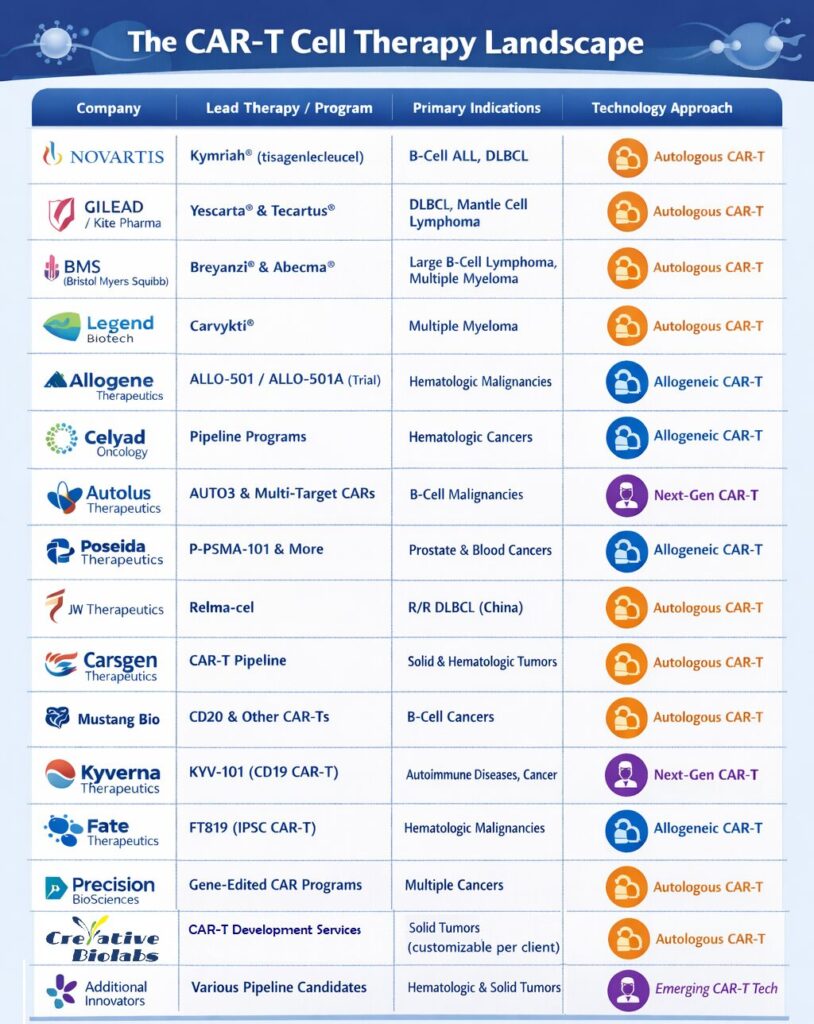
Key Global Market Leaders in CAR-T Therapy
-
Novartis – As the pioneer behind Kymriah®, Novartis has established leadership in pediatric acute lymphoblastic leukemia (ALL) and adult diffuse large B-cell lymphoma (DLBCL). Novartis continues to explore combination therapies and expansion into solid tumor indications.
-
Gilead/Kite Pharma – Kite Pharma, now a Gilead subsidiary, commercialized Yescarta® for DLBCL and is advancing dual-targeted and next-generation CAR-T constructs, including research on solid tumor CAR-T therapies.
-
Bristol Myers Squibb (BMS)/Celgene – Following its acquisition of Celgene, BMS brought Breyanzi® to market and is actively developing off-the-shelf CAR-T solutions, modular CAR constructs, and strategies to enhance safety and persistence.
-
Legend Biotech – Known for its BCMA-targeted therapy for multiple myeloma, Legend Biotech continues to expand indications and global reach through partnerships and clinical pipeline developments.
-
Juno Therapeutics (BMS) – Juno, now fully integrated into BMS, has pioneered innovations in T-cell engineering, emphasizing safety switches and improved in vivo persistence.
-
bluebird bio – Leveraging gene therapy expertise, bluebird bio develops CAR-T constructs for hematologic malignancies and is exploring combination approaches to improve efficacy and durability.
-
Autolus Therapeutics – Autolus focuses on precision-engineered CAR-Ts, including multi-targeted approaches designed to overcome tumor antigen heterogeneity.
-
Celyad Oncology – Specializing in allogeneic CAR-T platforms, Celyad develops off-the-shelf therapies aimed at reducing manufacturing times and broadening patient access.
-
Allogene Therapeutics – A leader in universal CAR-T technologies, Allogene focuses on scalable, donor-derived T-cell therapies that can be rapidly deployed for multiple cancer indications.
-
Tmunity Therapeutics – Tmunity is developing CAR-T and TCR-T therapies for both hematologic and solid tumors, with a focus on highly engineered T-cell platforms.
-
Fate Therapeutics – Fate is innovating in iPSC-derived CAR-Ts, providing a scalable, off-the-shelf approach that could redefine accessibility and treatment timelines.
-
Immunocore – Primarily recognized for TCR-based therapies, Immunocore is increasingly exploring CAR-T combinations, especially for solid tumors with challenging microenvironments.
-
Precision BioSciences – Using its ARCUS genome-editing platform, Precision BioSciences is developing allogeneic CAR-Ts with targeted genetic modifications to enhance efficacy and reduce graft-versus-host disease.
-
Senti Bio – Senti Bio is advancing modular CAR-T platforms with focus on safety switches and programmable logic circuits, aiming to improve precision and reduce off-target effects.
-
Celularity – Celularity develops allogeneic CAR-T and NK cell therapies, leveraging its proprietary cell platforms for broader oncology applications.
-
Creative Biolabs——Creative Biolabs is a leading provider of one-stop CAR-T therapy development services. Utilizing cutting-edge platforms like Surfarray™ technology, the company specializes in overcoming the challenges of solid tumors and advancing in vivo CAR-T engineering. Their comprehensive solutions range from optimized CAR design to supplying GMP-grade vectors, streamlining the path from discovery to clinical application.
Additional emerging players such as Bellicum Pharmaceuticals, Tessa Therapeutics, and Poseida Therapeutics are also making strides with novel CAR constructs, gene editing, and off-the-shelf solutions, indicating a highly competitive and innovative market environment.
Comparison of Key CAR-T Market Competitors
-
Allogeneic CAR-Ts (“Off-the-Shelf”) – Utilizing donor-derived T-cells, these therapies reduce manufacturing timelines and improve patient access compared to autologous approaches. Companies like Allogene, Celyad, and Fate are at the forefront of this trend.
-
Multi-Targeted CAR-Ts – To overcome tumor heterogeneity, dual- and triple-targeted CAR-Ts recognize multiple antigens, reducing the likelihood of relapse. Autolus and Kite Pharma are notable developers.
-
In Vivo CAR-T Engineering – Experimental approaches aim to engineer CAR-T cells directly inside patients, potentially simplifying manufacturing and lowering costs.
-
Safety Switches and Modular CARs – Innovations such as inducible suicide switches or modular CAR designs improve control over T-cell activity, mitigating risks of cytokine release syndrome (CRS) and neurotoxicity.
-
CAR-NK and CAR-Macrophage Therapies – Expanding beyond T-cells, NK- and macrophage-based CAR therapies aim to target solid tumors and immune-suppressive microenvironments. Cellularity and Tmunity are active in these modalities.
-
Combination Approaches – Pairing CAR-Ts with checkpoint inhibitors, targeted therapies, or oncolytic viruses is showing promise for enhancing efficacy and persistence.
The Future of CAR-T Cell Therapies
To summarize, CAR-T therapy continues to reshape oncology and personalized medicine, offering transformative benefits for patients with limited treatment options. Market leaders like Novartis, Kite Pharma, BMS, and Legend Biotech have paved the way, while emerging innovators such as Allogene, Fate Therapeutics, and Senti Bio are driving next-generation approaches. From allogeneic and multi-targeted CAR-Ts to CAR-NK platforms and in vivo engineering, the field is evolving rapidly, promising a future where safer, more effective, and widely accessible cellular therapies become standard of care.
For stakeholders in biotech and pharma, understanding pipeline innovations, platform technologies, and competitive dynamics is essential to navigating this highly promising and fast-moving sector.