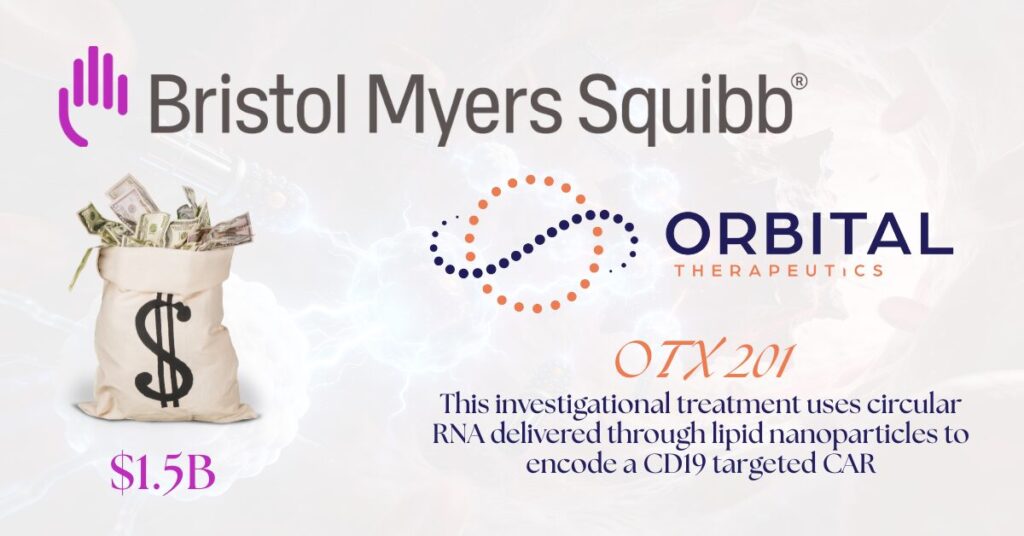
On October 10th, 2025, Bristol Myers Squibb (BMS) announced its plan to acquire Orbital Therapeutics for 1.5 billion dollars in cash. This decisive move places BMS directly into the rapidly growing in vivo CAR T sector. Orbital Therapeutics, based in Cambridge, Massachusetts, has been advancing a next generation RNA platform that is designed to reprogram immune cells inside the body instead of relying on the traditional practice of engineering cells outside the body.
Central to the acquisition is Orbital’s lead candidate, OTX 201. This investigational treatment uses circular RNA delivered through lipid nanoparticles to encode a CD19 targeted CAR. The goal is to create CAR expressing cells directly within the patient. This approach could reshape the entire cell therapy landscape by eliminating complex external manufacturing steps.
In Vivo CAR T Means and Why It Matters
Traditional CAR T therapy requires collecting a patient’s T cells, modifying them in a manufacturing facility, growing them to large numbers, and reinfusing them back into the patient. This process is slow, costly, and accessible only at specialized centers.
In vivo CAR T therapy takes an entirely different approach. Instead of engineered cells, the therapy delivers genetic instructions into the patient so that their own cells can produce the CAR inside the body. This method could reduce costs, shorten timelines, and broaden availability to a larger population.
Orbital’s platform focuses on optimized circular and linear RNA paired with finely tuned lipid nanoparticles. These technologies are designed to offer strong expression, controlled durability, and the flexibility to apply RNA programming across multiple therapeutic areas.
Reasons BMS is Making This Move
BMS is already a global leader in CAR T therapy with two ex vivo CAR T products on the market. However, these products are designed primarily for oncology. Demand for cell based treatments in autoimmunity is rising rapidly. In vivo methods could unlock far larger patient populations due to easier delivery and reduced logistical challenges.
By acquiring Orbital, BMS gains access to a broad RNA immunotherapy platform that can be applied across autoimmune disease, immuno oncology, and chronic conditions. BMS has publicly stated that it views this transaction as a way to advance therapies that can eliminate autoreactive B cells and reset the immune system. This is particularly relevant as early preclinical work from Orbital has shown full B cell depletion in non human primates across blood, spleen, and lymph nodes.
Scientific Significance of OTX 201
OTX 201 is Orbital’s flagship program and a major driver of the acquisition. Preclinical data suggest that circular RNA delivered via lipid nanoparticles can produce robust and durable CAR expression in vivo. This represents a potential shift away from viral vectors and other complex manufacturing technologies that dominate the ex vivo model.
Orbital has reported that OTX 201 achieved levels of B cell depletion in non human primates that are required for immune reset applications. If these results translate into human trials, the therapy could open a new era of scalable, repeatable immune reprogramming.
Industry Impact and Market Implications
The implications of this acquisition extend beyond BMS.
• Patients could gain access to CAR T therapies without needing specialized treatment centers
• Autoimmune diseases could become a major frontier for CAR T therapy rather than a secondary pursuit
• RNA based cell programming could outperform traditional cell engineering methods by offering easier dosing, scalable manufacturing, and the potential for redosing
• Large pharmaceutical companies may respond with competing acquisitions or platform partnerships
The fact that BMS paid a premium for a preclinical company signals the level of confidence in in vivo CAR T as a future foundational technology.
BMS is making a calculated bet that the next era of cell therapy will not rely on external manufacturing. Instead, it will rely on programmable RNA delivered directly into the patient. This approach has the potential to make CAR T therapy more accessible, more scalable, and better suited for chronic diseases that affect millions of people worldwide.
If the clinical data aligns with the preclinical promise, the acquisition of Orbital Therapeutics may be remembered as a defining milestone. It represents a shift from complex ex vivo processes to a new model in which the human body becomes the production site for therapeutic immune cells.