It took just over three decades for exosomes to move from a laboratory curiosity to a validated biological system with real therapeutic potential. First formally named in 1981 and identified in sheep reticulocytes in 1983, exosomes weren’t seriously investigated for medical application until the late 2000s and early 2010s, once researchers discovered they could shuttle transferable mRNA and miRNA between cells. That shift was cemented in 2013, when the Nobel Prize in Physiology or Medicine was awarded to Rothman, Schekman, and Südhof for validating the mechanisms behind vesicular transport.
Today, the science is scaling fast. PubMed indexes over 44,000 exosome papers as of June 2026 (up from 282 in 2010), with 6,304 papers published in 2025 alone. Asia/Pacific produces 52% of global publications, followed by Europe (28%) and the U.S. (20%, though the U.S. retains top citation impact and clinical translation leadership).
Patent activity shows a clear leadership hierarchy. Filings grew from just 8 in 2000 to 1,921 in 2025. By jurisdiction, the United States holds the largest cumulative filing base at 22,120 patents, followed by WIPO applications at 13,037 and China at 8,572.
At the company level, Bio-Techne leads all exosome-focused organizations with 427 granted patents and 566 pending, followed by Exosome Diagnostics (136 granted, 75 pending) and Evox Therapeutics (90 granted, 190 pending).
Notably, much of the foundational IP from the 2010 to 2014 wave, covering basic isolation and biomarker phenotyping, has now lapsed or been abandoned, broadening freedom-to-operate for new entrants while active rights consolidate around engineering, cargo-loading, and disease-specific delivery platforms.
Clinical Development
Clinical development includes nearly 600 registered trials globally (U.S.: 149, China: 138), with oncology representing roughly 30% of the pipeline.
By phase, the distribution skews early: 106 trials in Phase I, 100 in Phase II, only 10 in Phase III, and just 6 in Phase IV, with 336 trials not reporting a phase designation. This concentration reflects an industry still establishing dosing and efficacy benchmarks before broader confirmatory trials, with most late-stage activity concentrated in specific indications like ARDS (via ExoFlo) and Duchenne Muscular Dystrophy cardiomyopathy.
While no exosome-based therapeutic or diagnostic has full FDA approval yet, Capricor Therapeutics’ Deramiocel (CAP-1002) for Duchenne Muscular Dystrophy cardiomyopathy is closely watched. Though administered as a cell therapy, its mechanism is exosome-mediated (shifting macrophages toward a healing phenotype). Despite Priority Review, a July 2026 advisory committee voted 9 to 3 against approval for the original indication; Capricor resubmitted with a narrowed indication (upper-limb function preservation), with the FDA’s target decision date now November 22, 2026.
For diagnostics, two CLIA-certified tests already operate commercially: ExoDx Prostate IntelliScore (developed by Exosome Diagnostics, which MDxHealth acquired from Bio-Techne in 2025) and ExoTRU (Bio-Techne/Thermo Fisher).
Exosome Dealmaking is Intensifying
Dealmaking activity is intensifying across financing, M&A, and licensing simultaneously.
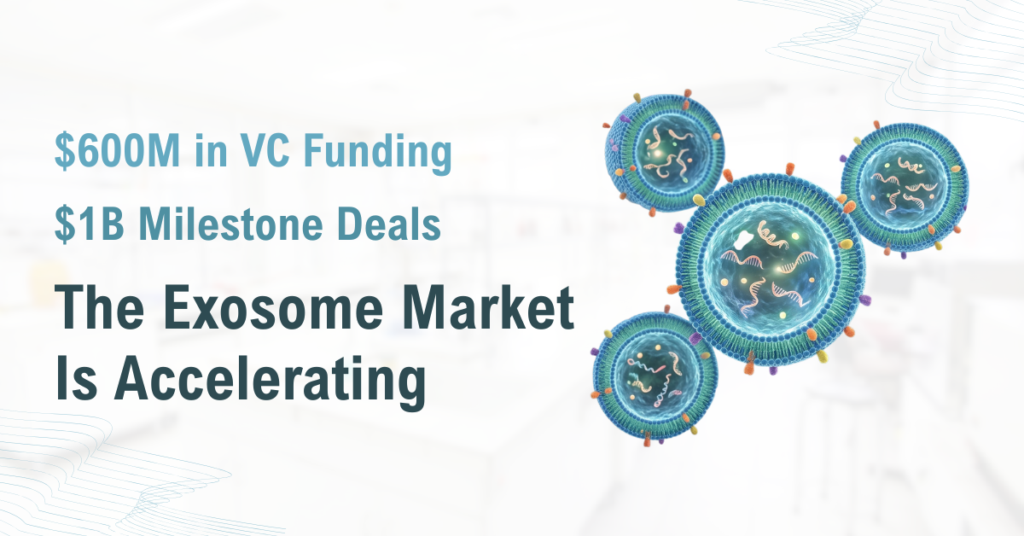
VC funding into exosome companies has reached roughly $600M since 2010, with about $155.5M raised between 2023 and mid-2026 across eleven disclosed rounds, mostly Series A and seed stage, ranging from $2M seed checks up to a $65M Series B raised by Annie Aesthetic Holdings.
On the acquisition side, five disclosed deals closed between 2023 and June 2026: MDxHealth’s $15M purchase of Exosome Diagnostics from Bio-Techne, ExoCoBio’s majority-ownership acquisition of BENEV, Evox Therapeutics’ acquisition of Codiak’s engineered exosome technology, ARCHIMED’s majority stake in Cellese, and Marijuana Inc.’s acquisition of Exousia AI’s exosome technology. Licensing deals can carry even larger potential value: Codiak’s own exosome platform agreement included milestone payments of up to $1B.
Growth rates vary meaningfully by segment. Medical Aesthetics and Research Products currently lead the market by size, but the growth curve is clearly shifting toward diagnostics and platform infrastructure as clinical validation accelerates.
Underlying all of this activity is the biology driving commercial interest in the first place. Exosomes are key mediators of intercellular communication, carrying cell-specific cargos of proteins, lipids, and nucleic acids (including mRNA and miRNA). More than 119,000 exosome-associated protein entries have been catalogued in databases like ExoCarta, with a single exosome carrying anywhere from dozens to 1,000 to 2,000 distinct proteins.
This cargo is exactly what makes exosomes valuable across the commercial fronts driving the data above, including liquid biopsy diagnostics (non-invasive detection of cancers, cardiovascular disease, neurodegenerative conditions), targeted drug delivery (engineered exosomes crossing barriers like the blood-brain barrier), regenerative medicine (cell-free alternatives to living-cell therapies), and medical aesthetics (serums and creams for skin rejuvenation, scar reduction, hair restoration).
Proprietary Exosome Market Insights from BioInformant
BioInformant offers a 385-page global strategic report that analyzes the six market segments that compose the global exosome market (Research Products, Development & Manufacturing, Diagnostics, Therapeutics, Medical Aesthetics, and Ready-to-Use Exosomes), with forecasts through 2034. A full geographic breakdown of global revenue share is also provided, alongside detailed patent, trial, financing, and M&A tracking tables. The report also profiles over a hundred global competitors, from research suppliers to clinical innovators and aesthetic-market leaders.
Most importantly, it was prepared by BioInformant’s experienced human analysts, not AI. This report would not have been possible without the past two decades (2006 to present) of aggregating vast datasets for the exosome industry, proprietary datasets to which AI does not have access.
Stop paying for ever increasing numbers of AI credits to receive info that is unvetted and likely inaccurate. Instead, claim credible, ready-to-use data from a trusted market research firm that has the datasets, deep industry relationships, and contextual experience that is needed to do future forecasts with accuracy and confidence.