Colorectal cancer (CRC) remains one of the leading causes of cancer-related deaths worldwide, claiming nearly a million lives each year. Despite advances in screening, surgery, and chemotherapy, the disease continues to pose a formidable clinical challenge, particularly when diagnosed at advanced stages. In recent years, researchers have increasingly turned to the immune system as a powerful ally in the fight against cancer. Now, a team at National Taiwan University has developed a novel vaccine strategy that may represent a major leap forward utilizing groundbreaking iPSC technology.
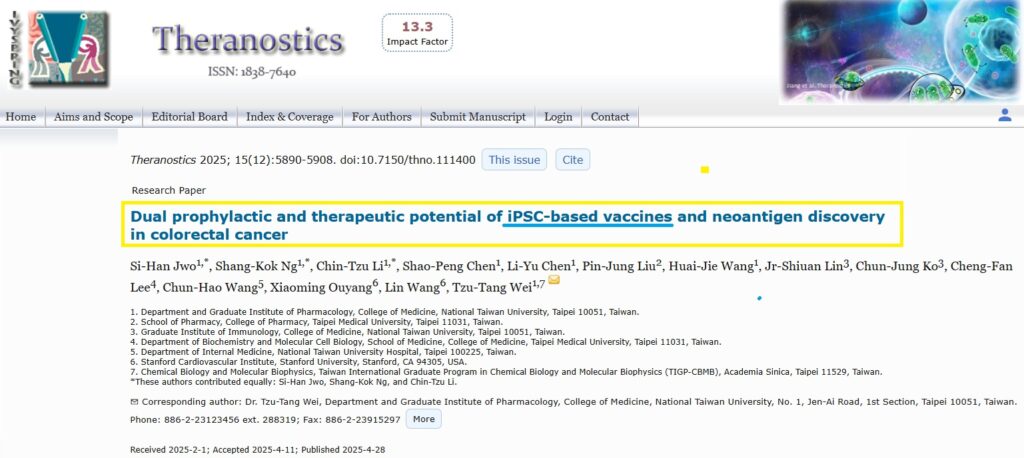
Titled “Dual prophylactic and therapeutic potential of iPSC-based vaccines and neoantigen discovery in colorectal cancer” and published in the journal Theranostics on April 28, 2025, the study led by Jwo and colleagues (Jwo SH, Ng SK, Li CT, et al.) demonstrates that vaccines derived from induced pluripotent stem cells (iPSCs), when paired with an immune-boosting adjuvant, can both prevent and treat colorectal cancer in mouse models.
The dual preventive and therapeutic effects highlight the potential for a universal vaccine approach, bypassing some of the challenges associated with personalized cancer immunotherapies.
A Novel iPSC Vaccine
Induced pluripotent stem cells are reprogrammed adult cells that regain the ability to differentiate into nearly any cell type. Interestingly, iPSCs share molecular signatures with cancer cells, including the expression of tumor-associated antigens. These antigens, normally hidden from the immune system, can serve as “red flags” once properly presented. By training the immune system to recognize iPSCs, scientists hope to exploit the overlap in antigen expression so that the same immune response will target cancer cells.
Previous preclinical work had shown that iPSC-based vaccines could inhibit tumor growth in melanoma, breast, lung, and pancreatic cancers. The Taiwanese group sought to test this concept specifically in colorectal cancer, which carries a particularly high global burden.
The Vaccine Design
The vaccine consisted of lysates prepared from iPSCs combined with CpG ODN 1826, a synthetic DNA sequence that acts as a potent immune adjuvant. CpG motifs stimulate toll-like receptor 9 (TLR9), priming dendritic cells to initiate strong T-cell responses.
The team tested this formulation in several rigorous mouse models of colorectal cancer:
- A classic CRC allograft model, in which tumor cells are implanted into mice.
- A colitis-associated cancer model (AOM/DSS), which more closely mimics human CRC that arises from chronic inflammation.
- A metastatic CRC model, which replicates cancer spread to distant sites.
This breadth of testing provided insights into both preventive and therapeutic applications across different disease contexts.
The findings were striking. In preventive settings, mice vaccinated with the iPSC + CpG formulation developed fewer and smaller tumors than unvaccinated controls. In therapeutic settings—where tumors were already established—the vaccine slowed tumor progression, induced regression, and in some cases eradicated disease. Importantly, these protective effects extended to both colitis-associated cancers and metastatic models, broadening the vaccine’s potential applicability.
Immunological analysis revealed that vaccinated mice had a marked increase in CD8⁺ cytotoxic T lymphocytes infiltrating their tumors. Depletion of T cells abolished the protective effect, confirming their central role. Furthermore, vaccination promoted the generation of central memory T cells, suggesting durable immune surveillance and reduced risk of recurrence.
Shared Antigen Between iPSCs and Colorectal Cancer Cells
To understand why the vaccine was so effective, the researchers conducted proteomic analysis combined with computational modeling. They identified two proteins—heterogeneous nuclear ribonucleoprotein U (HNRNPU) and nucleolin (NCL)—as shared antigens between iPSCs and colorectal cancer cells. These proteins, when used as vaccine components alongside CpG, were sufficient to elicit strong dendritic cell activation and robust antigen-specific CD8⁺ T cell responses.
This discovery is significant because it suggests that targeting just a small set of conserved proteins may be enough to generate a clinically meaningful immune response, without needing to tailor the vaccine to each patient’s unique tumor mutations.
The potential advantages of an iPSC-based vaccine are substantial. First, it could be broadly applicable across patients, bypassing the need for individualized sequencing and manufacturing that complicates current personalized vaccine strategies. Second, it functions in both preventive and therapeutic capacities. High-risk populations—such as individuals with chronic inflammatory bowel disease—could benefit from early vaccination, while patients with existing CRC might receive it as an adjunct to conventional therapies. Finally, the approach may extend beyond colorectal cancer, given the antigenic similarities shared across many tumor types.
While the preclinical data are compelling, important hurdles remain. Mouse immune systems differ from humans, and many experimental cancer therapies that succeed in rodents fail in clinical trials. Before translation to human use, the safety and efficacy of iPSC-based vaccines must be validated in additional preclinical models, followed by carefully designed Phase I trials.
Nevertheless, the study underscores the promise of harnessing stem cell biology for cancer immunotherapy. By leveraging the molecular similarities between iPSCs and malignant cells, researchers may be charting a path toward the long-sought goal of a universal cancer vaccine—one capable of both preventing disease and treating established tumors.
Reference:
Jwo SH, Ng SK, Li CT, Chen SP, Chen LY, Liu PJ, Wang HJ, Lin JS, Ko CJ, Lee CF, Wang CH, Ouyang X, Wang L, Wei TT. Dual prophylactic and therapeutic potential of iPSC-based vaccines and neoantigen discovery in colorectal cancer. Theranostics 2025; 15(12):5890-5908. doi:10.7150/thno.111400. https://www.thno.org/v15p5890.htm