The regenerative medicine industry has a communication problem, and it isn’t a scientific one. The field now broadly accepts that mesenchymal stem/stromal cells (MSCs) exert their effects largely through paracrine signaling rather than engraftment and differentiation, a reframing captured in Arnold Caplan’s proposal to rename them “medicinal signaling cells.” What hasn’t matured is the public’s understanding of any of it.
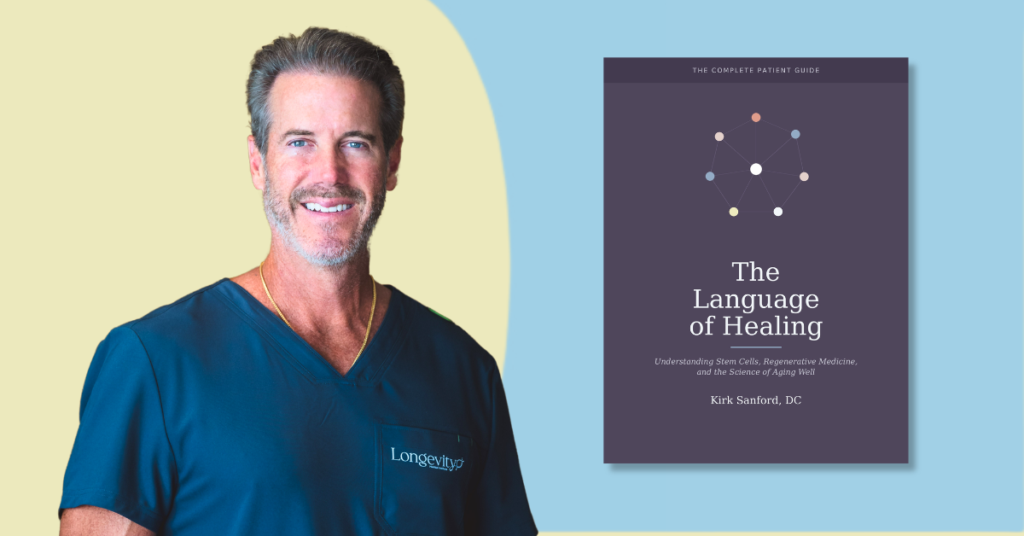
Patients arrive at clinics having read everything and understood little. They’ve met miracle claims on one side, dense primary literature on the other, and a great deal of marketing engineered to blur the difference. Into that gap, Dr. Kirk Sanford, founder and CEO of Longevity Medical Institute, has written a book aimed squarely at the reader the industry usually forgets: the patient.
The Language of Healing: The Complete Patient Guide to Understanding Stem Cells, Regenerative Medicine, and the Science of Aging Well is a plain-language account written for non-specialists without diluting the science. Its ambition is unusual. It sets out to be genuinely accurate about a field its own author works in, including where the evidence is thin.
A signaling-first narrative
The book’s central metaphor will be familiar to anyone tracking the MSC literature. Dr. Sanford frames the body not as a machine to be repaired part by part, but as a communication network, and positions regenerative medicine as an effort to restore that signaling rather than to physically rebuild tissue. Stem cells, in his telling, heal primarily by instructing. They modulate inflammation, recalibrate immune activity, and prompt the body’s own repair machinery.
This tracks the current consensus, in which the differentiation-and-replacement model has given way to an appreciation of paracrine and immunomodulatory effects. Dr. Sanford’s contribution is translational in the literal sense, rendering that paradigm into language a patient can hold onto. Recurring “In Plain Terms” sections restate a concept just introduced in clinical language as an everyday analogy, turning ideas like immunomodulation and paracrine signaling into something a reader can picture without a background in biology.
Connecting cells to aging
The book also links regenerative signaling to the biology of why we age. Rather than treating aging as a single process, Dr. Sanford walks readers through several of its recognized hallmarks: inflammaging, the chronic low-grade inflammation that builds with age; cellular senescence, the so-called zombie cells that stop dividing but linger and release disruptive signals; stem cell exhaustion; mitochondrial decline; epigenetic drift; and the shortening of telomeres. Presenting these mechanisms together lets him situate regenerative medicine within the larger science of aging, while remaining careful not to overstate what any single intervention can do.
Candor as a differentiator
What distinguishes the book is its willingness to name limits. It walks through the conditions patients ask about most, including joints, spine, neuropathy, autoimmune disease, and cognitive decline, sorting them into what the human evidence supports, what is emerging, and what remains unproven. He is equally candid about time, distinguishing established practice from what remains investigational, and sketching where the science is heading: cell-free approaches, a growing emphasis on characterization and quality, and a movement toward interventions matched to an individual’s biology. The book resists the reversal-and-cure language that has drawn regulatory scrutiny to the sector, treating the gap between a mechanism shown in vitro and a validated clinical result as a distinction worth teaching.
That restraint is notable from a clinic founder, and reflects an argument the industry has been making to itself: durable growth depends on credibility, and credibility depends on not overpromising. A book that teaches patients to ask sharper questions, about cell source, viability, characterization, and evidence, serves the responsible end of the field more than the marketing does.
An institutional backdrop
The guide emerges from Longevity Medical Institute, a stem cell, regenerative medicine, and longevity center operating from a 15,000-square-foot facility in San José del Cabo, Mexico. Unlike a conventional stem cell clinic, the institute runs a vertically integrated model, housing its own biotechnology laboratory, clinical laboratory, advanced medical imaging, operating room, and regenerative medicine center under one roof. A unified team of 17 physicians, scientists, and chemists works across five federal COFEPRIS licenses. Its in-house clinical laboratory measures more than 140 biomarkers, while full-body MRI enhanced by DeepRecon AI lets physicians correlate functional laboratory data with structural findings. Within the biotechnology laboratory, the institute develops and quality-controls five distinct mesenchymal stem cell products alongside exosome and natural killer cell technologies, retaining oversight from cellular development through clinical application.
That integration is the book’s argument in miniature. This is not an academic writing at a distance, nor a marketer writing to convert. It is a practitioner-operator making the case that measurement, verification, and honesty are the field’s real differentiators, and that a well-informed patient is an asset to legitimate medicine rather than a threat to it.
The Language of Healing: The Complete Patient Guide is an Amazon #1 New Release in Medical Biotechnology, Medical Research, and Preventive Medicine. It is available now in ebook, paperback, hardcover, and audiobook editions across major retailers including Amazon, Apple Books, Google Play, and Spotify. A free introductory edition, A Patient’s Introduction, is also available online and as an ebook. One hundred percent of the Complete Patient Guide’s proceeds are directed to a fund providing regenerative care for active-duty military and veterans.
Disclaimer: This article is for informational purposes only and does not constitute medical advice or an endorsement by BioInformant of any stem cell treatment, provider, or institution.