Across 2025, a striking trend has emerged in biotechnology. Major pharmaceutical companies are racing to acquire in vivo cell engineering platforms, signaling that reprogramming cells inside the body has moved from speculative science to strategic priority.
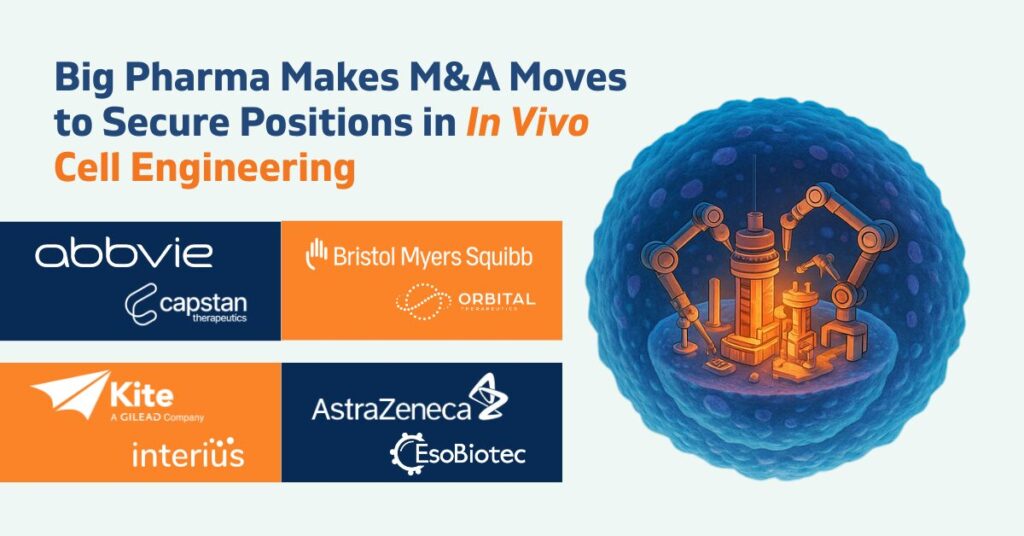
In just a few months, the field has transformed. AstraZeneca, AbbVie, Gilead’s Kite Pharma, and Bristol Myers Squibb have all made acquisitions designed to accelerate their capabilities in in vivo cell therapy. Each deal highlights the growing importance of technologies that can directly engineer immune cells without removing them from the body.
AstraZeneca Opens the Year with a Bold Entry
In March 2025, AstraZeneca acquired EsoBiotec for up to $1 billion, including milestone payments. The acquisition expanded AstraZeneca’s pipeline of RNA-based and viral-free delivery platforms aimed at creating in vivo CAR-T therapies. EsoBiotec had been developing an immune cell reprogramming platform capable of targeting multiple cell types, positioning AstraZeneca at the forefront of next-generation immunotherapies. The deal marked the company’s first major move into the direct reprogramming space, complementing its existing expertise in oncology and respiratory disease.
AbbVie Strengthens Its RNA Delivery Arsenal
By June 2025, AbbVie made headlines with its $2.1 billion acquisition of Capstan Therapeutics. The move gave AbbVie access to Capstan’s proprietary lipid nanoparticle (LNP) technology optimized for targeted delivery of mRNA and circRNA payloads to immune cells. Capstan’s approach had shown early promise in generating functional CAR-T cells in vivo and modulating immune activity without ex vivo manipulation. AbbVie framed the acquisition as part of its long-term plan to lead in RNA-based therapies across immunology, oncology, and regenerative medicine.
Kite Pharma Expands Its Cell Therapy Capabilities
In August 2025, Kite Pharma, a Gilead subsidiary best known for its leadership in ex vivo CAR-T therapy, acquired Interius BioTherapeutics for $350 million. Interius had developed a viral vector–free system for delivering CAR constructs directly into T cells within the body. The acquisition allows Kite to diversify beyond its traditional manufacturing-intensive CAR-T process, reducing production time and cost. For Gilead, the move represents an effort to remain competitive as newer in vivo modalities threaten to outpace legacy CAR-T products.
Bristol Myers Squibb Enters the Circular RNA Arena
The momentum continued into October 2025, when Bristol Myers Squibb announced its astounding $1.5 billion purchase of Orbital Therapeutics.
This deal secured for BMS a powerful circular RNA platform and a lead program, OTX-201, which delivers CD19-CAR instructions using lipid nanoparticles. The therapy aims to generate CAR-T cells within the patient to treat B-cell–driven autoimmune diseases. Orbital’s founders include Nobel Laureate Drew Weissman and other leading scientists in RNA biology, lending significant credibility to the company’s science and future pipeline potential.
Why In Vivo Cell Engineering Has Become a Strategic Imperative
The motivation behind these acquisitions is clear. Traditional ex vivo CAR-T therapy requires extracting a patient’s cells, engineering them in a lab, expanding them, and reinfusing them—a process that is both expensive and time-consuming. In contrast, in vivo cell engineering aims to streamline that process by delivering the genetic instructions directly into the body, where immune cells can be programmed in situ.
Several forces are driving the urgency:
• Operational efficiency – In vivo systems remove the need for manufacturing-intensive processes, making therapies easier to scale and potentially more accessible.
• Pipeline diversification – Many targets now extend beyond cancer. Autoimmune and inflammatory conditions are becoming major focal points, reflecting the potential for immune reprogramming to treat chronic diseases.
• Improved safety and precision – Advances in targeting ligands, RNA design, and lipid nanoparticles are helping mitigate off-target effects, a key regulatory concern.
• Scientific validation – Early preclinical data from companies like Orbital and Capstan have shown promising immune modulation and B-cell depletion in animal models, strengthening investor confidence.
Opportunities and Challenges Ahead
For Big Pharma, acquiring these technologies serves multiple strategic purposes. It provides entry into a rapidly expanding therapeutic class, helps hedge against the limitations of ex vivo therapies, and establishes early leadership in a space that will likely define the next decade of cellular medicine.
However, the opportunity comes with significant challenges. Regulators are closely scrutinizing in vivo genetic manipulation due to risks of off-target editing, uncontrolled immune activation, and variable persistence. Moreover, integrating small, agile biotech platforms into large pharmaceutical structures can slow innovation if not managed carefully. The scientific hurdles are matched by commercial and organizational ones.
Still, the direction of travel is unmistakable. From cancer to autoimmunity, the ability to safely reprogram immune cells within the body represents a paradigm shift. As pharmaceutical companies consolidate capabilities across RNA formats, nanoparticle delivery, and precision targeting, the competition is intensifying.
For observers of the biotechnology market, these acquisitions signal that in vivo approaches are no longer theoretical, they are becoming a central pillar of therapeutic strategy. The companies that master precise, controlled immune programming will help define the next era of cell and gene therapy.
The race has begun, and the stakes are enormous: faster manufacturing, broader patient reach, and potentially curative treatments delivered not in the lab, but within the body itself.
Related: Global Regenerative Medicine Industry Database, 2026 – Featuring 1,920+ Companies