
PeptiGrowth Inc. (Headquarters: Chiyoda-ku, Tokyo; President: Jiro Sugimoto) has successfully developed a novel synthetic peptide called “FGF2 alternative peptide (FGFR1c agonist)”, which has equivalent function to recombinant FGF2 (Fibroblast Growth Factor 2, basic FGF (bFGF)). This product will be on the market at the beginning of October 2024.
Development of Synthetic Peptide Growth Factors by PeptiGrowth
Conventional growth factors and cytokines used in the manufacturing of regenerative medicine and cell therapy products face various quality challenges such as lot-to-lot variation, potential contamination with biological impurities, low stability, and high cost. PeptiGrowth has been working on the development of a series of synthetic peptides that can address these challenges, while maintaining equivalent function to the conventional growth factors and cytokines on the market. Our peptides are completely chemically synthesized and animal component-free, enabling xeno-free and chemically defined cell culture media.
About FGF2 alternative peptide (FGFR1c agonist) [Product code: PG-011]
➢ Working mechanism of FGF2 alternative peptide
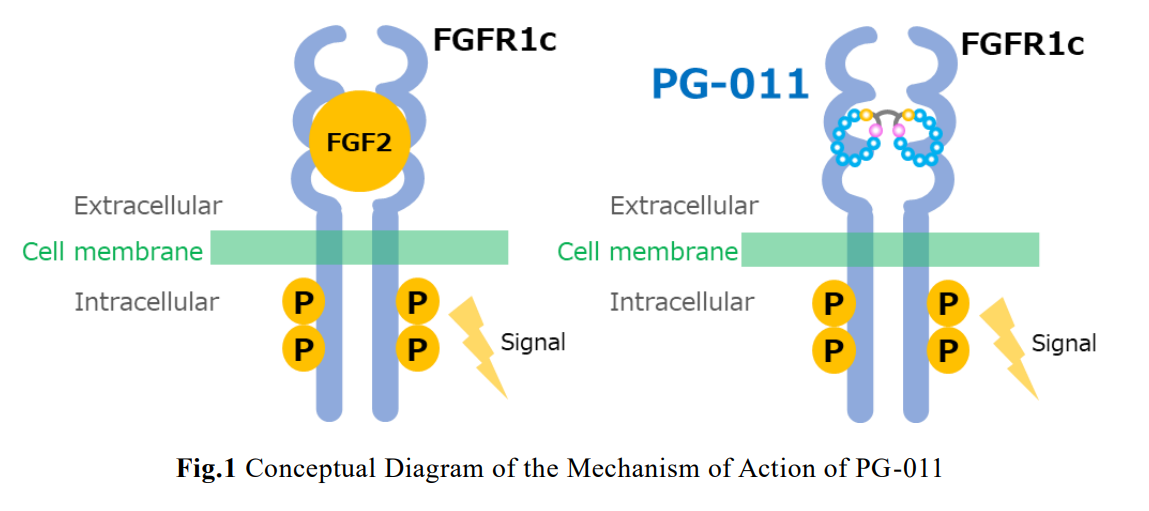
The FGF2 alternative peptide (PG-011) is a dimeric peptide composed of cyclic peptides that bind to human FGFR1c. PG-011 exhibits agonist activity toward FGFR1c by binding to it, thereby activating signaling pathways in various types of cells (Fig.1).
➢ Activation of FGFR1c and proliferation activity in human MSCs
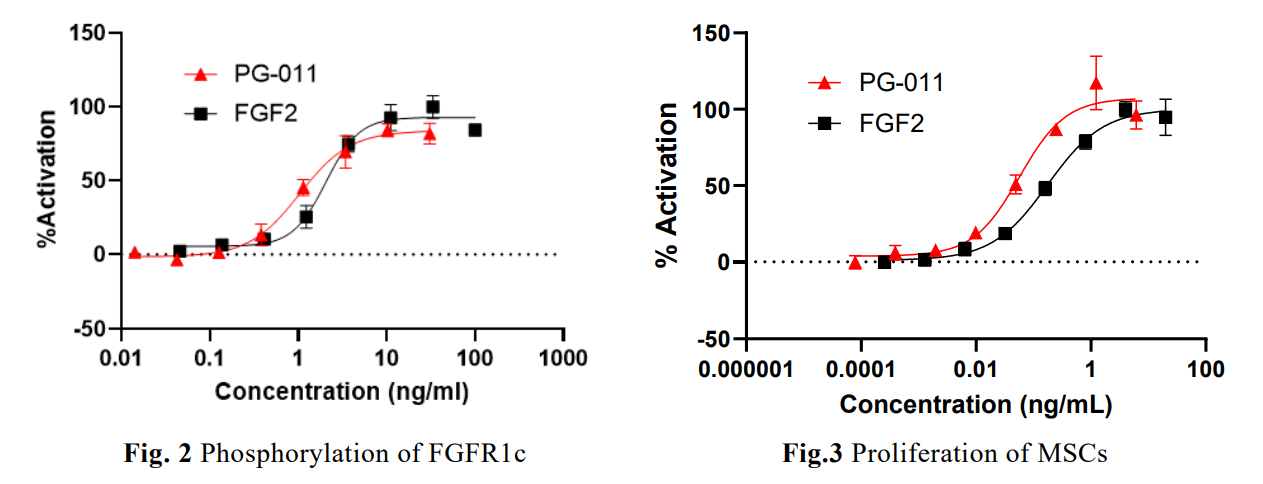
We confirmed that PG-011 exhibits phosphorylation activity toward FGFR1c (Fig. 2). Additionally, we compared the cell proliferation activity of PG-011 on human MSCs with that of recombinant FGF2. The results demonstrated that PG-011 exhibited nearly equivalent proliferation activity to FGF2 at approximately one-third the concentration of FGF2, based on a ng/mL comparison (Fig. 3).
➢ Ability to maintain the undifferentiated state of human iPSCs
In collaboration with Professor Masayoshi Tsukahara and Dr. Anna Ueda from the CiRA Foundation at Kyoto University, we evaluated the ability of PG-011 to maintain the undifferentiated state of human iPSCs. Three iPS cell lines were cultured for 7 days in medium containing either 100 ng/mL (~5.9 nM) of FGF2 or the same molar concentration (equivalent to ~30 ng/mL) of PG-011, followed by three passages. Afterward, we conducted cell morphology observations and measured undifferentiated markers (Fig. 4).
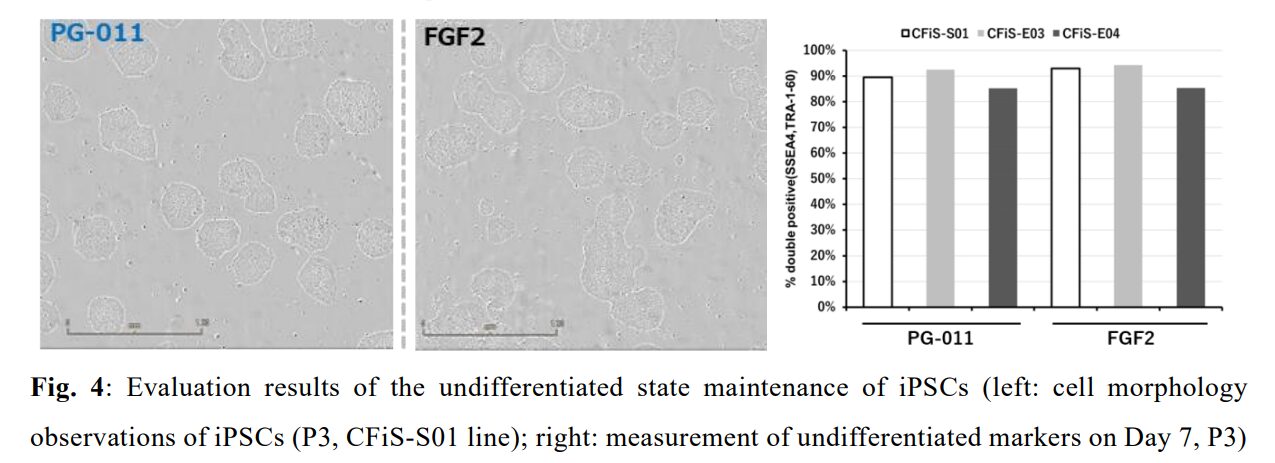
As a result, after 3 passages, iPSCs under both PG-011 and FGF2 conditions were found to exhibit nearly identical morphology. Additionally, measurements of undifferentiated markers (SSEA4 and TRA1-60) showed that iPSCs cultured with PG-011 displayed a positivity rate similar to that of cells cultured with FGF2. Furthermore, the cell proliferation rates during the culture period were equivalent under both PG-011 and FGF2 conditions. These results suggest that PG-011 possesses an ability to maintain the undifferentiated state comparable to that of FGF2 for iPSCs.
➢ Superior stability compared to FGF2
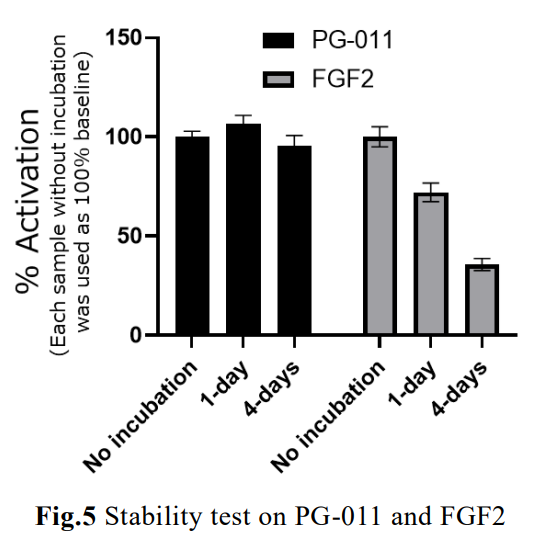
Recombinant FGF2 is known to have very low stability, easily degrading and losing activity under culture conditions. This necessitates the use of high concentrations and frequent medium exchanges, which presents significant challenges in terms of manufacturing costs and workload. To compare the stability of PG-011 and FGF2, we incubated FGF2 or PG011 in culture medium at 37°C for 1 and 4 days, then assessed residual activity based on human MSC proliferation. The results showed that FGF2 exhibited a significant decline in activity after incubation at 37°C, while PG-011 maintained full activity even after 4 days, demonstrating superior stability compared to FGF2 (Fig. 5). These results suggest that using PG-011 could reduce the frequency of medium exchanges and allow for lower usage concentrations.
➢ Proliferation activity of PG-011 in bovine satellite cells
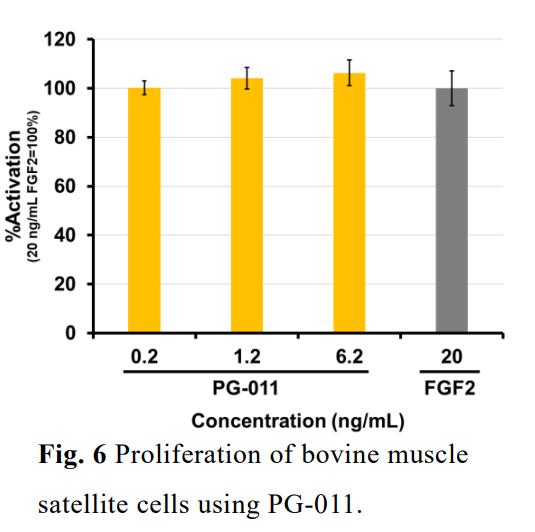 FGF2 is one of the key cell growth factors in cultivated meat production. To evaluate the potential of PG-011 in the cultivated meat industry, we assessed its cell proliferation activity in bovine muscle satellite cells (Fig. 6). The results showed that PG-011 promoted the proliferation of bovine muscle satellite cells. These results suggest that PG-011 may demonstrate cross-reactivity across various cell types, not limited to human cells, and holds promise for use in cultivated meat production.
PG-011 provides cell proliferation and undifferentiated state maintenance comparable to FGF2, but with superior stability. This can reduce usage costs and workload. It also shows excellent proliferation in both human and bovine cells, making it a promising choice for regenerative medicine and cultivated meat production.
➢ Product Overview
Product name: FGF2 alternative peptide (FGFR1c agonist)
Product code: PG-011
Product form: Lyophilized
Storage conditions: -20°C or less
Purity: ≥95% by HPLC
Molecular weight: 5127.81(Acetate)
Size: 10 µg, 50 μg (volume per glass vial)
- This product can be provided with an Animal Component Free (ACF) certificate.
- This product is for testing and research use only (RUO).
- There is a possibility that the specifications can change.
➢ Purchase the Product
If you would like to purchase our products, please contact us using the information below. For customers who would like to purchase GMP compliant products as well as the above PG products in bulk scale, please contact us using the information below.
Development of other peptides from PeptiGrowth We have developed alternative peptides targeting numerous growth factors and cytokines. To date, we have launched 11 products and plan to launch several additional growth factor alternative peptides targeting PDGF-AA, KGF, and IL-15 between late 2024 and mid- 2025. Details will be updated on our website . If you are interested, please contact us using the following contact information.
Contact Information
PeptiGrowth Inc.
Tel : + 81-(0)70-4503-1497
E-mail: contact@peptigrowth.com